Lupita Villalobos is out of the fight against Kim Shantal in Supernova Génesis after being diagnosed with a subdural hematoma. The influencer will remain under medical observation after her emergency hospitalization, invalidating her participation in the April 26 event at the Mexico City Arena.
You may also be interested in: Why April 20 is International José José Day
Medical emergency cancels the confrontation at the Mexico City Arena
Lupita Villalobos’ participation in the Supernova Génesis event has been officially canceled just a few days after its completion. The member of “Las Alucines”, who was supposed to enter the ring next Sunday, April 26 to face Kim Shantal, does not have authorization from the sports authorities due to critical health complications reported during the last weekend.
The alert was activated after the content creator was urgently admitted to a hospital due to an intense headache. Although uncertainty reigned among his followers during the first days, on Monday his withdrawal from the billboard was formalized. This movement has sparked speculation in the sector, pointing to Monterrey model Karely Ruiz as the possible replacement to fill the vacant place in the sporting event.
The official diagnosis issued by the World Boxing Council
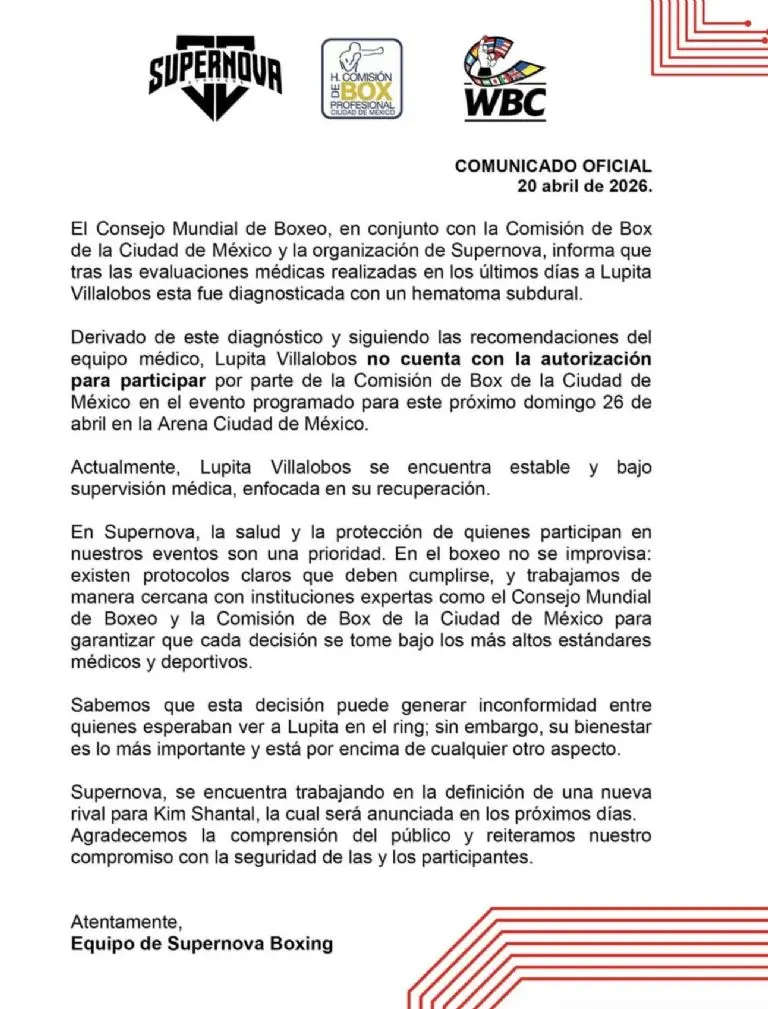
The Supernova Génesis organization, in coordination with the World Boxing Council (WBC) and the Mexico City Boxing Commission, issued a technical statement detailing the competitor’s clinical situation. Rigorous medical evaluations confirmed the presence of a subdural hematoma, a condition that compromises the physical integrity of any athlete, especially in contact disciplines.
- Current status: The influencer is stable but under constant medical supervision.
- Clinical priority: The total focus of the patient and her team is on neurological recovery.
- Legal restriction: The Mexico City Boxing Commission has denied permission to fight following international security protocols.
Risks and nature of subdural hematoma in athletes
A subdural hematoma is technically defined as the accumulation of blood located between the covering of the brain and its surface. This condition is usually the direct consequence of a severe head trauma, where bleeding occupies the brain space at an accelerated rate, exerting dangerous pressure on the nervous tissue that can lead to fatal consequences if timely intervention is not taken.
The symptoms of this condition are variable and depend strictly on the magnitude of the blood accumulation and the area of intracranial pressure:
- Cognitive alterations: Persistent drowsiness, confusion, memory loss or coma.
- Motor deficits: Difficulty maintaining balance, problems walking and focused weakness.
- Vital and sensory functions: Complications speaking or swallowing, as well as vision problems.
- Acute physical manifestations: Nausea, vomiting, seizures and severe headaches.
- Psychological changes: Sudden behavioral changes or episodes of psychosis.
Due to the severity of these indicators, Villalobos’s permanence under medical surveillance is strictly necessary to prevent permanent damage or worsening of the clinical condition detected after his hospitalization.