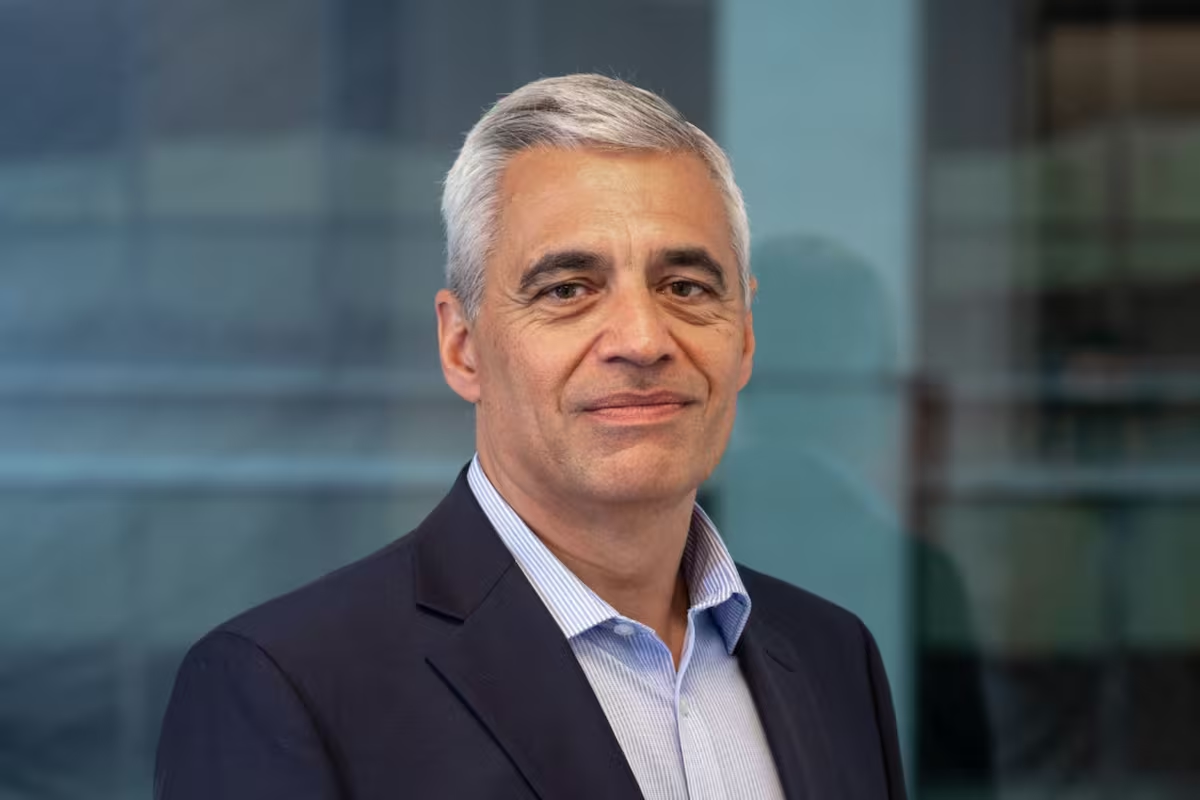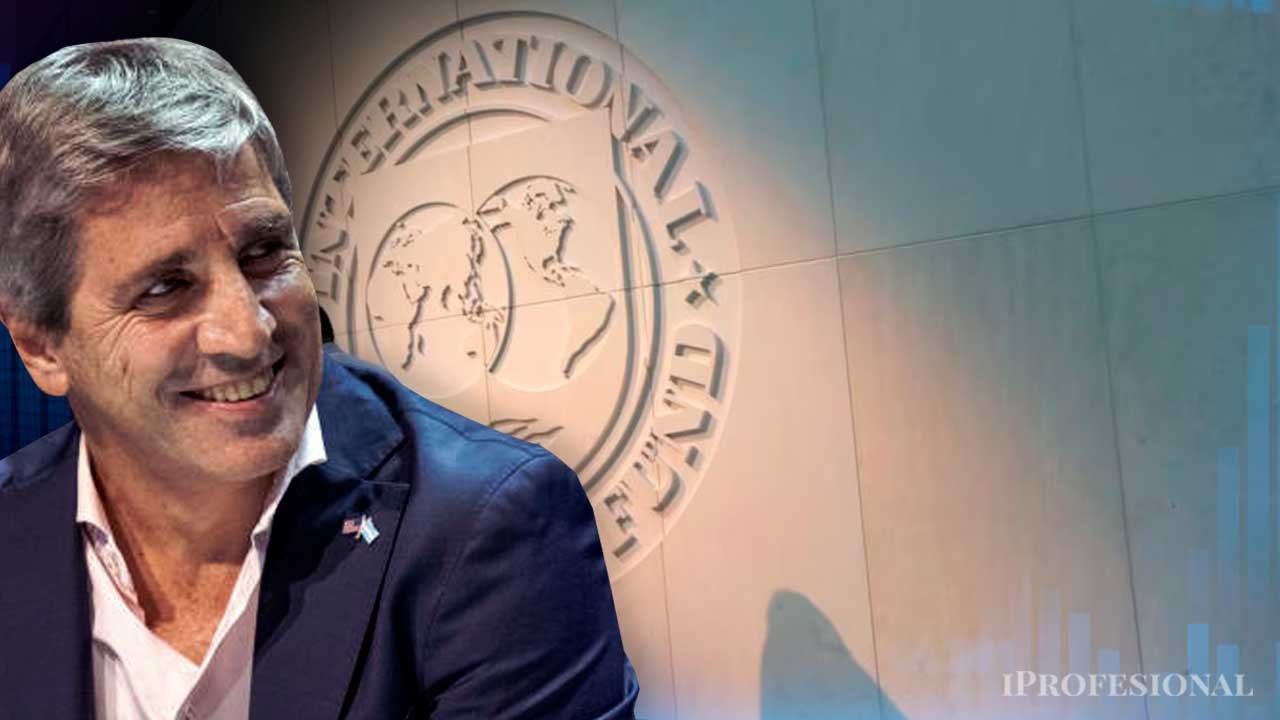
After more than 70 hours of intense agendawhere he managed to get the second review of the agreement signed last year with the International Monetary Fund (IMF) approved and obtained US$2,550 million in guarantees from the World Bank and the IDB To face debt maturities until the end of 2027, the Minister of Economy, Luis Caputo, and his economic team returned to Argentina.
From what he could know iProfessional from a source close to the Government, Caputo is convinced that this was his best performance since 2016in which he attends the annual assemblies and meetings of the IMF and the World Bank as an official.
“The announcements of the approval of the second review of the agreement with the IMF, the guarantees of multilateral organizations to finance debt and the new signs of support from the Managing Director of the IMF, Kristalina Georgieva, and the technical staff are the greatest demonstration of a very successful journey,” the source commented to iProfessional.
Regarding Friday night’s meeting with Georgievathe source commented: “It was a very pleasant meeting of just over an hour where there was total support for the economic plan.”
At the end of that meeting, Caputo gave new details to the journalists who were waiting for him about the financial mechanism that he announced during the week with the support of the World Bank and the Inter-American Development Bank (IDB) to obtain US$8 billion from private banks and refinance the debt that matures next July, an idea that arose last December.
Caputo highlighted his personal relationship with Georgieva and explained that, for now, it is not the time to go out into the international markets in the midst of the war between the United States and Israel and Iran, and said that it was a matter of the best Argentine mission to the IMF since the collapse of 2001. “There is trust from the IMF in Argentina that there has never been since 2001,” the minister told reporters.
“It was a very pleasant meeting because there is a relationship of trust,” Caputo said at the end of the meeting. “Georgieva is impressed by the economic and political achievements of President Javier Milei, such as the reduction in inflation, the reduction of poverty and the economic growth of two consecutive years“he added.
The minister was accompanied by the president of the Central Bank (BCRA), Santiago Bausili; the Vice Minister of Economy, José Luis Daza; the vice president of the BCRA, Vladimir Werning; and the Argentine representative to the IMF, Leonardo Madcur, an official who worked with Milei at Corporación América.
How the economic team plans to get US$10 billion in record time
“The IMF knew of the Government’s strategy to obtain guarantees from multilateral organizations and Georgieva has a very close relationship with Ajay Banga, the President of the WB, and with Ilan Goldfajn, the president of the IDB, to whom Milei would have advanced the request a week before,” the source explained to iProfessional.
Caputo explained to Georgieva how the economic team plans to raise some 10 billion dollars with three parallel strategies: some 4 billion dollars of syndicated loans from private banks through guarantees from multilateral organizations, another 4 billion dollars with bond tenders for local investors in dollars for 2027 and 2028, and another 2 billion dollars as a product of privatizations that, according to the views of the IMF technicians, are very behind.
“With that we would have the financing for the next three payments, that is, 18 months covered“, detailed the source to iProfessional.
In this regard, it should be noted that, in their presentations to private investors, the members of the economic team highlighted a difference in the structure of the guarantees designed with the WB and the IDB.
While in the first case, for an amount of 2 billion dollars, the WB will be in charge of everything and implementing it with the private banks; In the case of the IDB, which announced guarantees for 550 million dollars, the economic team was the one that made the request for proposals from the banks.
“With the guarantee of the IDB, the banks then make us a proposal that, in this case, will probably be two to one. The same thing if we closed another one such as the Development Bank of Latin America and the Caribbean (CAF), the level of leverage would be two to one,” the source highlighted. iProfessional.
With these guarantees from the IDB, Caputo would aim to obtain funds for 1.1 billion dollars from private banks that would be used to pay amortization and interest maturities for 4.3 billion dollars on July 9of which some 1,000 million are in the hands of ANSES.
The calendar that explains the urgency to obtain dollars before 2027
The calendar of public debt maturities in dollars between now and the end of 2027 explains the urgency of the economic team to obtain the dollars necessary to meet these maturities.
Until the end of 2027, the Treasury and the BCRA will have to face debt payments of more than $30 billionwhich include dollar bonds, Bopreal, commitments with the IMF and multilaterals, and repo credit with private banks.
According to what he could know iProfessional From that source, the Minister of Economy, Luis Caputo, returns from Washington “with more achievements than expected before traveling.”
The source also added that we will have to be attentive from the financial aspect to the next movements that the economic team will make between now and the end of June, when the largest dollar liquidation of the year in the industrial agro-export sector ends.
“What we are going to look for is lower inflation sharply and accumulate a large amount of dollars to avoid what happened before last year’s elections, that Argentines bought some 30,000 million dollars when they fled the peso for fear of a triumph of Kirchnerism in the Province of Buenos Aires (PBA).”
Caputo already got 1 billion dollars from the IMF as a result of the approval of the second review of the Extended Facilities (EFF) agreement signed on April 14 of last year and, apparently, obtained another 2,000 million dollars from the World Bank, to which another 500 million from the IDB and 500 million from the CAF could be added.
The BCRA has already reached the 60% of the annual purchasing goalalthough the accumulation of international reserves was limited by the foreign debt payments made by the Treasury, which acquired part of the dollars from the BCRA.
Official estimates suggest that, according to the demand for pesos and the supply of foreign currency, the net balance of purchases this year could range between 12,000 and 15,000 million dollars.
The goals that the IMF requires of Argentina to sustain the agreement
In the new agreement announced, a lower primary surplus was projected, a strong increase in the RIN and a financing strategy for the next two years, in which some 20 billion dollars of debt in dollars mature, and two qualitative goals that are a tax reform and a pension reform.
The new agreement establishes that net international reserves (RIN) will increase by at least 8 billion in 2026driven by the mobilization of financing in foreign currency and sustained foreign currency purchases by the BCRA for a minimum of 10,000 and a maximum of 17,000 million dollars.
The net international reserves objective is a key data that marks what the reserve accumulation goal that the IMF requires of Argentina during this year will be, after having failed to meet it during 2025 and having received a waiver or forgiveness for the second time. The IMF’s objective is for them to increase this year by about 8,000 million dollars compared to a deviation of (11,500 million) last year.
At the end of last week, gross international reserves reached 45,791 million dollars and, in February, those reserves reached 46,905 million, the highest level since 2018 and a maximum in the current administration. The recent moves reflect both debt payments in foreign currency and changes in the valuation of assets, including gold and bonds, in a changing international context.
But in addition to closing financing needs, the economic team is preparing the ground to continue lowering interest rates and reactivating credit for people and companies, which will be driven by Banco Nación Argentina (BNA). The recent drop in reserve requirements 65% that decided to apply the BCRA to the banks so that they can mobilize more pesos is going in that direction.
“We have met with the CAF and they have every intention of joining, I cannot guarantee anything because we have not closed it down,” Caputo added in front of journalists.
This is a strategy that emerged in December, in one of the meetings with Banga. “I told them that it seemed to us that the best way to help was for them to show flexibility when creating new products. And the president of the World Bank usually wants to do things of that type, to go outside of the traditional. That’s when we decided not to go to the market, because we saw that they were going to help us and it was going to be much cheaper.”
Caputo explained that the rates of these structures guaranteed by international organizations are between 5.5% and 6.5%, less than 9.5% or more than the Government could obtain in the international market at this time.
Regarding the fact that, with an eventual downward trend in country risk, the Government could evaluate returning to the international market this year, Caputo said that he did not believe it was likely.
“This year I don’t see resorting to the market again. It’s a good question because the market can surprise you. So, now that they understand that there are different alternatives, what is called repricing occurs. Not even we, who have worked there for many years, know the timing of the market,” he explained.
“Today the economic fundamentals of Argentina would be equivalent to a much lower country risk. Now, the market predicted it higher because it takes into account the Argentine past, which weighs a lot. You were a country that defaulted nine times, that took 13 zeros out of its currency, that had two hyperinflations. No one is rushing us, the idea is that we will go to the market when we think that the country risk warrants it. But since in the meantime we have the money to pay for the next 18 months, why force a situation?” he indicated.
He noted that in the meeting with Georgieva they talked about the situation in the Middle East and the resumption of the IMF’s relations with Venezuela, which were suspended since 2019.