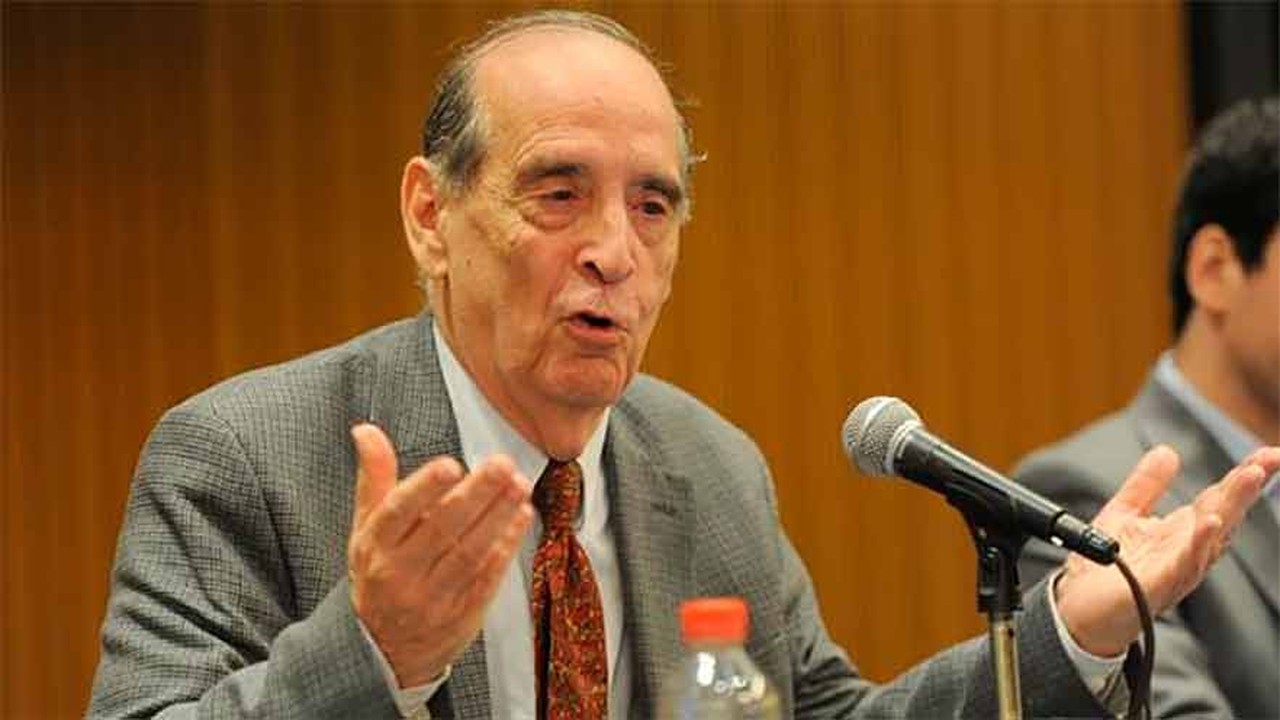
The economist Ricardo Arriazuone of the analysts most listened to by the Government, warned that the level of unemployment in Greater Buenos Aires is configured as the main focus of political risk for the official strategy.
As he explained, the process of productive transformation underway is generating a dynamic in which jobs are being destroyed at a faster rate from which new ones are created. During a presentation at a conference organized by a financial firm, sstressed that this transition impacts with greater intensity in the regions and sectors where most employment is concentrated.
Arriazu warned of “greater job destruction than creation”
Within the framework of a dissertation organized by BlackToro Asset Management, Arriazu maintained that the change in the economic model causes “more job destruction than creation” and explained that this phenomenon manifests itself mainly in the Buenos Aires suburbs.
“Destruction is faster than creation”he stated, describing the central tension of the scheme promoted by the Government. According to his analysis, the activities that today lead growth – such as energy, mining and agriculture – demand a high amount of foreign currency, but generate little absorption of labor. In contrast, the sectors that concentrate employment – industry, construction and commerce – show declines and have their core in Greater Buenos Aires.
The economist also analyzed how changes in state incentives impacted both entrepreneurs and workers. “The businessman is not to blame for having invested where he invested: it was the incentives that the governments gave. People are not to blame for having moved to Greater Buenos Aires either; They were also the incentives that the government gave him. And now the rules of the game change and some are left in harm’s way,” he explained.
In his opinion, this scenario “it can generate political noise” with concrete electoral consequences. “The challenge is the election in Greater Buenos Aires next year“he stated, marking the axis of the problem for the ruling party.
In terms of data, Arriazu indicated that the drop in employment in the region far exceeds the generation of new jobs. At the country level, the employment rate fell 0.7 percentage points, while in the Buenos Aires Metropolitan Area (AMBA) the decline doubled that record. He also pointed out that the migration of workers to more dynamic areas, such as Neuquén, is not advancing at the pace demanded by the situation.
In his structural diagnosis, the economist maintained that “Argentina has an artificial productive structure, the product of almost a century of punishing the sectors in which we have a comparative advantage and subsidizing the sectors where we do not have a comparative advantage.” In that sense, he added that currently “we are with forces of change. Some come from nature and outside. Others are internal policies, although internal policies also affect nature.”
By 2030, Argentina could export US$32 billion thanks to Vaca Muerta
Regarding the sectors with the greatest projection, Arriazu highlighted the energy potential, in particular the development of Vaca Muerta. “Vaca Muerta is possibly the best rock in the world. At least equal to Permian. Be careful not to confuse with conventional, which are much more productive than unconventional. The break even point in Argentina should be forty-two dollars a barrel. Argentina is in the middle of the development process, it has more gas than oil. Production is growing, it lacked infrastructure. So that? To transport it and be able to, let’s say, market it.”
In this framework, he projected that By 2030, the country could achieve energy exports of US$32 billiondriven by the expansion of production, new transportation works and the growth of liquids derived from gas. For the short term, it estimated external sales of 135 million barrels of oil this year and 225 million next year. “Every dollar that the price of oil increases is US$135 million this year and US$225 million next year,” he said.
It also focused on mining development, especially on the Vicuña copper project in San Juan, which integrates the Josemaría and Filo del Sol initiatives, with an investment of US$16,000 million. According to their calculations, once fully operational around 2032, only copper could contribute US$25,000 million annually in exports. In parallel, he considered that agriculture could add an additional 60 million tons if withholdings were eliminated, which would imply close to an extra US$20 billion in foreign currency.
“The Central Bank should lower the interest rate”
However, Arriazu warned that the present does not yet reflect that medium-term potential. “We have to see where the bottlenecks are going to be and how they are compensated,” he said. In his vision, construction and commerce are the only sectors with the capacity to generate enough employment to compensate for the industrial decline, although they are currently limited by a restrictive monetary policy and high interest rates. “The Central Bank should lower the rate”he stated, and linked the increase in bank delinquencies with that context. “The economy was flattened,” he summarized.
On this point, he added: “At this time, my opinion, the Central Bank should lower the interest rate. It is the same as in 2024. The Fund said it had to be raised, the majority said it had to be raised, we said it had to be lowered. This time we believe that it must be lowered because people think in dollars. The banks are afraid because their irregular portfolio has increased. The irregular portfolio increased because the interest rate increased and because the economy expanded“.
Regarding consumption, he explained that aggregate levels remain high, although distorted by the strong growth of items such as tourism, cars, motorcycles and travel, which increased between 40% and 60% in the early stages of recovery. “That’s why people think that the consumption record is a joke,” he stated, pointing out that mass consumption is much further behind.
Likewise, he indicated that a large part of this spending was financed with credit, and that the rise in rates together with the stagnation of income left many debtors with difficulties in meeting their obligations. This led banks to tighten conditions and an increase in irregular portfolios.
In the final section of his presentation, Arriazu revised upwards his estimate of the probability of success of the economic program, placing it at 50%, compared to 30% the previous year. However, he stressed that the main challenge remains political: “We are the country of lost opportunities. If you overcome the bottleneck of the next election in Greater Buenos Aires, have no doubt: Argentina changes”. In that sense, he raised the need to implement compensatory policies such as the Universal Child Allowance, unemployment insurance and targeted public works, tools that—as he indicated—are not yet being deployed.
Finally, he reflected on the interaction between economy, politics and society: “You cannot separate economics from politics from sociology. You cannot make an economic program from a vacuum without seeing the political and social consequences. In the same way that you cannot make a political program without seeing the economic consequences. The classics looked at the great dynamics and here what we are looking at is the great dynamics. Yes, a great road, but with detours that are going to be inevitable and expensive.”
And he concluded: “I have been insisting, A general equilibrium study must be carried out to determine where the bottlenecks will be and how they can be compensated.. “The construction sector, in March, seems to have improved, but it is bad, but it is the only one that, together with commerce, can give you employment that compensates for the loss of employment in some industrial sectors.”