Defaults in wallets and banks reached record numbers according to reports from various consulting firms. But in the fintech sector they assure that these figures are “inflated” and, although they are still worrying, They launched a rescue operation so that the credit lines do not fall.
Default in wallets: the operation
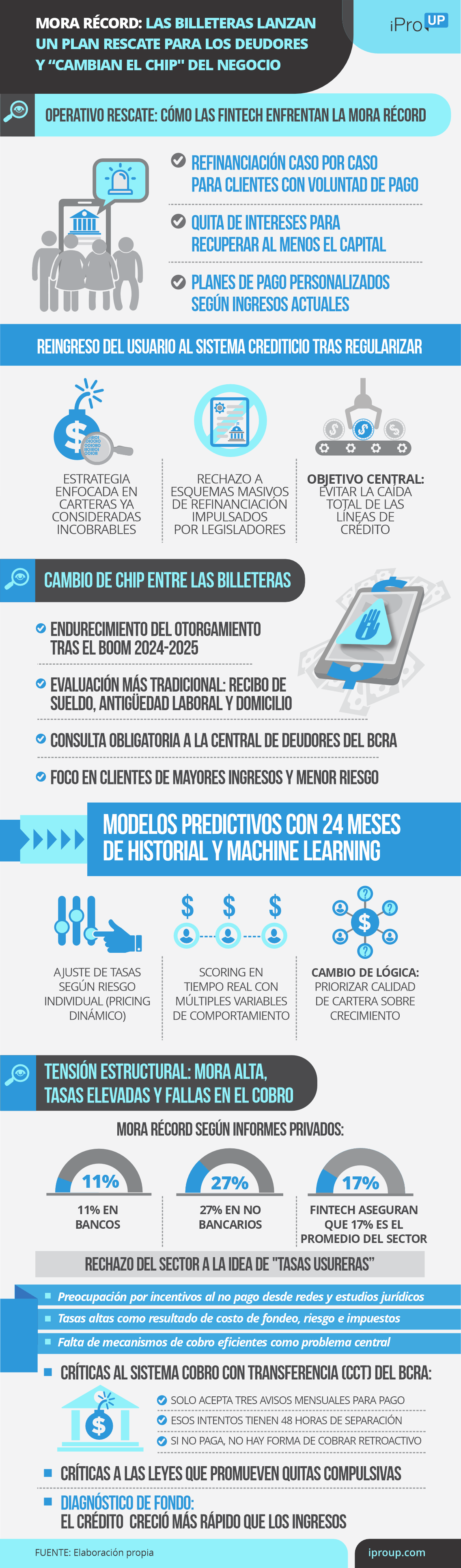
The immediate response to The default was not to tighten the collection but to sit down and negotiate with those who still want to pay off their debt.. The logic they apply behind closed doors is pragmatic: recovering something is better than not recovering anything.
“We are refinancing those who are willing to pay,” explains a source in the sector strictly. off-the-record. “We take away the total interest and put together a tailored plan so that you can pay according to your current capacity.“he adds.
“In that way, companies begin to recover what is ‘already lost’ and the client begins to recover their credit in the systemwithout being excluded,” he remarks.
In practice, this means giving up the accumulated interest in exchange for recovering the capital. For many portfolios that were already classified as bad debts, it is a result that would not otherwise exist.
From the fintech sector they believe that these types of individualized agreements (far from the massive refinancing scheme that some legislators demand) It is the only tool that works in a context with record levels of delinquencies.
Keys to record default
The default crisis reached unprecedented levels in 2026with 11% irregularity in family loans (the highest value since the 2001 crisis) and up to 27% in the non-banking sector.
But fintech companies defend themselves: they assure that default levels reached 16.8% as of February. They are a part of the non-banking sector but not all: There are commercial chains, cooperatives and even mutuals, which in general were less impacted because they charge with a discount code on their pay stub.
Default in wallets: more requirements
From the fintech sector they warn that default levels will be reduced. It is not an optimistic forecast but rather confirmation of what they have already changed. The credit granting mechanism was fundamentally transformed after the 2024-2025 boom left contaminated portfolios. Today, the evaluation process of the main platforms includes:
- Consult the Central Debtors of the BCRA
- Pay stub verification
- Job seniority
- Applicant’s age and address
“Today, we have to give loans to the sector that earns the most money,” they say from the fintech, confirming the “change of chip“. And they warn: “It is not what we want, we are the industry that achieved the most financial inclusion in the history of the expanded financial system, so we want to lend to those who have the capacity and willingness to pay.”
But the most important change is the predictive model. From the fintech sector they explain that they analyze 24 months of history backwards and build with machine learning a compliance projection.
“If you are late, they will charge you more“summarizes a source. This is not a punishment but a mere risk adjustment. That is, a greater probability of default implies a higher rate to compensate for the expected loss.
Besides, Platforms such as Mercado Pago use scoring systems that analyze dozens of variables in real time to adjust credit to payment capacity of each user.
The difference compared to what they did in 2024 is that then these models had less historical data available and the appetite to grow the portfolio was greater. Now the equation has been reversed: better customer, more access.
Wallets fight back
One of the points of greatest tension between fintech and the legislative debate is the accusation that their interest rates are usurious and generate over-indebtedness. From the sector they ask that they not be blamed by the situation and they are forceful: “We do not set prices.
The distinction they make is technical but important. An experienced consultant assures iProUP that “A rate of 150% or 200% annually on a short-term personal loan is not the whim of a company, it is the result of adding the funding cost, expected default, operating expenses and minimum profitability“. To this, national, provincial and municipal taxes are added.
The Government lowered the cost of borrowing, with the TAMAR rate almost 10 points below inflation, but The sector continues to require an effective tool for the other variable that influences delinquency: collection.
The structural problem they identify is that they lack efficient collection mechanisms. The BCRA announced the Collection with Transfer (CCT) system with mandatory effect only by August 2026, since The problem is not only the price of the credit but the impossibility of recovering what was lent when the debtor decides not to pay.
The fight against “don’t pay”
There is a front that at this time is described with genuine concern: the proliferation of voices that actively encourage non-compliance. From the fintech sector they ask that defaults not be encouraged and are specific about who carries out these campaigns.
“There are people urging people not to pay. Lawyers who tell you ‘file for bankruptcy’‘”, they warn. The phenomenon ranges from legal firms that offer to manage insolvency declarations for fees, to publications on social networks that instruct users to uninstall a wallet to evade collection. But the obligation does not disappear: The user is registered in the Central Debtors of the BCRA, which closes the credit in any regulated entity.
In addition, collection managers eventually take over the delinquent portfolio. The Chamber of Deputies debated the phenomenon of family over-indebtedness, with 4.8 million people in arrears of more than three months in the payment of their debts, whether with credit cards or fintech loans. For that universe, the path of active default has consequences that go far beyond the original debt.
The situation is complicated by a regulatory element that the fintech sector received with resignation. The BCRA presented the Collection with Transfer (CCT) mechanism, but it is not enough. The system requires explicit consent and only allows debits if there are sufficient funds at the time of the attempt (up to three per month, with a difference of 48 hours), without the possibility of retroactive effect.
A fintech entrepreneur anticipates that “no one will use it, although everyone will have to offer it”, which will incur more expenses. The frustration is shared because the sector had been demanding for months a simple, interoperable and frictionless automatic collection tool, similar to Brazil’s Pix Automático or Australia’s PayTo. What arrived is perceived as a solution that creates a new procedure without solving the underlying problem.
What the fintech field says in voiceover points to a conclusion that is rarely formulated clearly in public debate: Delinquency is not a failure of the business model, it is the mark left on the balance sheets by a cycle of credit growth faster than the growth of real income.
The wallets lent to those who the banks did not serve, with data that the banks did not have. When the macroeconomy tightened, those debtors were the first to fall. Now the sector has tightened the criteria, negotiating interest reductions with those who want to pay. And he hopes that the normalization of rates and a collection tool that really works will stabilize the portfolio.
If that happens before Congress passes a “Second Chance” law with compulsory haircuts, the digital financial system will have absorbed the blow.. If not, the fintech credit that today reaches 6 million users may close before the recovery arrives. “It would be going back to the past by setting prices and we know that controlled prices do not benefit those they claim to protect,” they close.