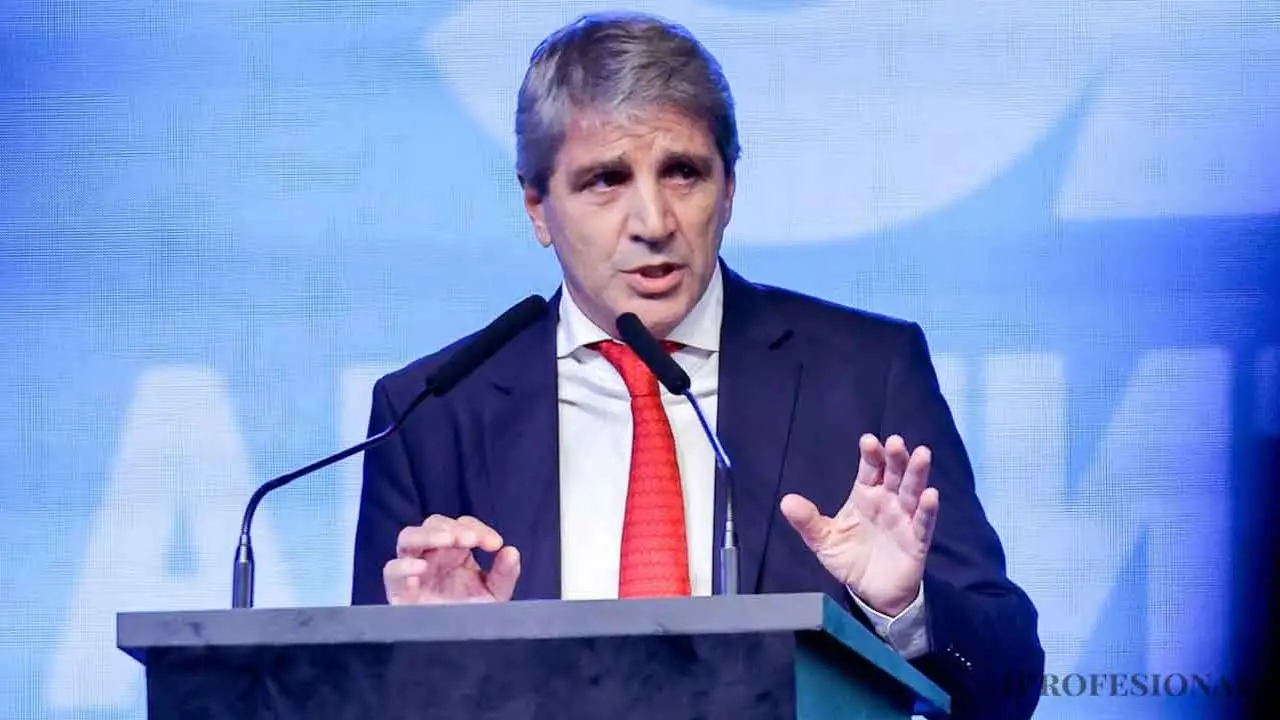
In his presentation at the Rosario Stock Exchange, the Minister of Economy, Luis Caputo, analyzed the economic situation and announced that March inflation will be above 3%.
Before businessmen and representatives of the financial system, the official explained that the data will be influenced by specific factors. “It will surely be above 3% because there was a shock that evidently had an obvious impact on everything related to oil.from domestic plane tickets to transportation; You have topics like education, which in March has its seasonality. Starting in April, a process of disinflation and growth is coming, the best months are coming“.
The statement came hours before the official publication of the price index by the National Institute of Statistics and Censuses (Indec), within the framework of the presentation of the book “Change the music, now you have to change the pace,” by analyst Salvador Di Stéfano. The event also served as a prelude to the minister’s trip to Washington DC to participate in the spring meetings of the International Monetary Fund (IMF) and the World Bank.
“Argentina’s best 18 months in the last two decades are coming”
Looking ahead to the coming months, Caputo was especially optimistic and projected a favorable scenario. “I couldn’t be more optimistic; the contrast that I feel and that we feel in the economic team and the president versus what is read, that gap, It is at its highest because Argentina’s best 18 months in the last two decades are coming“he stated.
During his speech, he also questioned what he defined as a pessimistic outlook rooted in the country. He argued that the idea that the economy will fail again due to negative antecedents conditions expectations and makes it difficult to consolidate a climate of confidence.
In that sense, he clarified that the Government never proposed an immediate solution to the structural problems and stressed the importance of the attitude of the different economic actors. “I change the music, am I willing to dance to this new music? That is a personal decision, everyone is free to do so. FATE hunted in the zoo; Four Chinese rubber bands came in and he said: ‘I don’t play.’ That is an option. So one can say that The tire industry in Argentina is not competitive and we do not know if it was someone’s decision“, he exemplified.
Finally, the minister referred for the first time to his arrival in the Government of La Libertad Avanza. He revealed that, before taking office, he received calls from leaders and economists who suggested he not accept the position or even let the economic situation collapse. “The power of the plan was that we really believed and had absolute confidence that it could be fixed, avoiding a crisis for the people.”. “I didn’t listen for two seconds to that advice about making everything ointment,” he concluded.
Milei’s inflation goal “with zero” in August seems unlikely
Although the consultants agree that once the rate adjustments and the seasonal peak in March have passed, inflation will return to the downward path, Javier Milei’s projection seems less and less feasible: The President reiterated on several occasions that In August of this year inflation could “start with zero”.
That is, in his words, it would register advances of less than 1% per month, such as 0.9% or less. Due to the latest variations and the inertia it exhibits, economists are cautious and consider it a very optimistic projection.
The spike in the international price of oil, due to the war in the Middle East and the fall in global crude oil supply, affects and could continue to affect inflationary dynamics. Until now, the impact has been felt partially in the internal costs of fuels and, indirectly, in the entire chain that arises from transportation, logistics and inputs. It is not the main reason for the acceleration in prices, but it provides a certain amount of upward pressure.
Claudio Caprarulo, director of Analytica, estimates that while the rise in fuel prices played against the inflationary dynamic in March, the positive thing was in the food and beverage category, which would have registered a slowdown compared to the previous month. For the general level, it is estimated that in March the price index would have been at 3% monthlywhich would imply an acceleration of 0.1 percentage points compared to February.
“The fuels increased almost 12% during the monthwith a price transfer of only 50% of what the international price of oil rose. The direct impact of fuels on the CPI was 0.4 points and add others 0.2 points indirectlysince fuel works as an input to the rest of the goods and services,” details Lucio Garay Mendez, chief economist at EcoGo.
When will inflation slow down again in Argentina?
Garay Mendez does not rule out that the reduction in global energy supply, due to the paralysis of maritime traffic in the Strait of Hormuz due to the war in the Middle East, could extend for several more weeks and keep the international price of oil high, which would continue to put upward pressure on fuel prices. Therefore, it is estimated that the general level of the CPI in April and May, although it would decelerate, would probably would be above 2% monthly.
Camilo Tiscornia, director of C&T, estimates that the CPI for April “will give much less than in March, unless something crazy happens with gasoline.” Caprarulo agrees with this, and also estimates an inflationary slowdown in April, although “the big question remains the price of oil.” For the period between April and June, the director of Analytica projects a inflation around 2.6% monthly average.
“For April, we project a deceleration of inflation to 2.4% monthlyafter the 3% estimated for March. Inflation will remain high for the drag left by March (+10%)but it would weaken due to the drop in meat prices. In fact, if meat falls further, the slowdown could be even more pronounced. Furthermore, with the price of oil at US$101the gasoline continues with a 8% delay. If corrected during April, it could add 0.2 additional points of inflation,” adds the consulting firm FMyA.
According to Max Capital, the market expects the international price of oil to remain above last year’s levels, even if the conflict in the Middle East stops. Higher oil prices, he highlights, have implications for both inflation and external accounts, since it represents a “double edge shock” for an energy exporting country that seeks to reduce inflation and at the same time needs to accumulate reserves.
“The inflationary implications are similar to those of other countries, although the lack of a strong nominal anchor from the monetary side and greater inflationary inertia could generate a more pronounced impact. On the external side, however, part of the effect could be offset by a stronger currency thanks to higher mining and oil prices, along with a good agricultural harvest, Foreign Direct Investment (FDI) flows and debt issues also directed at these sectors,” he adds.
The broker maintains that the general effect of these dynamics would be:
- A slightly higher inflation
- A faster accumulation of international reserves
- A more appreciated currency in real terms
From a structural point of view, he highlights, “the shock reinforces recent dynamics, which favors energy and mining, sectors that are growing at a faster rate, but affects industrial production” due to the less competitiveness which implies a lower exchange rate in real terms.