A technology is carrying out a silent revolution in different industries, opening up scenarios that were previously unthinkable. Thanks to tokenization, today it is possible to be part of the investment of illiquid assets with high tickets – such as apartments or field productions – in a short time: such is the case of a small building in Salta that brought together 132 investors from 17 countries and managed to finance the construction of the project, located in one of the most sought-after and tourist residential areas in northern Argentina. All in less than 24 hours.
But, what does tokenize mean? In simple words, one could say that consists of representing on a “digital paper”-better known as token- an asset. Just as a casino chip is a physical representation of value of something else, a token is the digital representation of an asset of economic content. This is recorded in a blockchaina type of digital network thatunlike conventional databases, It is decentralized and protected with cryptographywhich makes it immutable, that is, it has no intermediaries, therefore, there is no financial entity behind it that controls it or that can alter it.
But what’s new about this? Among other things, once the asset is tokenized, it can be fragmented into many parts, allowing someone, who would never have been able to invest in a field to exploit it or in a department, Today you can buy a fraction of it with just US$100, or even lessand be part of the profit it generates. Little by little, this technology is expanding to different areas and, in fact, Today in Argentina buildings, fields, wines, and tennis and soccer players are being tokenized.
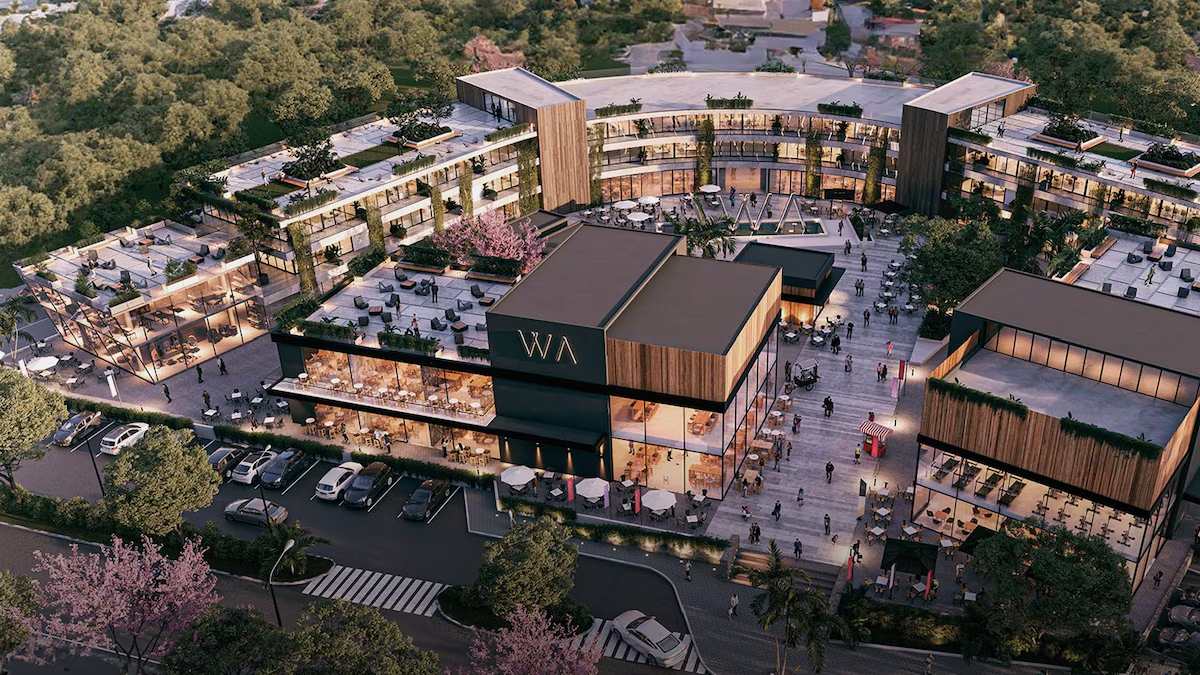
In the middle of the Argentine valleys in the north of the country, a corporate hub is being built that brings together offices, gastronomy, shops and services in an area in full growth, hand in hand with the boom lithium miner. This is the WAD Center corporate campus, located in San Lorenzo Chico, Salta, in what is known as the Lithium Triangle (the geographical area shared by Argentina, Bolivia and Chile).
Indeed, lithium exports in Argentina continue to rise; They went from representing less than US$300 million in 2021 to US$849 million in 2023. In fact, Rio Tinto and First Quantum Mineralstwo international mining companies that develop copper and lithium projects in the north of the country, presented their quarterly results last February and They highlighted that Argentina remains a priority destination for future investments.
According to data from the real estate developer MDAY, Salta is experiencing an expansion of residential demand towards nearby municipalities. Cerrillos and, especially, San Lorenzo register accelerated population growth rates, the former having increased by +56.3% between 2010 and 2022, and the latter by +133.7%, in the same period.
Among the real estate projects that are being built in that area is Salta 4, a commercial premises with more than 500 m² covered, distributed over three levels, including the ground floor, first floor and a second level with a terrace. It is integrated into a hub which has a gastronomic offer, offices and health services.
In just 24 hours, 132 investors from 17 countries (including Spain, Argentina, France, Germany, Sweden and Paraguay, among others), closed a financing of US$958,800, to build this real estate project, which has an estimated projected annual return of up to 18%.
“Salta is consolidating itself as one of the most dynamic economic poles in northern Argentina. The growth of the mining sectorespecially lithium, is generating a growing demand for corporate infrastructure and associated services“said Eric Sánchez, founder and CEO of Reental, the company behind the tokenization of the project, which, with this new event, has already tokenized projects close to US$3 million in the province. The company has positioned itself in the universe of tokenization of real-world assets and currently has more than 32,000 registered users in more than 100 countries; it has financed more than US$100 million in more than one hundred projects.
It is worth mentioning that the previous project, Jump 3, managed to raise US$1.36 million in just over ten minutes. “This type of development responds to an urban transformation that is already being seen in Salta: companies, professionals and services that accompany the growth of mining activity and the expansion of the city towards new corridors,” explains Magdalena Day, founding partner of the MDay group, developer that is carrying out the real estate project.
Indeed, the interest is not a coincidence, since, according to project data, the region concentrates close to 60% of the world’s lithium reserves and registers important international investments linked to mining and the global energy transition. This drives a growing demand for professional services, corporate infrastructure and commercial spaces linked to the mining ecosystem.