March inflation was 3.4%, which represented the largest monthly increase in a year. In this scenario, the Minister of Economy Luis Caputo analyzed the main factors that drove the jump in the CPI and predicted when it may begin to fall.
On Monday, in a speech, Caputo himself had anticipated that March inflation would be above 3% and that it would begin to decline in April. He also announced that “the best months of recent years are coming.”
Luis Caputo’s explanation of the harsh inflation data for March 2026
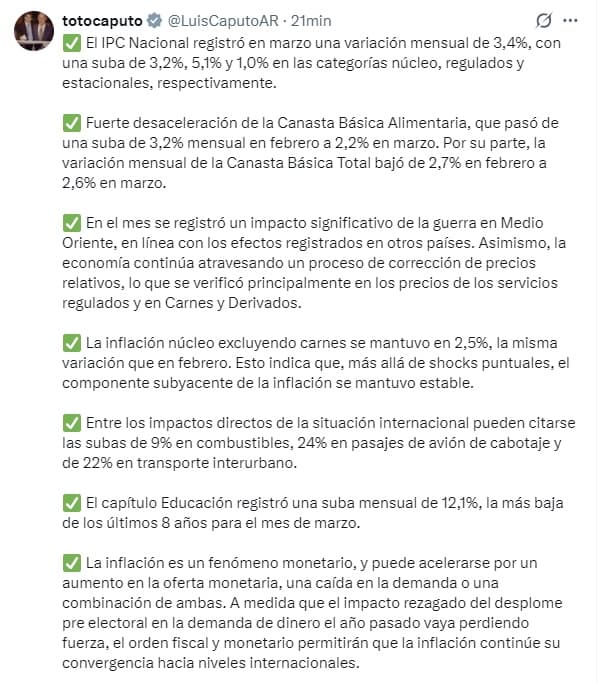
Caputo wrote a post in X in which he analyzed the factors behind the rise in inflation in March. “The National CPI registered a monthly variation of 3.4% in Marchwith an increase of 3.2%, 5.1% and 1.0% in the core, regulated and seasonal categories, respectively,” he said.
“Strong deceleration of the Basic Food Basket, which went from a monthly increase of 3.2% in February to 2.2% in March. For its part, the monthly variation of the Total Basic Basket fell from 2.7% in February to 2.6% in March,” he added, in relation to the indicator that serves to measure the limit of poverty and indigence.
“In the month There was a significant impact of the war in the Middle Eastin line with the effects recorded in other countries. In addition, The economy continues to go through a process of relative price correctionwhich was verified mainly in the prices of regulated services and in Meat and Derivatives,” he noted.
And he detailed: “Core inflation excluding meat remained at 2.5%the same variation as in February. This indicates that, Beyond specific shocks, the underlying component of inflation remained stable”.
“Among the direct impacts of the international situation The increases of 9% in fuels, 24% in domestic plane tickets and 22% in intercity transport can be cited”he added.
Meanwhile, he maintained that “the Education chapter registered a monthly increase of 12.1%, the lowest in the last 8 years for the month of March.”
And he concluded: “Inflation is a monetary phenomenon, and can be accelerated by an increase in the money supply, a fall in demand, or a combination of both.. As the lagged impact of last year’s pre-election collapse in money demand loses steam, the fiscal and monetary order will allow inflation to continue its convergence toward international levels.”
On Monday, in addition to anticipating that the March figure would exceed 3%, Caputo also announced that starting in April it will begin to decrease: “Starting in April, a process of disinflation and growth is coming, the best months are coming.”
Luis Caputo’s message after the March inflation data
March inflation accelerated and accumulated 9.4% in the first quarter
The March inflation was located in the 3.4% and, as the market and even himself had anticipated, Luis Caputoaccelerated again after two consecutive months at 2.9%. This way, recorded the highest increase in a year: the figure for March 2025 had been 3.7%.
In this way, the inflation toaccumulated in the first three months of 2026 reached the 9.4%while year-on-year inflation was 32.6%.
In this way, inflation continued with a clearly upward trend. The CPI began to climb from May 2025when it registered an increase of 1.5%. After the 1.6% in June, had a variation of 1.9% in July and August, while it was 2.1% in September, 2.3% in October, 2.5% in November, 2.8% in December and finally 2.9% in January and February.
According to INDEC, at the category level, the Regulated prices (5.1%) had the largest increase due to adjustments in public service, transportation and education ratesfollowed by the core CPI (3.2%) – with a variation slightly lower than the general level – and Seasonal (1.0%), with increases linked to tourism and the change of season in clothing that compensated for the falls in prices of vegetables and fruits.
The division of greatest increase in the month was Education (12.1%): like every year, this increase coincides with the start of classes. The second division with the greatest increase was Transportation (4.1%) due to fuel, public transportation and air tickets.
The division with The greatest impact on the regional monthly variation was Food and non-alcoholic beveragesmainly due to the increase in Meat and derivatives (6.9% in GBA).
The two divisions that recorded the smallest variations in March 2026 were Miscellaneous goods and services (1.7%) and Home equipment and maintenance (1.3%).
April inflation: the first surveys and what the City anticipates
Lucio Garay Mendez, chief economist of EcoGo, does not rule out that the reduction in global energy supply, due to the paralysis in maritime traffic in the Strait of Hormuz due to the war in the Middle East, could extend for several more weeks and keep the international price of oil high, which would continue to put upward pressure on fuel prices. Therefore, it is estimated that the general level of the CPI in April and May, although it would decelerate, would probably would be above 2% monthly.
Camilo Tiscornia, director of C&T, estimates that the CPI for April “will give much less than in March, unless something crazy happens with gasoline.” Caprarulo agrees with this, and also estimates an inflationary slowdown in April, although “the big question remains the price of oil.” For the period between April and June, the director of Analytica projects a inflation around 2.6% monthly average.
“For April, we project a deceleration of inflation to 2.4% monthlyafter the 3% estimated for March. Inflation will remain high for the drag left by March (+10%)but it would weaken due to the drop in meat prices. In fact, if meat falls further, the slowdown could be even more pronounced. Furthermore, with the price of oil at US$101the gasoline continues with a 8% delay. If corrected during April, it could add 0.2 additional points of inflation,” adds the consulting firm. FMyA.
According to Max Capitalthe market expects the international price of oil to remain above last year’s levels, even if the conflict in the Middle East were to stop. Higher oil prices, he highlights, have implications for both inflation and external accounts, since it represents a “double edge shock” for an energy exporting country that seeks to reduce inflation and at the same time needs to accumulate reserves.
“The inflationary implications are similar to those of other countries, although the lack of a strong nominal anchor from the monetary side and greater inflationary inertia could generate a more pronounced impact. On the external side, however, part of the effect could be offset by a stronger currency thanks to higher mining and oil prices, along with a good agricultural harvest, Foreign Direct Investment (FDI) flows and debt issues also directed at these sectors,” he adds.