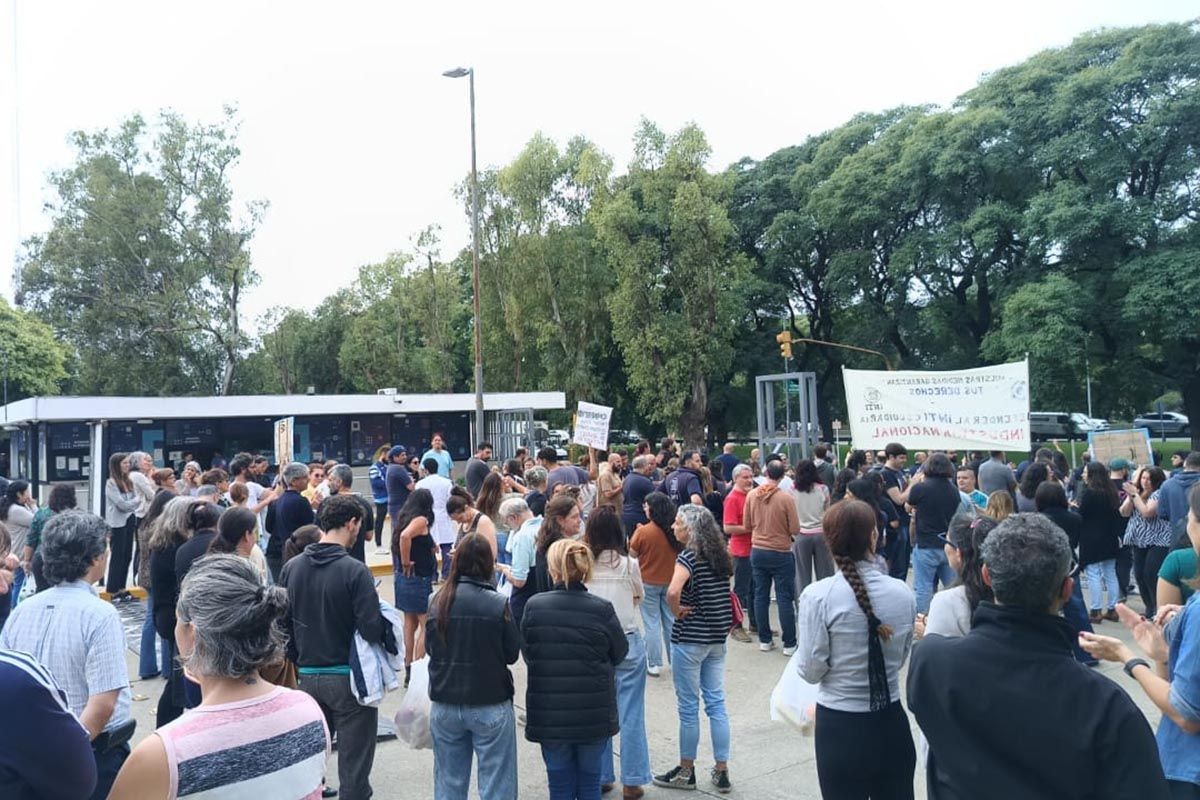
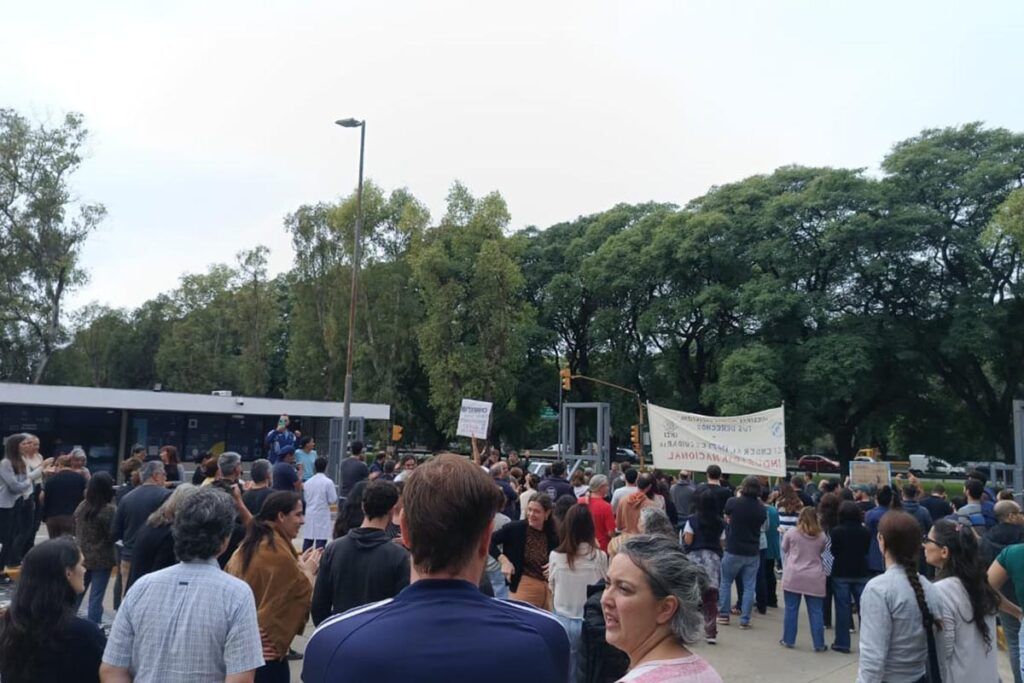
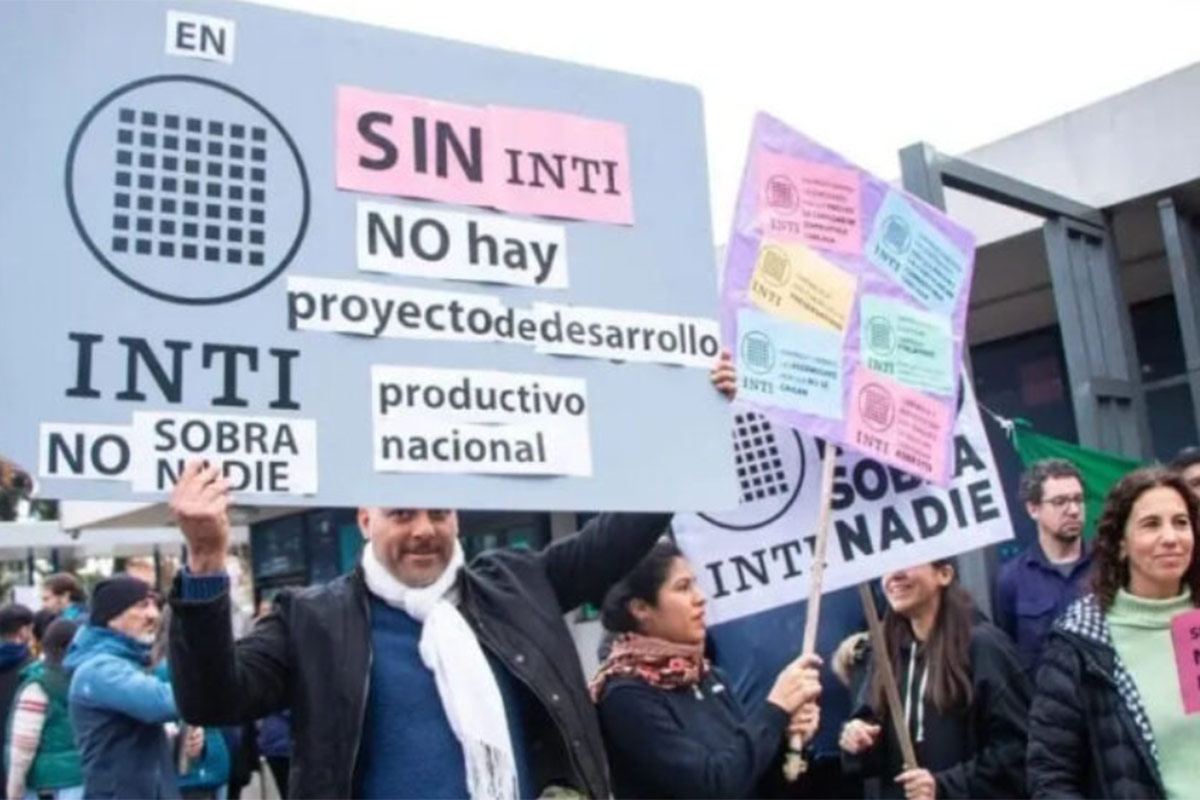
The Miguelete Technology Park of the National Institute of Industrial Technology (INTI), in the town of San Martín, northwest of the Buenos Aires suburbs, was the epicenter of a massive protest by the Institute’s staff over a decision by the national government that not only means the scrapping of the organization but the possibility of concrete consequences for society: the removal of more than a thousand services that control food and beverages.
“The workers of the National Institute of Industrial Technology are mobilizing en masse at the door of the institute, since We are rejecting the decision they want to implement to cancel more than a thousand essential services for industrial development and for the protection and care of society.d”, Yamila, one of the protesters, remarked to this newspaper, Yamila, one of the protesters, remarked to this newspaper.
“This would leave 700 technicians and professionals on the street. and in serious danger to the Argentine community, since many processes would remain adrift or in the hands of the private sector, without the impartiality that this implies,” he said.
More fired, less control
The Government is moving forward with the scrapping of the National Institute of Industrial Technology (INTI), based on the elimination of services with a profound impact on a sensitive area for the population: the control of food and beverages.
The official resolution formalizes the withdrawal of a battery of tests and technical services that functioned as support for companies, control organizations and consumers. Tools that operated as an independent verification instance of companies on quality, composition and food safety.
The text approved by the Board of Directors of the organization provides for “the cessation of the provision by the NATIONAL INSTITUTE OF INDUSTRIAL TECHNOLOGY (INTI) of the systematized services detailed in Annex I.”
The measure relates to the signatory Minister of Economy, Luis Caputo, and to businessmen in the food sector, especially Daniel Funes de Rioja, former president of COPAL, the chamber of food businessmen. Caputo already carried out a similar maneuver but with the INTI fuel calibration service, to benefit the Argentine Accreditation Body and the company Lenor, in particular..

Dismantle state science organizations to favor businessmen
The measure It is similar to that taken by the government in other industrial services that the science and technology organization provided until months ago, such as metrology for the fuel sector.. The scientific-technical organization provided the fuel vending control service for all service stations in the country, but nearby companies that provide the same service but with much lower quality of control (and also less structure and capacity of workers) pressured the Milei government to retain that technical assistance.
The private sector celebrates the dismantling of the INTI, which had been developing control operations with high quality standards from the State for years. And furthermore, at a value below the market reference price, because the assistance was to sustain industrial activity, seeking the general benefit of the productive sector.
Now, without the INTI, Lenor was left with the path paved to monopolize the fuel vending control service and is already evaluating increasing the tariffs that the INTI made to a value of 25 thousand pesos per fuel vending peak. From the firm they talk about a charge of 75 thousand for the same benefit.
The low-cost, high-quality service generated income of between 3,600 and 4,000 million pesos for the national scientific organization. The private sector came out to shout “unfair competition”, then Milei intervened, raising the INTI tariff to 100 thousand pesos, seeking that this would generate in users the decision to move to the private sector, but the service stations continued to bet on the INTI, which carried out 9 out of 10 certifications were carried out in the country and that irritated private laboratories.
That’s when the Government directly decided to definitively close the INTI metrology area with the service included, at the end of last year, by order of Caputo and pressure from Lenor in the Ministry of Economy. Something similar will happen now with the dismantling of the food area.

Key services for INTI
In the case of food, the list of official controls includes from analysis of additives, antioxidants and sweeteners to studies of shelf life, sensory profile, caffeine content or detection of contaminants such as mycotoxins.
Among the tests that will no longer be provided are those linked to the measurement of texture, color and functional properties of foods, as well as the analysis of specific compounds in meats, dairy products, oils, beverages and processed products..
They are also suspended consumer studies and sensory evaluations, tools used by the industry to validate products before they are released to the market. In parallel, controls on substances such as aspartame, sucralose or acesulfame K, in addition to determinations on antioxidants and chromatographic profiles. A relevant part of the technical validation system is outside the state orbit.
Article 3 establishes a transition framework, detailing that “the agreements, work orders and other contractual commitments in force (…) will be fully complied with until their completion.” However, the scope is limited to the agreements already signed. Article 5 proposes an “adequation of the institutional technological offer”, reducing the presence of the organization in historical areas.
Another effect of the measure is that brands will begin to want to hire qualified workers in a particular way. “This job offer offered clandestinely implies individual billing for these services; That is, they offer us to violate the Public Ethics Law, which imposes exclusivity and confidentiality on State workers.”, point out the organization’s workers.
They describe the situation as a “talent hunt” that exposes the dependence of the private system on technical skills trained in the public sphere.
“INTI is the only organization with the technical capacity to guarantee the quality and traceability of measurements.. (The companies) They do not have the fundamental thing: we, the INTI workers, our capacity and technical expertise.”
Milei has just resolved the annihilation of the National Institute of Industrial Technology (INTI)
The cessation of more than 900 technological offers that the Institute provided to the productive network is ordered. It is not an isolated event, it is a systematic policy of dismantling.
To the… pic.twitter.com/GH03ULzsGN
— Julia Strada (@Juli_Strada) April 13, 2026
Annihilation of the INTI
The national representative Julia Strada He also denounced that the national government moved forward with “the annihilation” from the National Institute of Industrial Technology (INTI).
For the president of the Economy Commission, “it is not an isolated event, it is a systematic policy of dismantling, because at the same time its operational functioning is suffocated.” In this sense, he also pointed out that “Per diems are not paid, which prevents technical teams from visiting companies, a central instance for the provision and development of services”.
Within the framework of an adjustment policy that has taken budget investment to its historic lows in the area, Strada added that “In parallel, institutional ties are paralyzed,” and he charged: “New agreements are not promoted and existing ones are suspended, dropped, or directly annulled.”