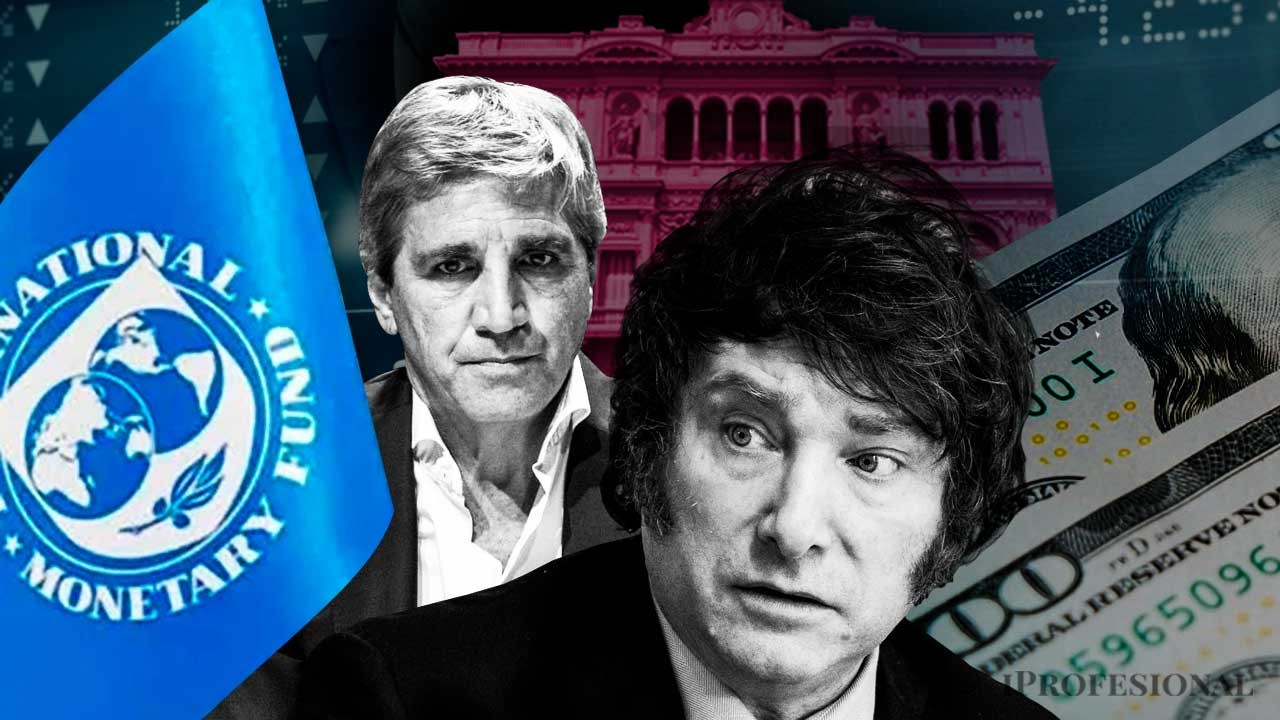
What did the Minister of Economy see to launch such a bold forecast in the last hours? Indeed, Luis Caputo believes that he is about to break a dynamic that plays against him: inflation has been rising uninterrupted for ten months and the country risk resists falling from the level of 500 points.
The head of the Treasury understands that inflation has reached a peak. He dared to make such a prediction, sensing that The war in the Middle East will be resolved soon. Otherwise, no one could risk predicting the stability of the barrel of oil globally.
For the Government, there is an urgency to show better economic numbers: the vast majority of opinion polls – even those followed by the Government – show a growing bad mood on the part of societydue to the economic malaise.
“We are convinced that inflation will go down in the future,” he promised. Javier Milei before the businessmen of American companies in Argentina.
“We must be patient, we are not going to go against economic theory,” the head of state asked, again, confident that The current recipe will bring greater success in the short term.
Most of the consulting firms that measure inflation on a weekly basis have already been detecting a disinflation in this first half of April.
The freezing of prices at fuel pumps is key to explaining the result. But it is not exclusive. Profitability in meat prices also helps. What’s more: the value of the media res has already registered a 5% recoil so far this month.
We will have to see the transfer of this movement to supermarket refrigerators and neighborhood butcher shops.
The process is different for other food products. Although for now there is no evidence of a wave of rebranding on the shelves of the chains, in the food factories they do not rule out further increases in the coming weeksdue to the impact of the war on some prices of inputs linked to oil: from packaging to fertilizers.
Inflation in April: for now, consulting firms aim for a CPI of less than 3%
The consultants estimate, for now, a inflation around 2.3%-2.4% for April. This point of decline would be explained by the aforementioned freezing at service stations.
However, the decline could be greater if one takes into account that this month the strong momentum of the educational sector, which in March climbed no less than one, has already disappeared. 12 percent.
The same could be said of meat, which no longer shows the marks registered until last month.
However, the inflationary dynamic is not explained exclusively by these items. We will have to be attentive to the evolution of other “problematic” items when measuring inflation: regulated rates and private services They have been moving in a manner consistent with the current dynamics of price acceleration.
Caputo plays a key game with the country risk
Caputo believes that the country risk index will decrease in the coming months.
The question to be clarified is whether Milei and Caputo plan to enter the international market to refinance debt maturities in dollars.
There is a view in the market that the Government should test the waters of Wall Street to refinance liabilities. The last to ask for this path was former minister Nicolás Dujovne.
The theory is that if the Government goes out to the international market it will be able accumulate reserves in the Central Bank. And if that happens, the country risk will decrease. In this context, a virtuous circle that will bring long-term investments and growth.
Between the end of January and the end of February of this year, Argentina had a clear opportunity to issue debt abroad. At that time, country risk opened the possibility of placing bonds at a rate close to 10% annually. The GD35 bond was trading at 9.25% in New York.
A level that even allowed countries like Ecuador to return to the market after six years of absence. However, the national government chose not to move forward. Caputo believed that the country risk would drop to a floor of 400 points. At least it was the scenario commented on in public by Javier Milei.
That bet was cut short by the outbreak of the war at the end of February, which triggered the long-term rate in the United States and increased the risk of emerging markets.
The country risk exceeded 600 points a few days ago. Will there now be a new opportunity?