Between March 2024 and mid-2025, credit experienced something similar to euphoria in Argentina. The Personal loans and cards combined grew by 130% in real terms in that period, in a context where banks relaxed requirements. Consumption was reactivated, balance sheets looked healthy and credit seemed to be the engine of economic recovery.
This expansion had, however, a fragile logic. Loans were granted to segments of the population with adjusted payment capacity, many times against minimal documentation. When the cycle closed, the bill arrived suddenly.
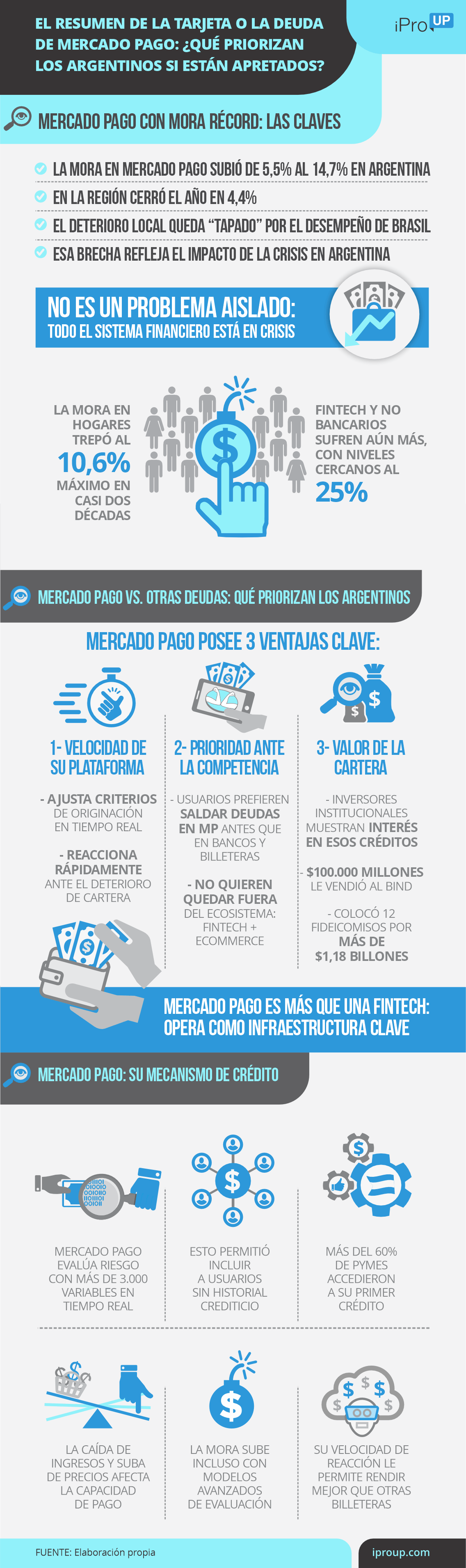
The proportion of Delinquent debt almost quadrupled in twelve monthsgoing from 2.7% in January 2025 to 10.6% in January 2026. It is not an isolated data, it is the fifteenth consecutive month of increase and represents the worst record since the exit of Convertibility in 2001.
The other key figure: direct hit to profitability
The deterioration of the portfolios translated into concrete losses for the system. According to a report by the consulting firm CML&A directed by Pablo Curat, former director of the BCRA, the Return on equity (ROE) fell from 11% in the second half of 2024 to 4% in the same period of 2025, and the 40% of the 73 entities analyzed presented negative real ROE.
The difference between winners and losers is brutal. Automotive finance companies lead the profitability ranking, because they always lend with collateral. At the opposite extreme, Ualá, Columbia, CFA, Másventas, VOII and Sucrédito accumulated the worst performances:
- Orange achieved a profitability of 68%
- PSA registered 57%
- rhombus got 50%
- Fiat Achievement 46%
Record defaults in wallets and banks
For the economist Pablo Marino, the explanation is structural: “Whoever lends with collateral collects. Whoever bet on massive credit without support, today absorbs losses“.
“The Private retail banks show an abnormal portfolio of 16.8%double the system average,” the expert tells iProUP.
Fintech and wallets, the most vulnerable front
If the traditional banking system shows signs of stress, outside of it the situation is directly critical. The consulting firm EcoGo revealed that the Irregularity in non-bank credit portfolios reached 23.9% in January 2026almost four times the irregularity of the total credit of the financial system.
The numbers per entity are even more eloquent. Orange Card tops the list with 35.7% of loans in irregular situation, Cencosud reported 25.5% and Consumption credits reached 25.4%. Mercado Libre presented a rate of 14.7%.
The problem is not only of magnitude but of debtor profile. Fintech and wallets captured sectors that traditional banking did not touch (informal workers, small merchants, people without credit history) and now they face the cost of that inclusion without the prudential network that banks have. The regularity of these portfolios fell from 92.1% to 76.1% between December 2024 and January 2026.
Macroeconomic data has its correlation in the domestic economy. A survey by the consulting firm Proyección carried out on 2,000 homes clearly reveals surgical precision the level of financial stress:
- He 20.1% asked friends or family for money to make ends meet
- He 11.1% paid the credit card in minimum installments
- He 10.9% went to a bank
- He 9.1% went to Mercado Pago or used quotas from digital platforms
- Only the 42.9% declared that they had not needed to go into debt
In other words, more than half of Argentine households had to resort to some financing mechanism to sustain its daily consumption. The most worrying fact is that the “solidarity cushion” is being exhausted. That is, loans between family or friends represented the 35.4% of non-bank debt in 2025 and fell almost 20 percentage points. When that resource is also depleted, there is not much margin left.
Argentines accumulate today more than $39 billion in debtof which $32.1 billion are banking and $6.9 billion are informal.
Record default: what the system needs to stabilize
Specialists agree that the default does not resolve itself. For financial analyst Matías Robledo, there are only two relief mechanisms. “Trigger new loanssomething that dilutes the index; wave debt refinancing in an irregular situation”.
“From mid-2025 the credit stopped growing in real termsand signs of refinancing are scarce,” adds the expert.
The Central Bank tries to influence these variables. Implemented measures such as automatic debit of loan installments and works to lower short-term rates, with the aim of generating conditions for gradual consolidation. The logic is simple and indicates that cheaper credit makes it possible to refinance expensive debt and get defaulters out of the hole.
Moody’s estimated that the Delinquencies will continue to increase during the first half of 2026to begin to gradually stabilize in the second half of the year. The only segment that escapes the trend is the mortgage sector, where the default remains around 1%. “Debtors prioritize the roof over any other obligation,” concludes Robledo.
There is a paradox at the heart of this problem. Credit was the instrument that allowed consumption and economic recovery to be sustained from 2024. But that same credit, granted with lax criteria and high real rates to vulnerable segments, became the vector of the current deterioration.
If real income fails to reach the level of accumulated debt, the system enters a vicious circle: more defaults force banks to lend less and with tougher conditions, which reduces consumption, which further deteriorates the ability to pay. In an economy where more than half of households depend on financing to make ends meet, that scenario is not just a banking risk. It is a macroeconomic risk of the first order.