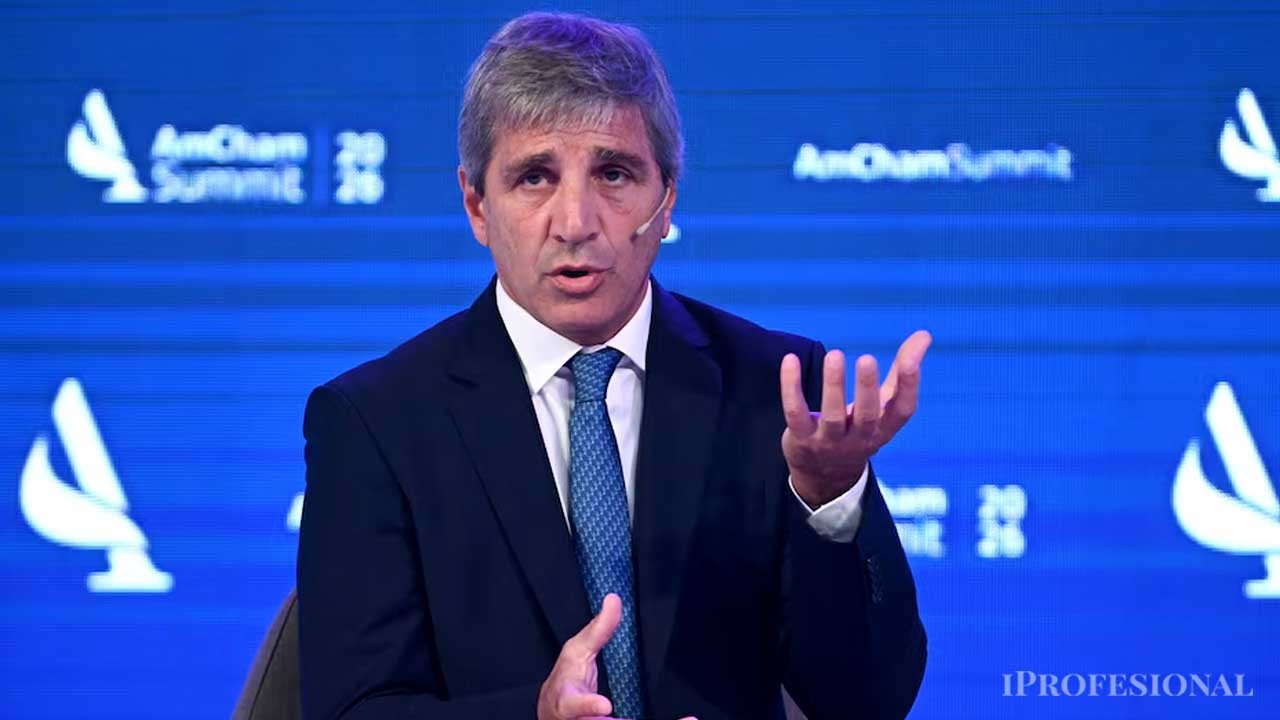
Luis Caputo took its revenge: after the last tender in March, several analysts considered that the margin to “live with our own” with regard to the Treasury financing with dollars of the domestic market. However, this Thursday it was demonstrated that the minister can still get the most out of the liquidation of the banking system.
Unlike the previous tender, in which it had to be content with raising US$431 million, 14% less than expected, this time it did manage to complete the US$500 million limit. And, best of all, at a lower interest rate than the one that had to be validated in the previous tender.
In this way, it managed to reinforce its image just when it is trying to obtain credit from the international market. And it dispels reports that its ability to fund itself with local investors was already coming to an end. After all, the system still shows record deposit levels, already for above US$40,000 million, of which almost half have not been placed as loans in the domestic market.
Again, Caputo offered two securities, one “low risk”, with a maturity date before the 2027 presidential election, and another that incorporates the “kuka risk” because it returns the capital only in October 2028. In both cases, the monthly coupon payment scheme is maintained, which excited bank executives that the instrument could be attractive to small savers, as it is assimilated to real estate income.
The tranche maturing in 2027 will pay un annual effective yield of 5.12%, while he who wins in 2028 it has a rate of 8.51%.
Confirmation of the “Kuka country risk”
From the government’s point of view, this must be interpreted as a sign of confidence on the part of the market. In February, when the first tender was held for a bond to be subscribed in dollars, under Argentine law, the rate was 5.8%. The government celebrated the fact that the market had shown attractiveness for that security, to the point of buying it above its nominal value, and accepting a rate lower than the 6% that appeared in the official offer.
Two weeks later, The same bond raised US$250 million againbut already with a lower rate, of 5.4% effective annually. And then, on his third outing to the market, Caputo once again found itself with high demand – US$466 million for a quota of US$150 million. and at a rate of 5.02%.
Now, on his fourth attempt, they accepted the cut-off rate at 5% nominal. And as for the bond payable in 2028, a slight drop was also recorded, given that the rate closed at 8.2% nominal, while 15 days ago the financial cost was 8.5%.
This difference of 320 basis points between two similar securities that barely have a year difference in their maturity has been taken advantage of by the government to support the theory that eThe “true” country risk is not the one that arises from long-duration bondsbut rather short bonds, which do not imply a risk of default or re-profiling because they mature within the Milei government period.
With that argument, the “Milei country risk” is around 120 basis points. That is the number that arises from subtracting the cost of the global reference rate from the AO27 bond rate, which is around 3.8%. For the government, this rate is low because it implies a country risk that is much lower than what it measures. the JP Morgan index At a global level it was, until two weeks ago, above 600 points.
In contrastthe country risk as of October 2028 is calculated by Caputo at 440 points. And the “forward rate” – as the difference in interest between two future moments is called in financial jargon, in this case October 2028 versus October 2027 – is equivalent to an annual nominal rate of 14%.
The bad part for the government is that, behind the chicane to Kirchnerism, there is a recognition that the market continues to see a relatively high probability of a break in economic direction and a change of political direction after next year’s elections.
Looking for reasonable rates
Until now, adding the four tenders made with the new bonds, The Treasury raised US$1,431 millionout of a total of US$2,000 million that it announced that it would seek throughout the year, with the aim of financing itself to meet the debt maturity schedule.
In particular, the government was concerned about bulky July expirationwhen capital plus interest must be paid for US$4.2 billion.
The officials of the economic team have tried to convey calm to the market by ensuring that funding is already guaranteed to face the remaining payment schedule of the year – about US$11.9 billion.
However, this does not dispel the market’s concern, which shows doubts about whether the government will be in a position to face the demanding schedule of 2027, when US$23,195 million must be canceled or renewed in the name of the Treasury, plus US$11,213 for bonds and credit lines from the Central Bank.
It is for this reason that the minister is now trying to take advantage of his international contacts, to obtain credit to a “reasonable” rate. Given that in the latest tests there was no way to obtain financing for less than 9% per year in dollars, a credit organization, possibly the World Bankact as guarantor, as a way to lower the political risk component.