In it San Martin Theater, Elena Roger prepares to debut Invasions 1: Don’t bomb Buenos Airesa rock opera that crosses the English Invasions with the songs of Charlie Garcia. “It has many nice things,” he says in conversation with Clarionas he tries to put into words why he accepted the project. She was attracted to that mix of a national story told from a more metaphorical place, with a contemporary look that is based on a repertoire that is part of the Argentine cultural DNA.
The plot revolves around cassandrathe character that Elena Roger plays, a young woman who, due to circumstances beyond her control, finds refuge among the lamplighters, who at that time also fulfilled the role of watchmen.
From this universe, the work – with a cast of more than thirty artists on stage, selected in open auditions and composed of leading figures of the genre – immerses itself in the first English Invasion of the Río de la Plata, in 1806an episode that, according to her, “goes quite unnoticed.”
On that journey, furthermore, values the role of women in these processes, often made invisible: “They were transcendent, but they did not always transcend” he states.
For Elena, getting on that stage also implies defend public theater. “It is beautiful to enjoy and support it”, he raises about the Martín Coronado Room of the San Martín, with the conviction that there may be proposals there that do not always find a place in the commercial circuit.
Added to that is the music, which is not a minor detail. Singing Charly García entails a responsibility that he assumes with respect, almost with modesty.. Defines the musician as a cultural hero, someone “we should never forget again”and admits that performing his songs generates a mixture of admiration and vertigo. “It doesn’t even bother me, I don’t know if we are up to it”, he admits.
The expectation for the premiere of Saturday April 18he assures, is that the public not only has a good time, but also leaves with concerns, wanting to “search for information on Wikipedia about Argentine history.”
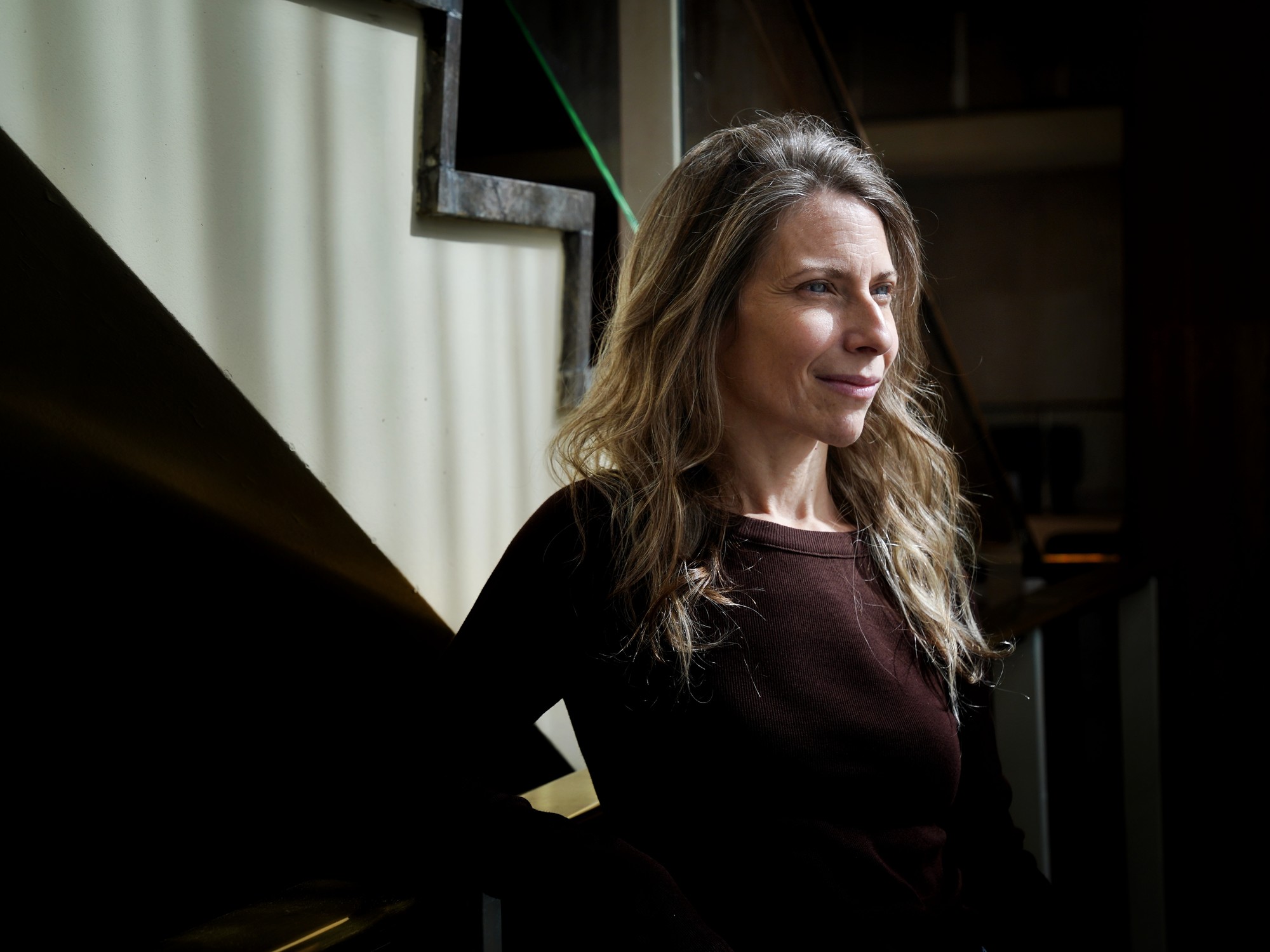
 Elena Roger is the youngest of three siblings. He says that singing to Charly García makes him shy. Photo: Emmanuel Fernández
Now, that woman who speaks so clearly about what she does, about the meaning of a work, is the same one who, minutes before, arrived at the theater hall wearing loose rehearsal clothes, her hair tied up and her face washed for this interview. Petite and without grandiloquence, far from that imposing image that she occupies when she goes on stage.
Beyond her talent – that same talent that led her to play Avoid in London or to get into the skin of Edith Piaf in London’s West End -, the power that defines her is trained every day, with four-hour days for this premiere, and work is done on every detail, at every stage of her life. And there, when the technical curtain is drawn, the underlying question appears:What Elena Roger is made of?
A house full of people and music
To get to know her better you have to return to Barracas, to that house where her parents, her two brothers, her grandmother and she, the youngest, lived together; the same one where his mother and uncles had also grown up. A home that the Italo company gave to her family and where she lived until she was 30, when she was finally able to move out on her own.
That origin marks a way of being in the world. A shared life, with the house always full, meetings, music that came and went. “My entire childhood was through music“, he says, and in that memory appear tangos, opera, boleros and rock playing all day.
She tells it enthusiastically, almost like a historian of her own family. He talks about his ancestors, about how many, in one way or another, were linked to art, and about that interest in understanding which patterns are repeated, which are not, what is inherited beyond the obvious, even from family constellations. “Finding where what you do comes from has to do with the roots”, he reflects.
 Elena Roger, in her role as Cassandra for “Invasions 1: Don’t Bomb Buenos Aires.” Photo: Press
But if there is a figure that condenses all that, it is his grandmother, the ninth Amalia. Matriarch of the house, yes, but she also cooked, recited poetry and sang.
From this upbringing comes one of his strongest ideas: art is not a privilege of a few, but a way of inhabiting the world. “We are all creative, not just the one on stage”she says, convinced that this playful universe is necessary to live more lightly and be able to process what is happening.
To the surprise of many, his career, in that sense, was not the result of a millimeter plan. “Life was taking me“, she repeats. At the age of 11 she started dancing at a neighborhood school where she fused Spanish, American tap dancing, jazz and classical, and at 14 she added lyrical singing at a conservatory, encouraged by her mother’s cousin who saw qualities in her.
At 17, she was already teaching dance classes and there appeared a first certainty that she could make a living from it. At that time I imagined a destiny as a music teacher, after having also spent several years at a conservatory. Today, at 51 and with the journey done, he summarizes that “It doesn’t matter if things go well or badly for you, if what you choose makes you happy.”
 Elena Roger has been working on her talent every day, since she was very little. Photo: Emmanuel Fernández
The auditions took place in parallel until, in 1995, he was The Hunchback of Parisby Pepe Cibrián. That work was, according to her, a real school. “I learned discipline, care, how to behave as an artist“, he remembers. There he understood that talent is not enough without work and perseverance. Since then, he says, he never stopped working.
Over time, the great protagonists began to arrive and, with them, new challenges. Each work asked something different of her, forced her to know herself more, to discover how far she could go and to push her own limits a little further.
In Mina, what’s upFor example, language was a barrier that had to be broken down with constant practice. “I trained a lot to be understood,” he says, laughing, biting his lips when he remembers it. In Piafthe challenge was to find a way to sing, to understand a completely different style. “The first time it seemed scary, I couldn’t get it out,” he admits. And in that process, there was also an extra demand because they were functions without replacement.“I lived as a nun. From the theater to my house. There was no room for me to get sick.“It was absolute dedication.
Elena Roger: daughter of a loyal mother and a strong father
In the midst of that growth, life burst in with a blow that was difficult to avoid. His father suffered a stroke after going through the economic crisis of 2001 with extreme stress. He was in a coma for 45 days and survived, but with consequences that changed everything. “He was never again my dad as I knew him“, he says. And yet, something essential was still there: “A lot of his being was alive… being able to hug him, kiss him, it was gratitude”.
His mother cared for him for more than two decades and predeceased him at age 83. This whole process marked a before and after. “I matured with slaps“she says, remembering that moment when, suddenly, she felt that she became a bit of a mother to her own parents. Roles, priorities and the way of looking at everyday life changed. “You learn not to make trouble for stupid things“he reflects.
 After family dramas, Elena Roger claims that she learned not to get in trouble for stupid things. Photo: Emmanuel Fernández
When she talks about her parents, she understands what parts of them are still alive in her. From her mother she rescues empathy, that way of being there for others without judging, of accompanying even in the most difficult moments; a sensitivity that he recognizes as his own. From his father, on the other hand, he takes something of the unusual emotionality for his time. “He cried, he got emotional… and that was strange,” he says. Having seen a man like that, open, human, was an enormous “gift” for her, a different way of understanding strength.
She also remains with her resistance after the stroke, that ability to continue, to return home again and again, to sustain herself even in fragility. In that mix -empathy, sensitivity and resilience- appears part of what Elena is today.. “They were a few blows”, he says, and his voice breaks.
The loss led her to rethink the link with the past. “Losing your parents confronts you with a very strong orphanhood“, she acknowledges. But she also understood that grief involves learning to let go. Not forgetting, but remembering from a more serene place, without being trapped in anguish. She believes that death is not an absolute end, but rather the beginning of another stage, and that holding on too much can make that process difficult.
That experience also seeped into his work. Because for Elena, acting is not just interpreting, it is transforming what is experienced into scenic material. during the work AvoidFor example, there was no function in which personal images were not crossed. “There was an autopilot that sustained the technical, but I was going through all that… like a catharsis“She explains. During that same period, she took her father in a wheelchair so he could see her in that role, a scene that still moves her very much every time he mentions it.
 Elena Roger in the hall of the San Martín Theater where she rehearses four hours a day for “Invasiones 1”. Photo: Emmanuel Fernández
 Later came motherhood and with it the need to reconfigure the balance. Today, with two children with the actor Mariano Torrehis focus is also distributed on his family. His eldest daughter (13) is already beginning to follow the artistic path in the musical Billy Elliotwhile the youngest (8) is still exploring.
Although he admits that he is moved by seeing her on stage, he makes it clear that he does not want any of his children to choose a path by mandate. She only cares”“Let them do something that makes them happy.” because he maintains that “ugly moments can also happen in art“and he wouldn’t want them to have a bad time.
At the end of the talk, when he is asked to define himself, he becomes uncomfortable. He pauses, remains silent, as if searching for an answer that doesn’t sound imposter. She doesn’t like to put herself in that place, even though everyone names her as one of the greats of musical theater. After a few seconds, he resolves it with the phrase: “I am a person who is learning”.
And in that definition, Elena is made up of the heritage of a family crossed by art, the discipline she has sustained for decades, the blows that forced her to grow up and the way she chose to stand in front of life.
Now, in the skin of Cassandra, a woman marked by what she suffered, but who continues to move forward. Like her. As if each character were another way of organizing what we experienced, bringing it to the stage and continuing to learn.