
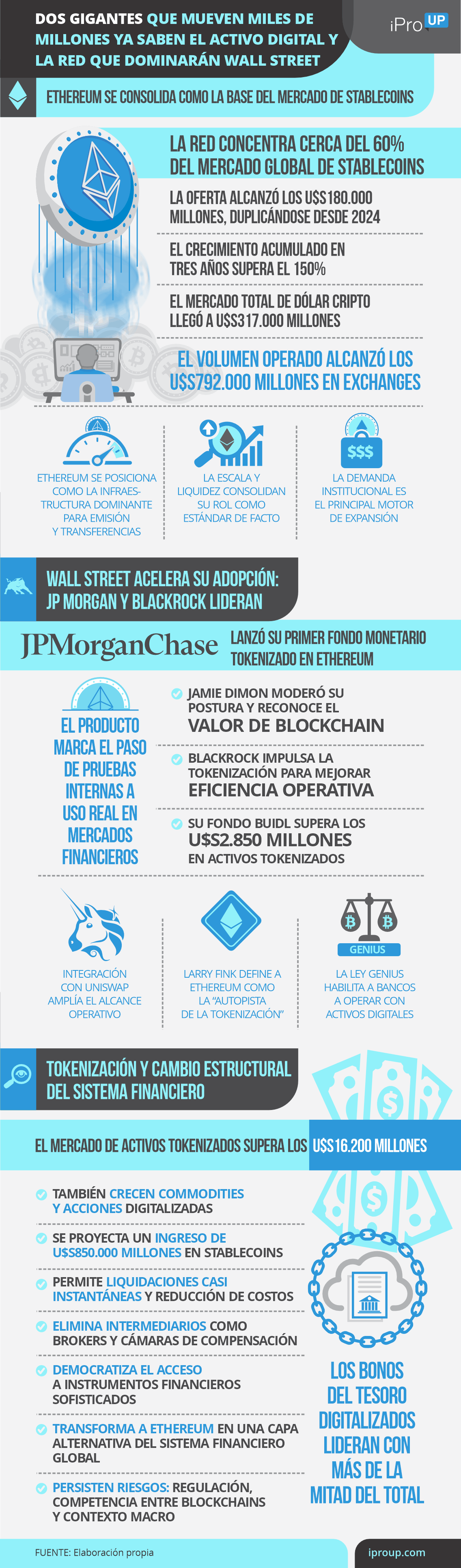
Ethereum consolidates itself as the main infrastructure of the stablecoin marketwith an offer that reached US$180,000 million and represents the 60% of the global total.
Two of the biggest players on Wall Street, JP Morgan and BlackRockbegan to move forward with concrete developments on this network, which marks a change in position towards the use of blockchain technology in traditional finance.
The clearest movement came from JP Morgan, which in 2025 launched its first tokenized monetary fund on Ethereum. The decision involves using the network as a basis for structuring traditional financial instruments, rather than limiting itself to internal testing or closed solutions.
Its CEO, Jamie Dimon, began to recognize the competitive potential of tools such as stablecoins and smart contractsin a relevant turn in the face of his historical skepticism.
For its part, BlackRock accelerated its asset tokenization strategy on Ethereum. The objective is to improve efficiency in the issuance, distribution and settlement of financial instruments, taking advantage of an infrastructure that allows continuous operations, greater transparency and less dependence on intermediaries.
Behind this change there are structural factors. First of all, the scale achieved by Ethereum. The supply of stablecoins on the network has doubled since 2024going from US$90,000 million to current levels, driven mainly by institutional demand and improvements in the system’s operational capacity.
The new Wall Street powered by crypto
According to CoinDesk, Ethereum consolidates itself as the main infrastructure of the stablecoin market. “The growth is not marginal: in the last three years, the network expanded this segment by 150%and only since January 2024 has it doubled its size, going from US$90 billion to current levels,” the document analyzes.
The document highlights that this advance occurs in a context of broader expansion of the ecosystem. The total crypto dollar market reached a record of US$317 billionwhile the traded volume reached $792 billion in centralized exchanges.
Ethereum not only leads in volume, but is positioned as the dominant layer on which these assets are issued and transferred.
Asset tokenization: the push that consolidates Ethereum
The growth of tokenization reinforces that role. The tokenized asset market reached $16.2 billion in Marchwith a monthly increase of 8.93% and three consecutive months of expansion.
Within this universe, tokenized Treasury bonds explain more than half of the total, with US$9 billion, followed by commodities and stocks.which also show sustained growth. Projections ensure that the flow of stablecoins on Ethereum could add up to an additional US$850,000 M.
In that scenario, The network would cease to be just the main crypto hub and become a key infrastructure within the global financial system.driven by asset tokenization and growing institutional adoption.
It is that the possibility of settling transactions in near real time, reducing costs and automating processes through smart contracts represents a concrete advantage forehead to traditional financial infrastructure.
Finally, a deeper change appears: Ethereum is beginning to position itself not only as a technological platform, but as an alternative layer for the circulation of financial assets: Tokenization is no longer an isolated use case but a tool with systemic potential.
Progress, however, comes with risks. Regulatory evolution on stablecoins, competition between different blockchains and volatility global macro remain variables that can condition the speed of adoption.
Market focus will be on real-world asset (RWA) integration and Ethereum’s ability to scale through second layer solutions. If these two variables are consolidated, the institutional adoption process could accelerate.
In this scenario, Wall Street’s movement does not respond to a tactical bet, but to a progressive adaptation to an infrastructure change. Ethereum is beginning to be less of a crypto narrative and more of a piece within the global financial system.
The experts’ view: why Wall Street chose Ethereum
Mariquena Otermin, CMO of Bitwage, believes the market is at an inflection point, “the move from the ‘experiment’ narrative to real infrastructure.” He points out that players like JP Morgan and BlackRock no longer perceive it as a speculative asset, but as the technological rail on which operations can be settled in real time and without intermediaries.
“They chose this network because it is the de facto global standard: offers the greatest liquidity, security and a developer ecosystem that no other blockchain matches,” he explains.
Otermin warns that this transformation has deeper implications. “In the medium term, it breaks the entry barriers and democratizes access to sophisticated instrumentsallowing a digital representation of value that is immutable and auditable in real time,” he points out.
He states that the tokenization process exceeds the technological: “For the financial system, the problem solved is obsolescence. Tokenization is not just a technological improvement, it is Wall Street’s survival strategy to remain relevant in a world where the flow of capital no longer knows borders or office hours”
Why Ethereum is already key for Wall Street
Carolina Gama, Country Manager of Bitget for Argentina, says that JP Morgan took a decisive step by launching its first tokenized monetary fund on Ethereum. The vehicle, called MONY, started with US$100 million and allows institutional investors to obtain returns in dollars while maintaining their positions in tokenized format within the blockchain.
“Rescues can be made in both dollars and USDC. This is a relevant milestone: it is the most systemically important bank in the world to deploy a product of this type on a public network.“says Gama.
BlackRock had already moved in that direction. “Its BUIDL fund exceeds $2.85 billion in tokenized assets and was a pioneer in operating on Ethereum in 2024. Since February, in addition, started integrating with Uniswapthe largest decentralized exchange in the ecosystem, expanding its operational reach,” says the expert.
He adds that its CEO, Larry Fink, has been reinforcing this thesis by defining Ethereum as the “toll highway” of tokenization.in a context where more than 65% of the world’s digitized assets are already structured on that network.
For Gama, Wall Street’s change of position has a clear trigger: regulation. “The approval of the Genius Law gave banks a regulatory framework to operate with stablecoins and digital assets. Until now, interest existed but without clear rules,” he asserts.
The choice of Ethereum is not coincidental. Gama considers that on an institutional scale, it continues to be the network with the greatest depth: “It concentrates liquidity, offers complete traceability, has smart contracts tested for years and maintains one of the most decentralized validation schemes. For entities operating in volumes in the trillions, security and robustness outweigh any marginal advantage in speed,” he says.
The appeal, ultimately, is economic. Tokenization reduces time and costs. A tokenized Treasury bond, for example, can be transferred directly between wallets without going through clearing houses, brokers or traditional custodians.. It’s less friction, less cost and more efficiency.
“This change is already reflected in the numbers. The market for tokenized assets on Ethereum exceeds $22.5 billion and more than doubled its size in the last year. The conclusion is direct: It stopped being a proof of concept and became a functioning financial infrastructure“concludes the expert.