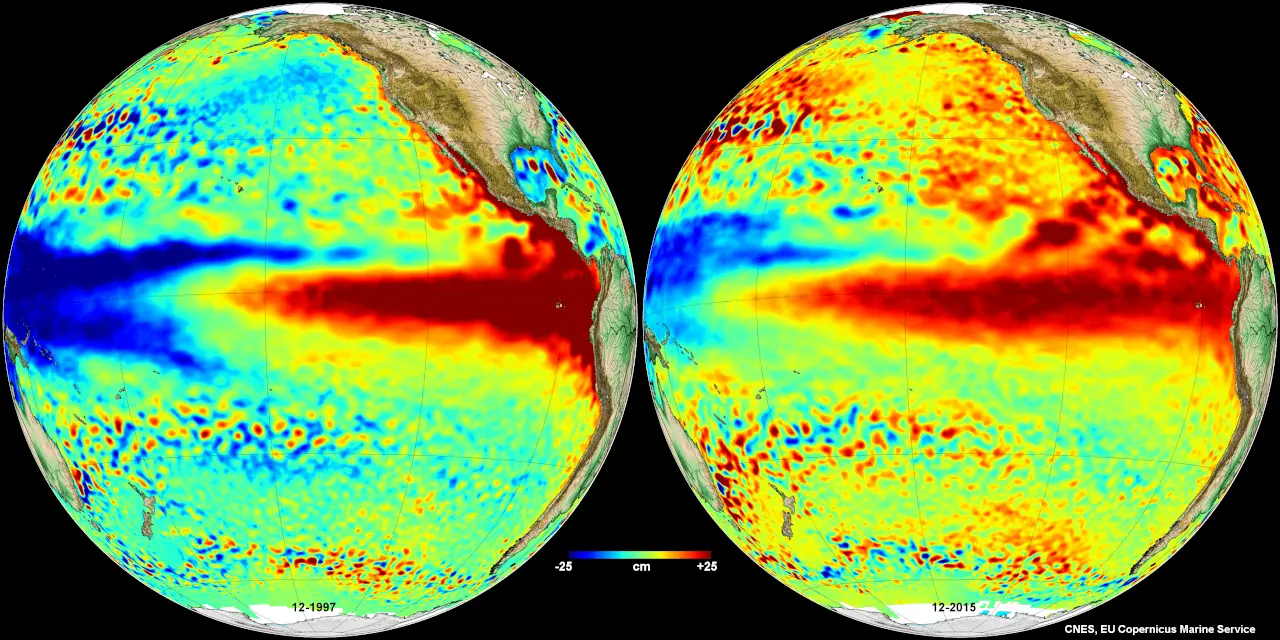
The El Niño phenomenon will return in 2026 as an atmospheric-ocean teleconnection that will alter precipitation and temperature patterns in Mexico. This event, marked by warming of the equatorial Pacific, will cause increased snowfall in winter and an elevated risk of severe drought during the subsequent spring.
You may also be interested in: Consolidation of Viva Aerobus and Volaris protects the survival of rates
Operational mechanics of the ENSO system in the Pacific
The phenomenon known as the El Niño-Southern Oscillation (ENSO) constitutes a complex interaction between the ocean and the atmosphere. This process involves determining fluctuations in atmospheric pressure, wind direction and sea surface temperature in a strip that extends from Indonesia to the coasts of the American continent.
Within this cycle, three different phases are identified: the warm stage or The Childthe cold stage called The Girl and a neutrality phase. The beginning of the warm phase occurs when the water temperature in the central-eastern Pacific exceeds the usual averages. This increase is driven by variations in the trade winds and the movement of ocean waves that transport masses of warm water towards America. The uniqueness of each event lies in the specific distribution of heat and the magnitude of these thermal anomalies.
Seasonal evolution and intensity cycles
The configuration of El Niño follows a predictable chronology but with variable effects. During the spring, the initial warming of the oceanic mass is detected, consolidating during the summer with drastic changes in the wind circulation over the Equatorial Pacific. The point of maximum intensity is usually reached in the period between autumn and winter, initiating a phase of cooling and dissipation towards the following spring.
In terms of meteorological activity, this cycle encourages a higher frequency of cyclones in the Pacific basin compared to the Atlantic. The incidence in the national territory manifests itself progressively, initially impacting the rainy season. During the phase of Caniculamarkedly drier and hotter conditions are recorded in the central, southern and southeastern regions of Mexico. However, towards the close of the season in September and October, the humidity of the Pacific and the arrival of the first cold fronts increase the volume of precipitation.
Configuration of wet winters and risk of snowfall
The activation of the jet stream is a direct consequence of a classic El Niño event. By converging with the cyclonic activity of the Pacific, this atmospheric flow transports humidity to the following strategic areas:
- Northwest and West: Increased humidity and persistent rains.
- North and Center: Cool and rainy conditions above average.
- East: Intense precipitation reinforced by early cold fronts.
This dynamic results in autumns and winters with lower temperatures and constant water saturation. Between December and January, the jet stream maintains periods of recurring activity, which enhances the occurrence of snowfall and frost in the aforementioned regions. The frequency of events called “North” intensifies, potentially generating extreme cold scenarios similar to the historical records of 1997 and 2016, where snow reached unusual geographical areas. Meanwhile, the southeast of the country tends to maintain a less cold profile and with lower rainfall rates during this cycle.
Transition to extreme heat and drought conditions
The closing of the El Niño cycle entails a drastic climatic metamorphosis at the end of winter. The transition to spring 2026 is taking shape under conditions of extreme aridity. The increase in temperature and the absence of precipitation increase the probability of:
- Severe heat waves: Peak temperatures that exceed historical records.
- Forest fires: Increased risk due to water stress in vegetation.
- Harmful droughts: Direct impact on dam levels and agricultural systems, especially in the central-southern half of the territory.
Immediate projections and thermal regulation
For the current period covering April and May, the probability of persistent heat waves remains at low levels. Any warm event is expected to be brief and of moderate intensity due to the alternation with frontal systems that provide humidity and coolness.
Rainfall from cold fronts will continue periodically, and the activation of tropical systems in May could herald a robust rainy season. This rainfall regime will function as a natural thermal regulator, stabilizing temperatures in most of the country, with the exception of the northwest region. The beginning of summer and the rainy season are expected within the usual calendars, except in the geographical extremes of the southeast and northwest, where water regularization will arrive gradually through the monsoon and the passage of tropical waves.