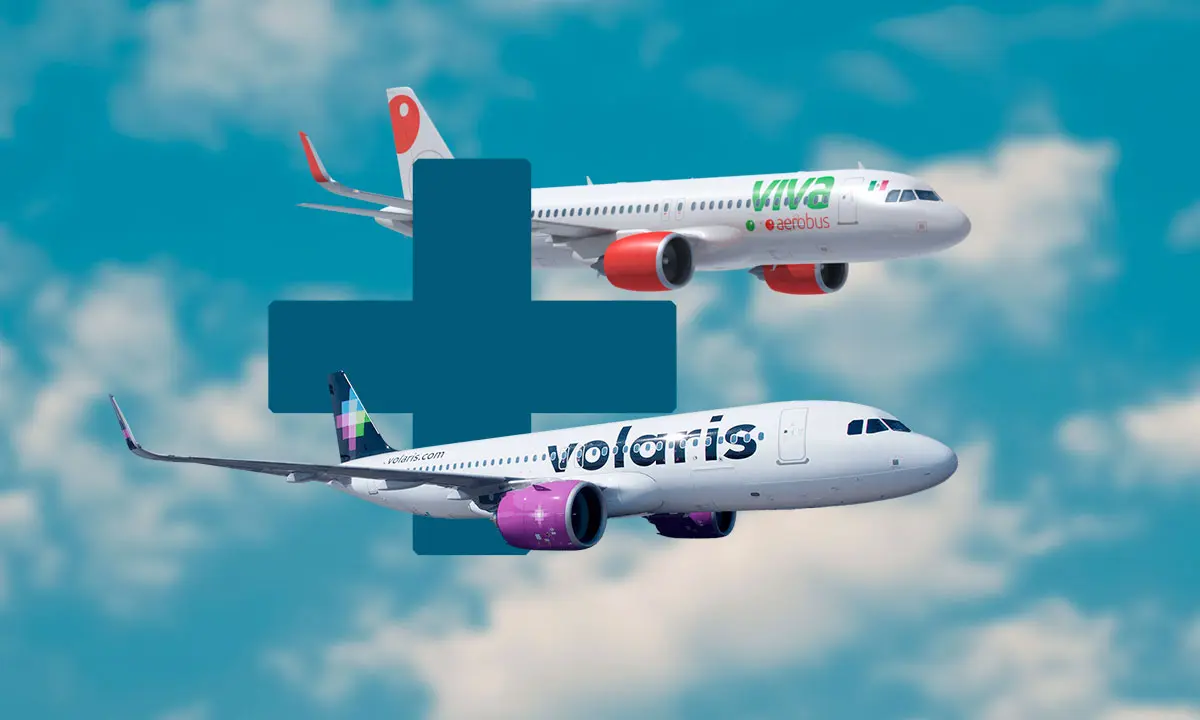
The integration of Viva Aerobus and Volaris into the Más Flights Group seeks to stabilize the market through operational efficiencies that mitigate the increase in global costs, ensuring the continuity of the low-cost model in the face of a market concentration of 74%.
You may also be interested in: Profitability of Banco del Bienestar falls and claims escalate 61%
Historically, air transportation in Mexican territory represented an exclusive service for segments with high purchasing power. The emergence of low-cost airlines transformed this dynamic, allowing the price of an airline ticket to compete directly with passenger bus fares. This democratization of the air made it easier for millions of users to access agile mobility. However, after almost two decades of expansion, this model is going through a structural shake-up. The possible merger between Viva Aerobus and Volaris not only implies a reconfiguration of the national air map, but also redefines the accessibility of economic flights in an environment where the two main forces in the sector intend to operate under the same corporate entity.
Impact of integration on the national price structure
The formation of the Más Viajes Group would give rise to a dominant player with control over almost three quarters of air traffic in Mexico. Under this scheme, Aeroméxico would position itself as the only large-scale competitor, which has generated warnings among sector specialists. Economic theory and industry analysis suggest that less competition typically provides wider margins for upward rate adjustments.
Despite the risks, the financial nature of low-cost airlines explains the urgency of this alliance:
- Extremely low profit margins that, in critical periods, lead to losses for each ticket sold.
- Imperative need to reduce operating costs through economies of scale.
- Strengthened negotiation capacity for fuel acquisition and fleet renewal.
- Strategic route optimization to eliminate operational redundancies.
Although these efficiencies could, in theory, keep prices low, the absence of regulatory guarantees maintains uncertainty about the final cost to the user.
Risk factors and inflationary pressure in the sector
The fear of a price escalation does not reside solely in market concentration, but in external variables that currently put pressure on the profitability of airlines. Fuel, which represents up to 33% of total operating costs, is extremely sensitive to geopolitical volatility. Conflicts in the Middle East and the blockade of strategic sea routes, such as the Strait of Hormuz, have made energy supplies more expensive.
Added to this are technical complications in engines that have forced aircraft to be grounded and a demand for travel that continues to grow. In this scenario, fare adjustment could occur organically due to the cost structure, regardless of the airlines’ willingness to remain competitive. Specialists agree that, although less competition is not a direct synonym of higher prices, it does increase consumer vulnerability.
Evolution and limits of the Low Cost model
The rise of economic aviation in Mexico tripled the number of domestic passengers in less than twenty years, basing its success on a high-volume strategy: full aircraft with low-entry tickets. However, factors such as the saturation of key routes and the absence of new domestic markets have placed a ceiling on this growth. The industry is now in a consolidation phase, where survival depends on more robust corporate structures capable of withstanding an increasingly onerous financial environment.
Determinant variables for the passenger experience
The outcome of this merger and its real effect on the pockets of Mexicans depend on a matrix of critical factors:
- Opinions and conditions imposed by regulatory authorities.
- Commercial aggressiveness of Aeroméxico to retain market share.
- Possibility of entry of new operators that challenge the de facto duopoly.
- Behavior of macroeconomic indicators and global input costs.
In an optimistic scenario, operational synergy will shield current rates; Otherwise, the market could face the closure of the era of budget flights in the country.
Strategic objectives of the Viva-Volaris alliance
The integration proposal is under a rigorous review process by regulatory bodies in Mexico, the United States and Colombia. The new consortium will operate a combined fleet of more than 250 aircraft, which represents a solid source of income with high investment capacity.
Key strategies of the new entity:
- Expansion of coverage: Increase in frequencies on national routes and strengthening of the cross-border market with the United States.
- Economy of scale: Obtaining better financial conditions for the purchase of aircraft.
- Operational efficiency: Reduction of fixed expenses to improve profit margins without abandoning the volume strategy.
Enrique Beltranena, general director of Volaris, maintains that low prices are the engine of growth in a market with low penetration like Mexico. For his part, Juan Carlos Zuazua, director of Viva Aerobus, emphasizes that the group’s growth will be strictly aligned with demand, which should ensure sustained growth under the low-cost scheme.