In Buenos Aires there are theater schools. And there are places that, in addition to teaching, produce scenes, put together groups and push much of the liveliest of the off. Defenders of Bravard Theater —founded by Matías Feldman and Santiago Gobernori— is one of those.
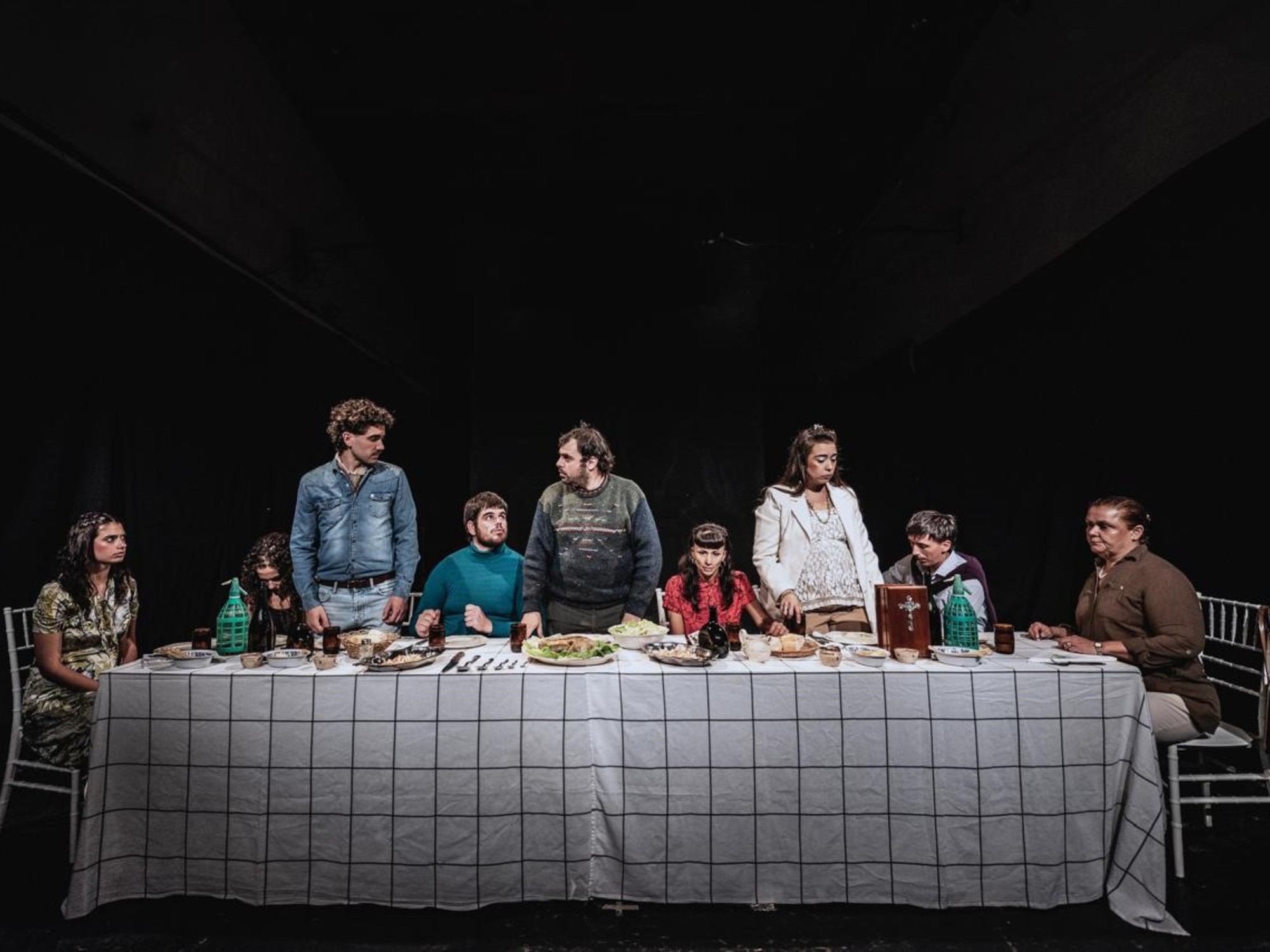
From there it comes Smells like Teen Spirit: a long table, nine people and a meeting that becomes tense until it breaks.
A long table and a family about to break up
Long, horizontal table. Nine. A meeting at a party. It matters little which one: Smells like Teen Spirit avoid the easy metaphor. It’s enough to put a family on stage and let the tension do the rest.
 In *Smells like teen spirit*, the family table also organizes roles and tensions.
Is everything very Argentine? Better: everything is very close. The work could take place in Temperley, on the outskirts of Rosario or in any periphery where a family sets up its (scene): meeting, custom, friction, hierarchies and small violence that does not need to be explained because as soon as they appear, they are recognized.
Bustle as a form
It begins as a battle of dialogues, something like a family “oratorio”, a cappella. And it works. The work quickly finds a magnetic rhythm in that murmur that first seems like pure disorder and then reveals remarkable precision. Everyone talks, everyone steps on each other, everyone occupies and fights for air. But the scene does not break: on the contrary, it finds its breath there.
“We call that beginning hustle and bustle,” says director Matías Feldman. That chaos, he explains, was worked “with a lot of repetition” until it became “a precise, exact score.” And he adds an idea that defines the work well: “Everything important happens at the same time. The viewer has to decide what to see and they are going to miss something.”
The table that orders and expels
Noise, disorder, bustle are not a defect or a rarity. They are part of the story.
And then the thing—the house—gets messy without becoming neat. There are dialogues, three talking or four in the background, others that are not seen and leave the field. The table changes. It is no longer just the place where you eat or talk: now organizes the scene and also the links.
 Smells like teen spirit* brings family unrest to the foreground.
The broken table: create combinations. Alliances, positions, proximity change. Someone is always left out. That is one of the most sharp findings of the work: from “The Geometry of Love”, Cheever’s great story, to the geometry of a family, naked and out of frame.
The tenth character, the extra dish
Smells like Teen Spirit It advances its plot by addition and subtraction. Also for an absence. Or better: for someone who is missing, but puts everything in order.
“There’s a tenth character,” Feldman says. “At the beginning of the play the dishes are counted and there is one too many.” This absence, he explains, becomes a constant presence in all the characters and pushes the strongest engine of the story: the one that drives the confessions, the crying and a final transformation that, perhaps, also dialogues with that background.
The (c)olor of a family
Costumes and color also count. There is the mother’s brown nailed to one end; the embroidery—yes, of course, that sweatshirt crossed over the shoulders—the type that doesn’t finish saying; the transparent blue of the invisible guest and possible gay couple, who keeps his voice until the end; the red, between melodrama and wound, that cries. Places at that table are also set up and disassembled by color.
When some wander into the kitchen—the real one and the other, that of a family intern—the image is cleaned. And then one of the strangest and most beautiful powers of the work appears: at times it has something of a tableau vivant, as if a photo of Marcos López were set in motion around a family table.
From Bravard to the table
The play is written by those who perform it and that closeness between text and character gives it thickness.
“The actor knows a lot about his character,” says Feldman. “He built it from the inside, with a privileged vision of his previous history, of what he receives and what he remains silent about.” That logic comes from Bravard, where acting and dramaturgy work together and many scenes come from the actors themselves.
Kurt Cobain and the absent
The title opens another door. According to director Matías Feldman, it appeared when the work was almost assembled, from the obsessive repetition of Nirvana by one of the characters. “We know how Kurt Cobain ends up,” he says. With that image several layers enter: adolescence, the ghost, the spirit, the smell of something that is still there. “It smells like teenage spirit, but it also smells like the spirit of someone who is not there,” he summarizes.
Feldman directs and Santiago Gobernori supervises. They are both playwrights, directors and actors and are part of the core of Teatro Defensores de Bravard. In Feldman’s tour they appear The translationin the Cervantes; Buenos Aires Scenic and Testing Project: The hyperlink (Exhibit 7). In Gobernori’s, playwriting, acting, the Young Art Biennial and the co-foundation of Bravard.
They also sit at that table Secrets and liesby Mike Leigh and Family holidaysby Jodie Foster: not as a quote, but because of that way of looking at tense bonds, where what is said weighs as much as what remains in suspense.
With performances at Teatro Bravard, Smells of Teenage Spirit invites you to enter a meeting that is already underway: voices that are stepped on, places that change, someone who is always left out. The title points to a sNirvana superclassic. The work touches it in its own way. And, in the process, it strikes a less obvious chord.