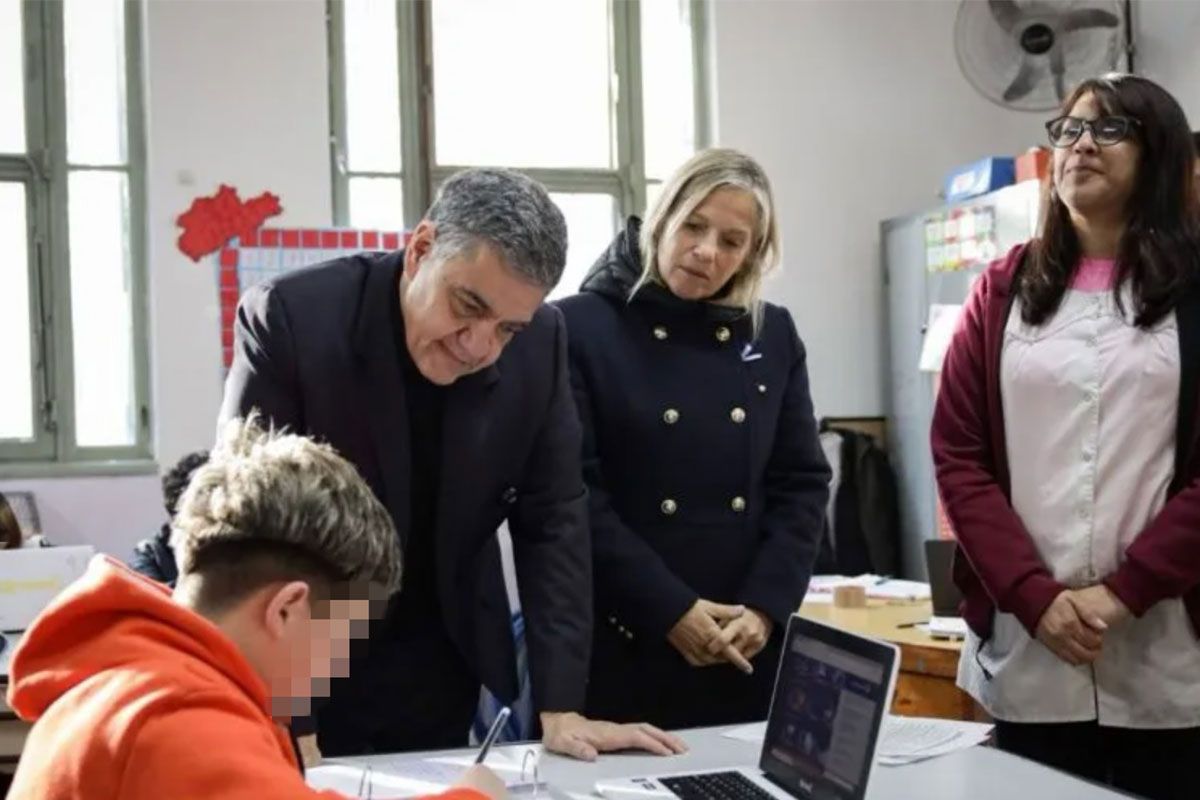
The first month of classes in the City of Buenos Aires was marked by two announcements from Jorge Macri’s government: the arrival of Google Gemini (Generative AI) at the primary and secondary level as a State policy and the proposal for “cell phone-free classrooms.” What at first glance seems like a contradiction condenses a debate that has shaken educational communities for years. What to do with technology at school?
In 2010, Conectar Igualdad was launched, a pioneering program that provided computers and technological equipment to Argentine secondary schools and which the government of Javier Milei discontinued. The objective was to promote access to connectivity to narrow the digital divide. Today, inequalities persist – in four out of every ten Argentine homes there is not even a computer – but new questions also emerge. That digital territory that contained a democratizing promise became a terrain monopolized by large technology corporations that determine what hundreds of thousands of children and adolescents consume daily. And they dispute their lifespan.
Santiago Stura is communication coordinator of the organization Faro Digital, which carries out workshops, campaigns, research and content on the subject. In dialogue with Time states that a challenge is to reconstruct chronological authority: “We need to know more about the functioning of platforms in digital territories to provide a robust discussion between school and the adult world about at what age each screen, platform and content.” This implies, in his opinion, “not being dazzled by a fetishistic view of technology and thinking that the best thing is the introduction of Artificial Intelligence at any age.” Conversely, one should not be scandalized “and believe that what needs to be done is to completely remove technology from schools.”
Cognitive impairment?
At the opening of CABA sessions, the head of Government announced that the City “is the first in Latin America to internationally accredit more than 7 thousand teachers in Google Gemini and guarantee access to Artificial Intelligence tools for all primary and secondary students.” The Minister of Education Mercedes de Miguel clarified that it is introduced in the last years of basic education in a gradual, guided manner and with written protocols for each teacher.
Alan Daitch, tech entrepreneur and AI specialist, pointed out in “Researchers call it ‘cognitive debt.’ The more you delegate, the less you get back.”
Diego Rubini is a teacher in public schools in CABA and took one of the Gemini courses. He maintains that AI can be very powerful for teaching planning. He uses it as an assistant to put together different proposals, based on the same content, according to the students’ level of knowledge. However, AI makes mistakes. And only those who have studied the subject before can identify them.
“That’s what primary school kids can’t do. In general terms, kids want to get rid of the work under the premise that ‘nothing happens later’. The temptation to use AI is very great. Even more so if there is no family behind encouraging them to think for themselves. Some did it even when I prohibited them from doing so, I explained why and gave them sources to answer the questions,” he tells Time.
Carina Lion, doctor in Education and technology specialist, believes that denying AI is not an option if we think about the future of children and adolescents. He explains that, from a linguistic point of view, we must put the magnifying glass on the limit between cognitive deterioration and a reasoning process that makes the decisions of students and teachers transparent. For example, what prompt was written, what the tool answered and what was done with it. The important thing, the expert insists, is that there is relevant teaching mediation, which allows the construction of knowledge.
“Can cognitive poverty or impoverishment be generated? Yes, if we do not think carefully about what we delegate to these tools. If we delegate synthesis and analysis, those capacities are lost,” he reflects. And he adds: “Generative artificial intelligence does not reason, predict, work on the basis of models and patterns. Instead, critical thinking must continue to be required from students.”
Free of cell phones and after
The other measure under consideration is the strict prohibition of the use of cell phones in the classroom, a path that the GCBA began in mid-2024. De Miguel’s management aims to use the technological equipment of schools over personal devices. In this way, a fairly widespread claim is collected in the teaching community.
“I think the measure is going in the right direction. Since progress was made along these lines, there has been a real positive impact. One sees in the classroom that it is easier to achieve a classroom climate without a cell phone. Students concentrate more,” describes Manuel Díaz, a History teacher in public schools in the City. Their analysis coincides with the results published by the GCBA: seven out of ten primary school students and six out of ten secondary school students said they pay more attention without
the device.
However, for the teacher, there is a lack of other complementary policies so that the implementation does not remain “half-finished” and access to study materials is guaranteed: “If not, a latent inequality between schools and areas of the city deepens. In many institutions, families do not
They have the economic possibility of paying for the purchase of a manual, book or photocopy booklet. There are no printers either. For this reason, we teachers resort to the cell phone that all the kids have.”
Díaz points out that, sometimes, the City Government’s announcements are very far from the reality of the classrooms: “In one of the schools where I work in Villa Lugano, classes have not started because we are in construction. We have Google Gemini, but we don’t have water.”
Furthermore, he insists that there is a lack of a sports, artistic and cultural offer policy so that teenagers do not spend hours scrolling when they leave school. The closure of youth orchestras such as Violeta Parra in Villa 21-24 and the “Virgen de Itatí” in Parque Chacabuco goes in the opposite direction. «
Photo: KENZO TRIBOUILLARD / AFP
Google in CABA and the government of education
What does the agreement between the City Government and Google Gemini imply? Will the data be used to train language models? Who guarantees its protection? What is the cost of this hiring? Time He consulted the Ministry of Education of CABA, but received no response.
Cecilia Rikap, author of the book Digital dependency theorywarns that it is “a foreign technology, adopted behind closed doors and provided by one of the largest companies in the world that has enormous capacity to govern and impose taxes on other States.” The term “government” is not an exaggeration: they are a few corporations that “govern in a completely undemocratic way and now they are also going to govern how children in schools are educated and how they think.”
There is a precedent: the Google School promoted by Macri when he was Vicente López’s mayor. Lion emphasizes that it is not only a digital dependence in cognitive and emotional terms, but also political: “These companies have shared the cloud and control the data and ideas. Because there is another problem in terms of sovereignty: whose ideas are when co-produced with Artificial Intelligence.” It is conclusive: big technology companies not only win with the City Government’s contract with Gemini, “but they also gain customers for life because these boys and girls will not know how to live and how to carry out their daily tasks without AI.” He says that the States of peripheral countries should cut ties with these large companies. The question is whether the conditions are in place to develop our own technological tools, with a view to the future.