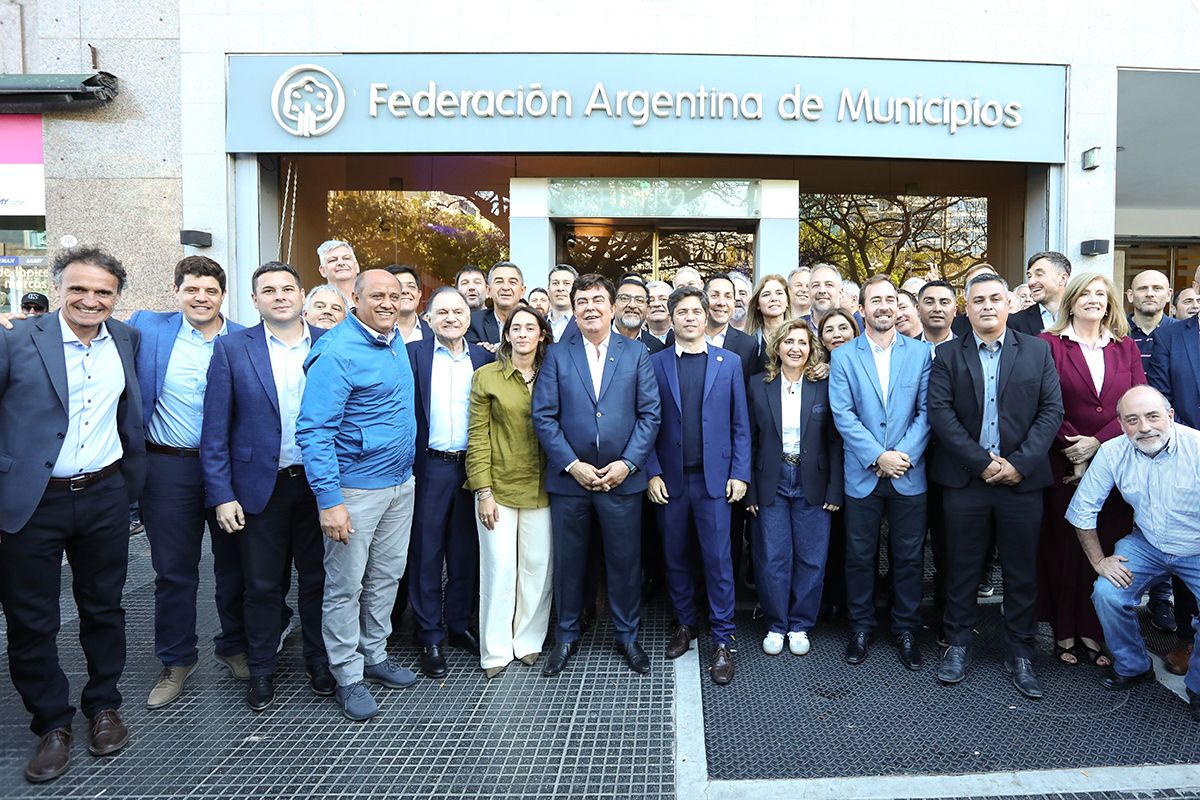
Summoned by the Argentine Federation of Municipalities and with strong support from the government of the province of Buenos Aires, inTenders from different parts of the country, accompanied by front-line provincial officials, plan this Tuesday to make a presentation at the entry table of the Ministry of Economy, with a complaint to Minister Luis Caputo for the cut of national funds to communal administrations.
Although both mayors and provincial officials were careful when disseminating the fine details of the presentation, Yes, it was announced what the central axes will be: a request to roll back the price of fuel to March 1, the claim for paralyzed national public works, and also for the general cut of national funds to municipalities.
In this line, the Minister of Government of the province of Buenos Aires, Carlos Biancoannounced this Monday that Governor Axel Kicillof plans to meet with the community leaders at the FAM headquarters, in Cerrito 800, Capital Federal, after the mayors carry out the presentation at the Ministry of Economy.
The FAM meets periodically, But according to Federation sources, the decision to mobilize the Economy gained strength in recent weeks following the push of its president, the mayor of La Matanza Fernando Espinoza. “What we are experiencing today in the neighborhoods is unprecedented, and Fernando was the first to read that there is no longer room for passive diagnoses. He has the thermometer of what is happening in the Conurbano, but in the video call we made it was clear that the interior is just as suffocated,” a FAM source confided to Tiempo.
“He was the one synthesized the widespread indignation by pointing out that the national government collected 3.5 billion pesos for the Fuel Taxbut it is not using them either to lower the price of gasoline or diesel, or to carry out road works,” he added. Added to this situation, the source pointed out, is the food emergency, the systematic destruction of SMEs, the “enormous” loss of jobs and the growing precariousness of the jobs that still survive.
ANDThis reading is shared at the Instituto Argentina Grande (IAG), the study center made up of the technical teams of the current Buenos Aires Minister of Infrastructure, Gabriel Katopodis.
According to this Institute, in the accumulated two years and four months of management, the current national government It has collected 6.1 billion pesos through taxes that were not executed for infrastructure works, as established by national legislation.
This amount is made up of 3.1 billion pesos from the former PAIS tax, and 3 billion pesos derived from the Liquid Fuels Tax. The IAG puts the magnifying glass on this tax: 28.5% of what is collected per liter of fuel must be allocated to the Transport Infrastructure Trust. In turn, 50% of this collection corresponds to road works (SISVIAL) and 4.31% to the Water Infrastructure Trust.
The other side of the same coin is the fuel increases in Argentina. From November 2023 to April 2026, the report states, gasoline increased by 542%, while inflation increased by 292% and private sector salaries registered a 288% increase. The price of fuel has increased by 24% so far this year and is expected to rise again starting May 1. “There is a drop in revenue, but taxes continue to rise,” they point out.
The There are several detailed reasons for this increase, such as the decision of the national government to eliminate the so-called “criollo barrel”.“and link local prices to international prices, as well as increase the Tax on Liquid Fuels. Although the conflict in Iran is an important factor in the energy crisis and the increase in the price of oil, the report notes, for example, that “today an Argentine pays, on average, USD 1.42 for each liter of gasoline, while an American pays USD 1.09 and a Brazilian, USD 1.31.”
National problem, from Ushuaia to La Quiaca
The problem is felt in almost all municipal administrations in the country, with adjustment processes in various areas and with fewer services for residents. The communal containment network is weakened. From Jujuy, the mayor of La Quiaca, Dante Velázquez, detailed to Time: “Throughout the great north, throughout Argentina, the municipalities are maintaining social peace with resources that are increasingly weaker. Our neighbors, with great effort, pay VAT and federal taxes like any Argentine, which do not return in programs or assistance. Today we have households in debt for the equivalent of six salaries, salaries that are not enough. Thus, federalism is not possible: there is concentration at the top and emergency at the bottom. That is why we ask for three very specific things: more municipal autonomy, a fair resource distribution scheme and an urgent plan for social debt relief and food security.”
Along these lines, the Jujuy communal chief reaffirmed: “That is why this Tuesday the 14th, the mayors marched with a message for President Milei, a message of love for the public, to deepen a more present State, with more respect, more solidarity and unity of all Argentines. Because we are kilometer 0, the first door that is touched, the unrestricted defense of sovereignty. We don’t beg. “We manage, we understand politics as the true transformation of people, even more so in times of crisis.”
Buenos Aires: first payment of the Emergency Fund
This Monday, at a press conference, the Government Minister Buenos Aires Carlos Bianco announced that the Buenos Aires administration transferred 13,010 million pesos to the 135 Buenos Aires municipalities last Friday, April 10, thus complying with the provisions of Law No. 15,561, more precisely with the first disbursement of the Emergency Fund and Strengthening Municipal Investment.
The amount was transferred to the Buenos Aires municipalities according to the Single Distribution Coefficient (CUD). These are non-refundable and freely available resources, associated with the first placement of bonds carried out by the Province in the local market in accordance with Law 15,561.
The Buenos Aires government highlighted the compliance with this payment and the joint work with the municipalities, but warned about the complex fiscal context that the province of Buenos Aires is going through as a result of the cut in non-automatic transfers by the national government and the “brutal” drop in collection.