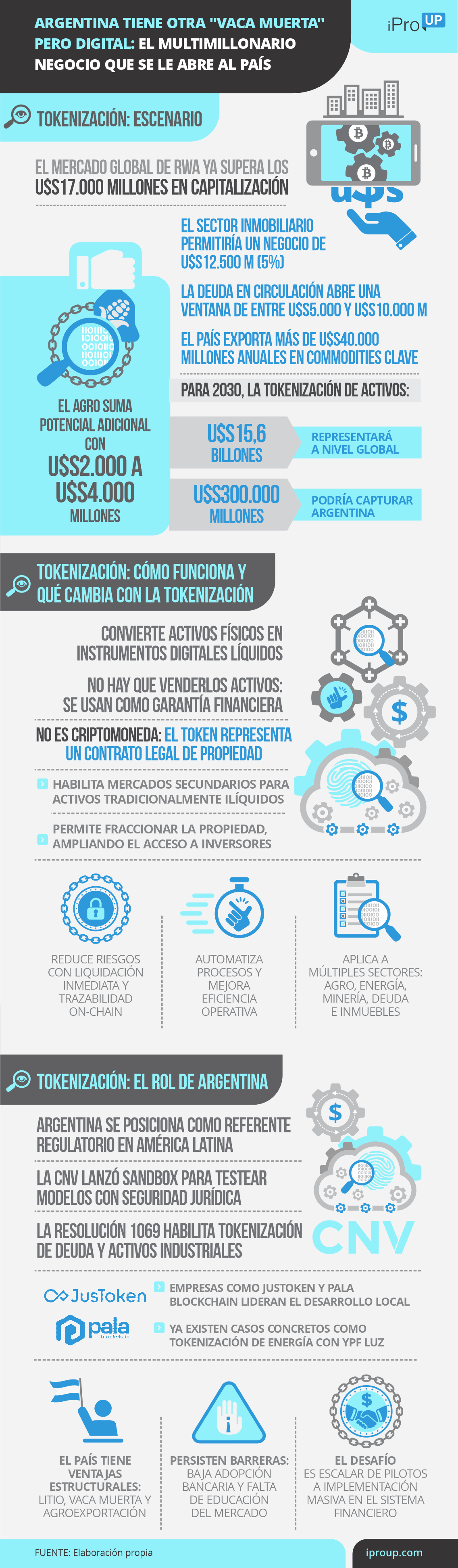
The real-world assets (RWA) ecosystem reached a point of maturity by exceeding $17 billion in capitalization active globally during April.
In Argentina, this model is presented as an alternative to channel investments in a context of exchange restrictions and volatility. The figures are promising:
- The real estate market is valued at more than US$250,000 million. Tokenizing 5% would imply a business of US$12,500 M
- The debt market exceeds US$100,000 million in circulation. Another US$5,000 million can be added to the US$10,000 million
- The country exports more than US$40,000 million annually in soybeans, corn and wheat. The digitization of export contracts or flows adds US$2,000 and US$4,000 million
In addition, Argentina positioned itself as a regulatory benchmark in Latin America after the CNV launched key regulations in 2025.: test environments (sandbox) regulatory to explore and provide legal security to this sector.
Asset tokenization: the business in Argentina
One of the firms that advanced is Justoken, a company that transforms raw materials and energy into liquid digital assets on the blockchain.. It is already the third largest commodity tokenizer in the world, with US$1.7 billion. Ariel Scalitier, CTO and co-founder, reveals to iProUP They expect to end the year with US$3 billion in tokenized assets.
According to the executive, the trend is growing because “allows the generation of new business models with real assets: secondary market, guarantees with better attributes and new forms of financing. In addition, it provides advantages from the operational point linked to the digitalization and automation of processes.”
Pala Blockchain is another of the big players. Rodolfo Vigliano, its CEO, highlights iProUP that the central advantage lies in “converting a ‘dormant’ physical asset into operational financial collateral without having to sell it.”
The new digital ‘Vaca Muerta’
“Today, an agricultural producer with 1,000 tons of soybeans in a silo, valued at US$350,000, can obtain liquidity without selling his grain. nor resort to credits with personal or mortgage guarantees. The deposit contract is digitized in blockchain and is presented to a bank as support to access a loan,” he exemplifies.
The technical key is that the token does not function as a cryptocurrency: it is the digital container of a contract, with rights and obligations. The same principle will apply to energy and mining: any physical asset whose existence can be certified by an “oracle” (depot, plant, concession or certifying entity). can be transformed into a digitalized contract that operates as a financial guarantee.
Rafael Ambrosi, CEO of Twin Finance, indicates that tokenization is a reengineering of real asset markets. In addition to the liquidity of “traditionally illiquid assets”, he highlights other advantages: “Fractionation opens the door to more investors“Immediate settlement reduces counterparty risks and programmable traceability is key in sectors such as agriculture and energy.”
Asset Tokenization: Vaca Muerta and Lithium
Various projections show the potential of tokenization:
- According to the Argentine Fintech Chamber and other estimates, it will grow 26 times by 2030 globally, up to US$15.6 trillion, against US$600,000 M in 2023
- Argentina can reach US$300,000 million by thenconsidering the possibility of tokenizing real estate, commodities, sovereign debt and export flows
The country’s opportunity is immense. Scaliter argues that Argentina needs to “finance large infrastructure projects“, be competitive, facilitate the management and decentralization of contracts, digitize documentation, create new businesses, products and services, facilitate access to large and small investors.”
It also advances great potential in energy, oil and gas, as in the case of YPF Lightthe world’s largest energy tokenization project. The oil company and Justoken sealed an alliance to launch Enertoken and bring energy assets to the XRP Ledger public blockchain, with an initial value of US$800 million.
Regarding the potential in niches such as lithium or Vaca Muerta, Vigliano maintains that traditionally they need a “massive investment” and traditional financing mechanisms (bank credit, debt issuance, equity) are “slow, expensive and concentrated.”
Instead, he states, tokenization allows “to digitize contracts on future production or resources already extracted, to use them as collateral before financial entities and the capital market, without the asset having to be sold or the producer losing profitability”.
“Argentina has the world’s third largest lithium reserve and a key hub in Vaca Muerta, together with a legal framework that allows operating both through the civil code and the negotiable securities regime. The technological infrastructure already exists: what is missing is for financial entities to be encouraged by the first pilot,” he anticipates.
De Ambrosi adds that traceability on-chain provides transparency and auditability, aligning with responsible investment criteria and attracting capital. “This makes it possible to convert concessions and reserves into negotiable instruments, use them as collateral to access international liquidity and create secondary markets that have not existed until now.”
Asset Tokenization: What’s Next
Resolution 1069 of the CNV in the country provides the legal framework for companies to begin issue debt and tokenize industrial assets with legal certainty, connecting the real economy with the liquidity of the crypto market.
This competitive advantage attracted the attention of global developers who see the country as an ideal laboratory to test “TradFi 2.0” solutions. which are then replicated in other emerging markets. However, many are still not convinced how these types of projects are supported.
“The same controls are needed as in the real world, existence and transfer tests are generated to ensure that the transfer of ownership occurs simultaneously in the real and digital worlds,” says Scalitier. Meanwhile, Vigliano warns about the lack of conceptual information: “Many still confuse tokenization with cryptocurrencies“.
“The model that works is radically different: the token is not a means of payment, it is not ‘crypto’, but rather a digitized legal document that generates a direct right over the physical asset,” he highlights.
The Twin executive details limitations, such as “the restriction of marketing to Virtual Asset Service Providers (PSAV)the inability to integrate custody with DeFi protocols, the exclusion of popular instruments (open investment pools) and a cumbersome approval process that discourages small issuers.
On the other hand, the CNV authorized a sandbox in which the tokenization of tradable securities is indirect. That is, the value must first be registered in a client account and then its digital representation must be created to respect the issuance and registration conditions defined in Capital Market Law 26,831.
“The good news is that the resolution opened the door on the side of negotiable securities and the Civil Code and Comercial now allows operating with tokenized private contracts. Both tracks regulations exist. What is missing is for more financial entities to take the first step,” adds Vigliano.
De Ambrosi believes that Argentina has strategic resources on a global scale and tokenization is a way to connect them with international capital in more competitive conditions. “The regulatory framework already exists, the challenge is to simplify its operations and educate the market so that the supply finds a demand capable of absorbing it,” he concludes.