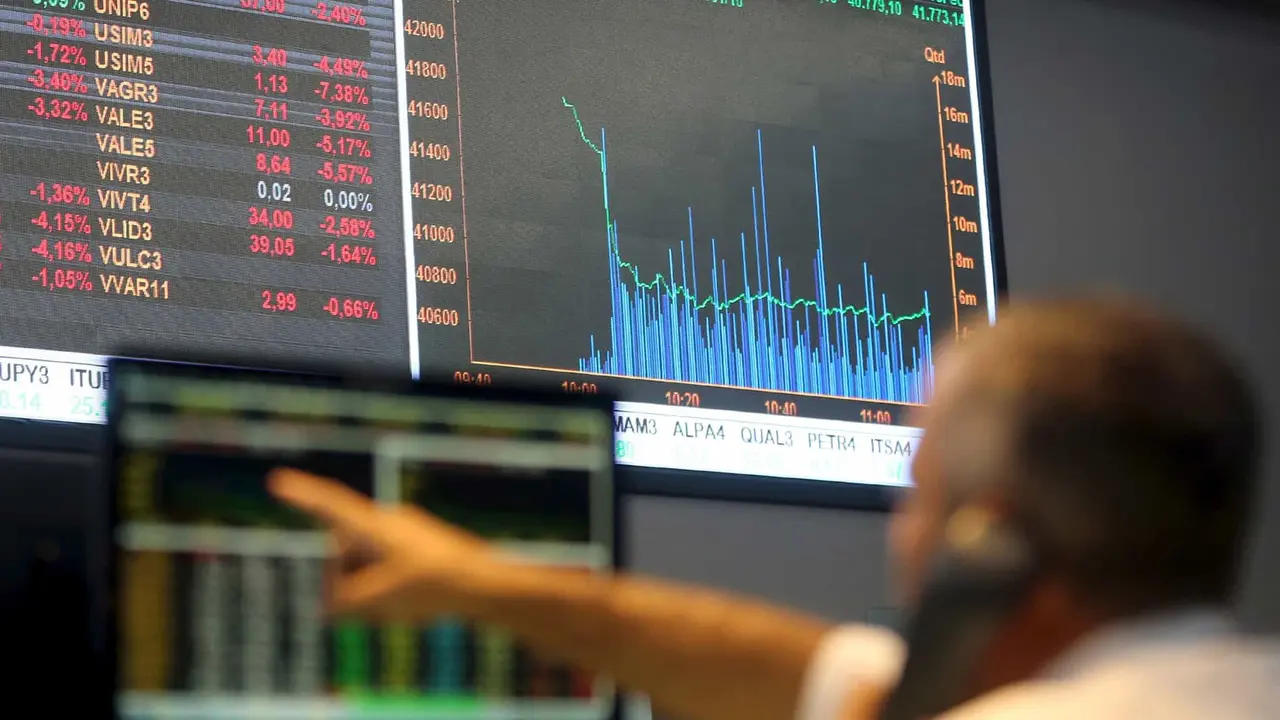
The financial markets are going through a day of contradictory signals for Argentina. Dollar bonds show increases and country risk declines. But Argentine shares listed on Wall Street register falls of up to 4.5%.
The behavior occurs in a more favorable international context. Geopolitical tensions are moderating and global investors are showing greater appetite for risk.
Local attention is focused on the March inflation data that will be published by INDEC and on the negotiations with the International Monetary Fund (IMF), two key factors that explain the caution of the stock market.
The external scenario pushes global stock markets
Global stock markets operate with a positive bias. Expectations for diplomatic progress between the United States and Iran They boost the investment mood.
Despite the fact that Washington moved forward with pressure measures, such as the blockade of Iranian ports, the market is betting on a possible resumption of dialogue in the coming days.
This scenario contributed to some moderation in oil prices. Contracts had escalated due to the risk of supply disruptions through the Strait of Hormuz.
The main stock indices show moderate advances. He S&P 500 up about 0.5%while the Nasdaq registers gains close to 1%.
In Europe and Asia, increases also predominate. Everything reflects a greater global appetite for risk, although conditioned by the evolution of the conflict in the Middle East.
Argentine bonds celebrate and country risk falls
For Argentina, this international context translates into an improvement in the price of sovereign debt.
Dollar bonds are trading on the rise, with increases of up to 1.2% headed by the longest-term securities. Investors welcome the combination of favorable external factors and expectations of progress with the IMF.
This dynamic drives a decrease in the country risk, which declines around 2.1% and is around 517 basis pointsapproaching the psychological threshold of 500 points that the market is watching closely.
The behavior of the bonds reflects confidence in the sustainability of the debt. International investors are betting that the program with the IMF will stay on track.
Argentine stocks fall without brakes on Wall Street
However, the improvement in bonds is not replicated in the equity segment. Argentine stocks listed on Wall Street show a majority of declineswith falls led by companies in the energy and financial sector.
Among the most marked setbacks are Transportadora de Gas del Sur, YPF and Central Puerto. These companies suffer the impact of uncertainty about energy prices.
Some companies such as Loma Negra, IRSA and Ternium manage to sustain moderate increases. But they are the exception in a markedly negative circle.
In the local market, the index S&P Merval also operates with a negative trend and falls around 0.9%in line with the disparate behavior of ADRs in New York.
The most pronounced declines are concentrated in energy companies. Some banks and companies linked to real estate show progress, but they are not enough to reverse the general tone.
March inflation makes the market nervous again
The internal scenario is strongly conditioned by the expectation regarding the inflation data for March. The National Institute of Statistics and Censuses (INDEC) will announce the index in the next few hours.
Private estimates place the Consumer Price Index at around 3%. This would imply a slight acceleration compared to February and would confirm the persistence of inflationary pressures.
The Minister of Economy himself, Luis Caputo, anticipated that the index will be above 3%. Although it projected a slowdown starting in April.
As Caputo explained, The increase would be linked to seasonal factors and the impact of rising oil prices. in the international context, an effect that is transferred to the entire chain of energy and transportation costs.
Even so, the Government maintains that a stage of lower inflation would begin in the coming months. The official bet is that the 3% floor has been reached and that April will show lower figures.
Market analysts warn that price behavior will continue to be a key factor in the short term. In particular, they point out that the increase in energy costs could be passed on to prices and affect both business margins and the level of economic activity.
The Government advances with a new debt tender in pesos
In parallel, the Government is advancing its financial strategy. The Ministry of Finance announced a new debt tender in pesos for maturities equivalent to $8.3 trillion.
The menu includes fixed-rate, inflation-adjustable (CER) and dollar-linked instruments. There are also redemption options for existing titles.
According to market estimates, the Treasury could achieve a placement higher than the maturities. It would be the continuity of the last successful tenders, in a context of high liquidity in pesos.
Added to this is the expectation of a possible technical agreement with the International Monetary Fund (IMF) within the framework of the second review of the current program.
If finalized, it would enable a disbursement close to US$1,000 Mwhich would reinforce reserves and contribute to sustaining financial stability. The market estimates that this announcement could arrive in the coming weeks.
Regarding the exchange rate, the official dollar remains around $1,375 at Banco Naciónwhile parallel quotes operate with limited gaps with respect to the wholesale market.
The blue dollar and the financial ones (MEP and CCL) move in a narrow range. Exchange stability is one of the pillars of the economic program that the Government seeks to preserve.
In summary, the Argentine market shows a dual dynamic: on the one hand, sovereign debt benefits from the external context and expectations of progress with the IMF; On the other hand, the actions reflect caution in the face of local uncertainty, especially around inflation and the impact of international factors on the economy.