
The Argentine financial market usually rewards those who manage to read price distortions before the rest. Today, that opportunity does not lie in short-term speculation that the Central Bank tries to stop, but in a technical arbitrage that allows conservative investors obtain returns in dollars that far exceed to those of any regional market.
The key to this maneuver lies in the value of the “exchange”: the price gap that exists between the dollar found abroad (cable) and the one operating in the local market (MEP).
Due to the current flow dynamics, the financial system is paying an extraordinary benefit to those who decide to enter their currencies into the domestic circuit, allowing an unbeatable entry point for building fixed income portfolios.
The “prize” for bringing dollars to the country
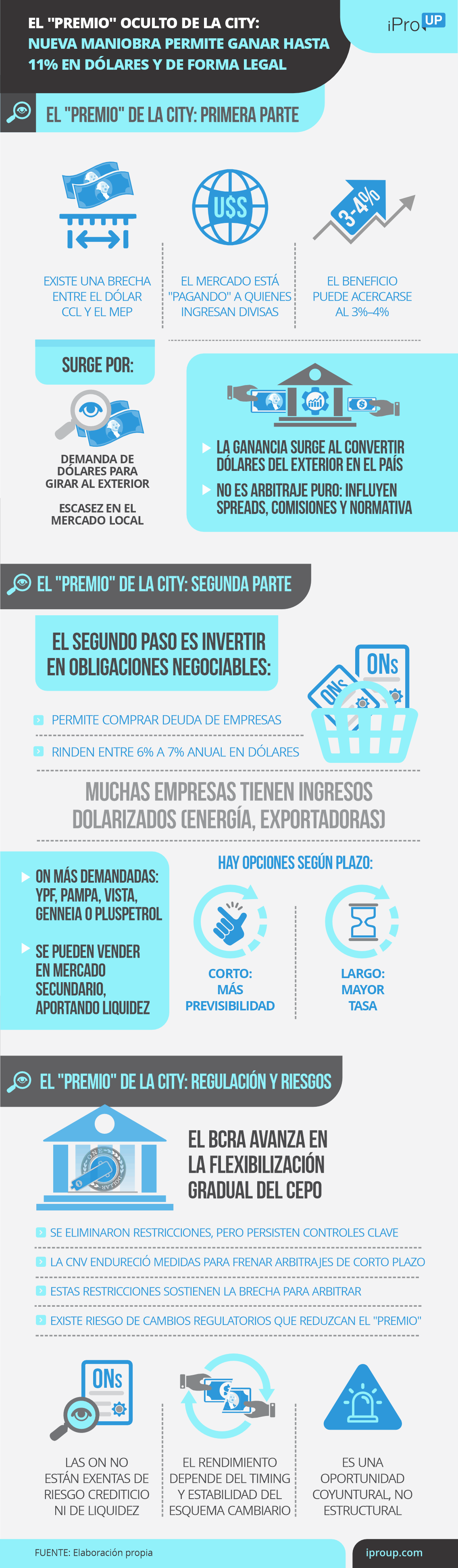
As the economist and financial advisor José Bano explains to iProUPbring dollars to the country via Cash with Settlement (CCL) currently grants the highest profit since March 2024.
This is a direct “prize” that ranges close to the 4% by the transfer operation alone.
“If you are a conservative investor, outside you can have a portfolio of bonds from Latin American companies that yield between 5% and 6%. But if you bring those dollars to build a portfolio of Negotiable Obligations (ON) here, the equation changes drastically,” says Bano in dialogue with this medium.
How the City’s ‘prize’ works to win in dollars
The mechanics are simple but powerful: due to the scarcity of physical dollars in the local market and the high demand from those seeking to transfer currency abroad, the system “rewards” those who do the opposite.
“For every US$100 that an investor transfers from an external account receives approximately US$104 to your local account immediately. That is the first step of a profit that is then enhanced by the rate,” details the expert.
Where to invest: the experts’ selection
The second step of the strategy is to place that liquidity in top-line private debt instruments.
Unlike sovereign bonds, which are subject to volatility policy and the payment capacity of the State, Negotiable Obligations (ON) allow you to bet on the solvency of companies with real cash flowsmany of them with dollarized income from exports or strategic sectors such as energy.
From Balanz They point out that corporate credit continues to be an extremely attractive alternative for conservative profiles.
Isabel Botta, Product Manager of the firm, stands out in dialogue with iProUP that in a context of rate compression, performance at levels close to 7% continues to be consistently reflected in demand.
The portfolio recommended by Balanz is based on sectors with solid fundamentals:
- Energy Sector: emissions of Pampa Energía (ON MGCRO) and of Pan American Energy (ON PN43O)both with returns close to 7% in longer tranches
- Shorter term options: For those looking for greater predictability, There are alternatives towards 2030 with slightly lower rates
- Middle Curve: opportunities in issuers such as Pluspetrol (ON PLC4O) and Genneia (ON GN49O)which allow maintaining profitability around 6.5% with a moderate duration
- Market Leaders: Demand remains strong for assets YPF (ON YM34O), IRSA (IRCPO) and Vista Energy (VSCVO)which combine credit strength and high liquidity
The regulatory scenario: flexibility and control
This window of opportunity occurs in a framework of profound regulatory changes. From Wise Capital they point out that The Central Bank (BCRA) has begun to gradually ease restrictions on foreign currency accessnormalizing operations for individuals and companies in an attempt to signal predictability.
Among the most notable measures are the elimination of the limit for card withdrawals abroad and the exception to settle foreign currency for small exporters of goods.
However, this openness coexists with a “hawk’s eye” on financial speculation.
“The organism hardened the cross controls to block financial arbitrage between the MEP dollar and the CCLseeking to neutralize short-term speculative maneuvers,” Wise warns in statements accessed by iProUP.
This strict supervision of the National Securities Commission (CNV) over the exit “roller” is, precisely, what keeps the price of the cable dollar high. and guarantees that the prize for those who deposit foreign currency remains valid.
The Government seeks to balance the gradual opening of the market with the need to preserve the accumulation of reserves.
Security and liquidity: the advantage over the “cushion”
A determining factor is the comparison between this strategy and traditional alternatives.
Unlike a property -whose liquidity is slow- or a fixed term -which usually loses against inflation-, ONs can be sold on the secondary market at any time if the investor needs the cash.
Furthermore, being assets that pay interest in “hard” dollars, they function as a perfect hedge against devaluation.
“You build a portfolio that yields 6%. So, if you entered with that 4% profit and then you have that capital yielding at that rate, after a year you end up with a total return greater than 11% in dollars“, emphasizes Bano.
While the traditional saver keeps his bills in a safe deposit box, losing purchasing power in the face of inflation in the United States, this strategy puts capital to work in the companies that today are the engine of the Argentine real economy.
It is the difference between an idle asset and a strategic investment that takes advantage of a temporary anomaly in the market to obtain a double-digit income in a completely legal and declared way.