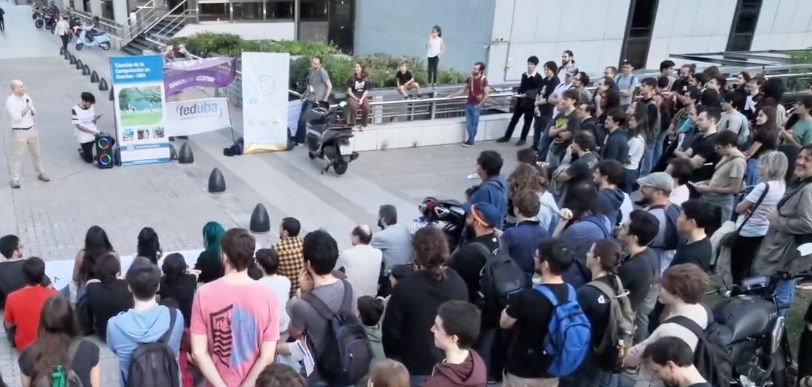
While the national government continues not to deliver the funds dictated by law (vetoed by Milei, later ratified by Congress and by Justice), and is now seeking the Court to agree with its development chainsaw, the universities continue to appeal to different modes of struggle and visibility of their claims. Along with forceful measures such as the strikes that multiplied this week, open classes are advancing throughout the country to show the community what they do, what they teach and what they are in danger with the adjustment of La Libertad Avanza. And these initiatives are involving all faculties and careers, even some identified as strategic for the future, such as computing.
“The public university generates 14,000 million dollars in the software industry, do not kill the goose that lays the golden eggs,” was the phrase left by the public class dictated in demand of compliance with the University Financing Law this Friday.
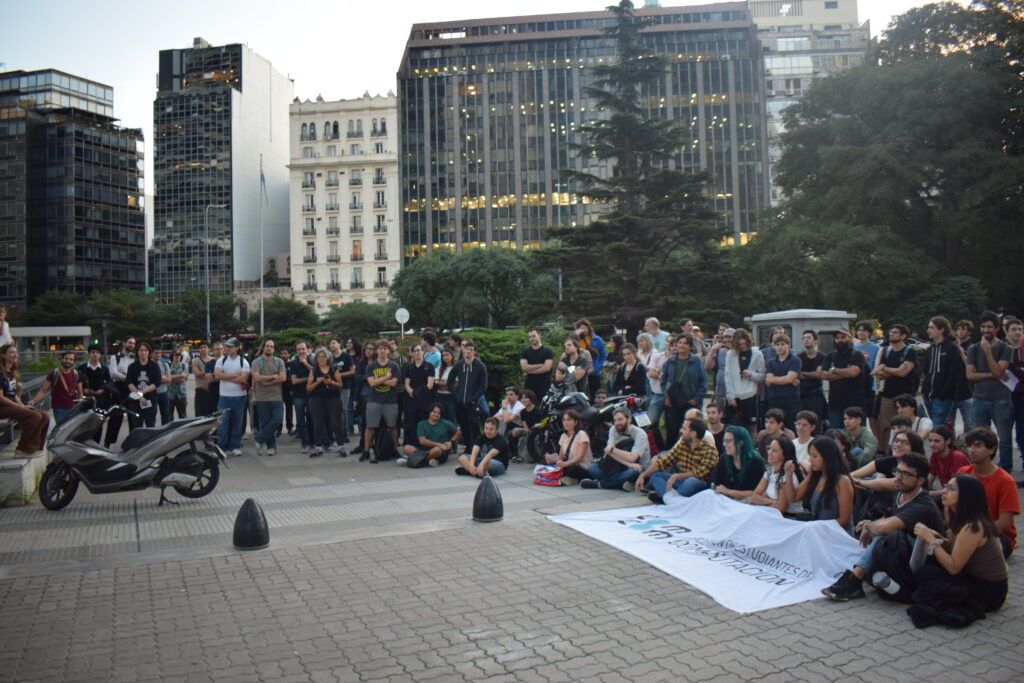
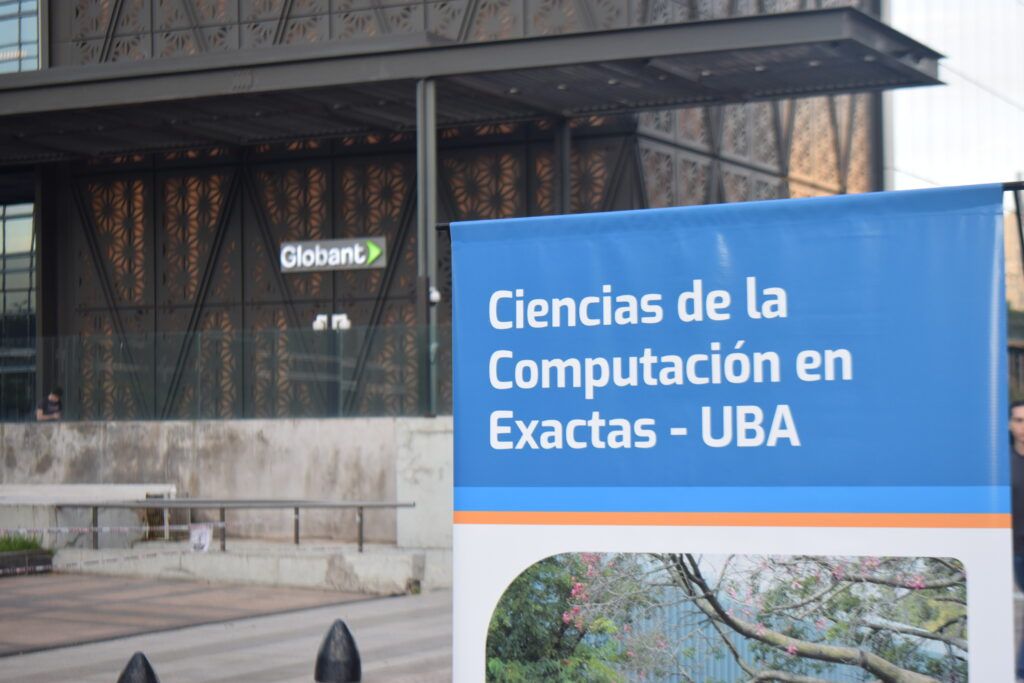
As the afternoon fell in the emblematic Torres Catalinas in downtown Buenos Aires, in front of the Globant offices, teachers and a large group of students from the Computer Science Department of the Faculty of Exact and Natural Sciences of the UBA debated the relationship between the public university and the software industry. The objective was to highlight that the serious situation that the study houses are going through also directly affects the most dynamic sectors of the economy.
They pointed out that compliance with the University Financing Law is urgent: “Not only are there no funds for research, we are also losing teachers every day and that is because salaries are in most cases below the poverty line. As an example, for a teacher to earn the same as in December 2023 adjusted for inflation, the current salary should increase by 54%.”
“Computers alone do not generate software products”
When detailing the origin of the figure of 14,000 million dollars owed to the public university, they explained that according to the most recent official data from the Argentine Chamber of Software (CESSI), during 2024 the turnover of companies in the sector reached 22,221 million dollars, while exports were around US$ 2,570 million. The same report lists 159,257 registered jobs.
The UBA teachers highlighted that it is these workers who allow the companies to make profits. “In the case of a factory, from common sense one could think that the raw material is what is necessary for the company to sell and make a profit, in the case of software it is exclusively about people putting their knowledge and ingenuity. Without computer scientists, computers alone do not generate software products,” they maintained.
And they added “The public university trains the talents that the industry needs to be able to successfully absorb the impact of disruptive technological changes, as AI represents today.”
They explained that although there is no official public data on the training of this staff, there are other sources such as periodic surveys that have very high levels of participation in the field (such as the salary survey of the sysarmy collective). In its most recent version, said survey indicates that 79% of workers in the sector have completed or ongoing university training.
Trained at a public university
“In Computer Science courses we have more and more students, but we do not have teachers to train them. There is talk about how magnificent the software industry is in Argentina and many think that this only has to do with what happens in companies, but it is a sector with a very close relationship to the training system,” says UBA professor and researcher at the UBA-CONICET Institute in Computer Sciences, Fernando Schapachnik.
“Around 80 percent of workers in the software industry study and graduate from public universities. So, the government is killing the goose that lays the golden eggs, because this industry could not have the levels of turnover it has without the talents that make up the Houses of Higher Studies.”
It offers examples of developments in the Computing career: one is the use of AI to detect reading problems. The tool allows you to transcribe recordings of students reading in one minute and evaluate how well they solved a reading task, comparing the words they pronounce with the original text. The objective is to be able to measure reading fluency, that is, the ability to read without errors, continuously and with a natural rhythm.
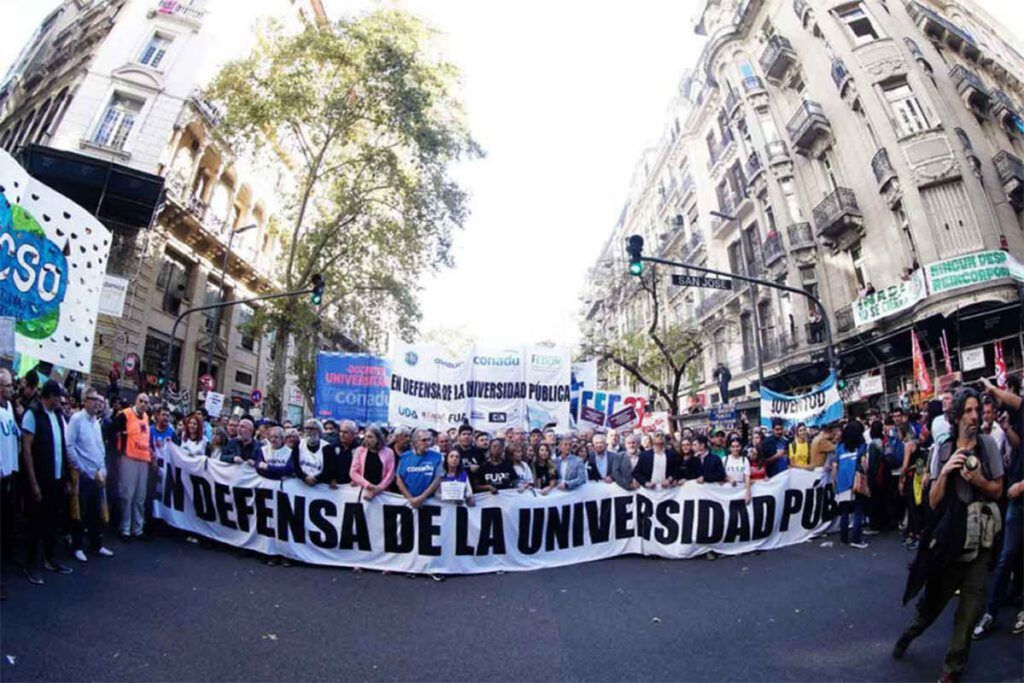
Photo: Edgardo Gómez

“The simplest way to have a measure that approximates the level of fluency is to count how many words were said correctly in one minute. From the automatic transcription, it is analyzed if there is correspondence between what was said and the text to be read and it is analyzed if each word was pronounced well. Finally, the total number of words said correctly is computed – explained Pablo Riera, researcher at the Laboratory of Applied Artificial Intelligence (LIAA, UBA-CONICET) -. A 2nd grade boy is expected to read approximately more than 50 words. correct in one minute.”
Another example is research on quantum computing: they define it as the technology “that is going to change everything after AI.” And there is also the team of researchers from the Institute of Computer Sciences that developed for Banco Provincia a tool that uses artificial intelligence techniques to show the evolution of Buenos Aires economic activity in real time. The indicator is called PBA Pulse and can simulate very short-term economic trends, helping to improve decision-making in public management.
Defunding the public university is putting the industry in check
In turn, according to data from the Secretariat of University Policies, 80.2% of Argentine university enrollment corresponds to public universities. “By conservatively combining both sources, it can be estimated that at least 63.35% of the staff of software companies in Argentina was or is being trained by the public university,” they explain during the public class.
Consequently, the training provided by the public university allows more than 14,000 million dollars a year in turnover and more than 1,600 million dollars in exports to be generated in the country’s software industry: “Defunding public universities is also putting one of the most dynamic industries in the country in check,” they say before the attentive gaze of students and passers-by.
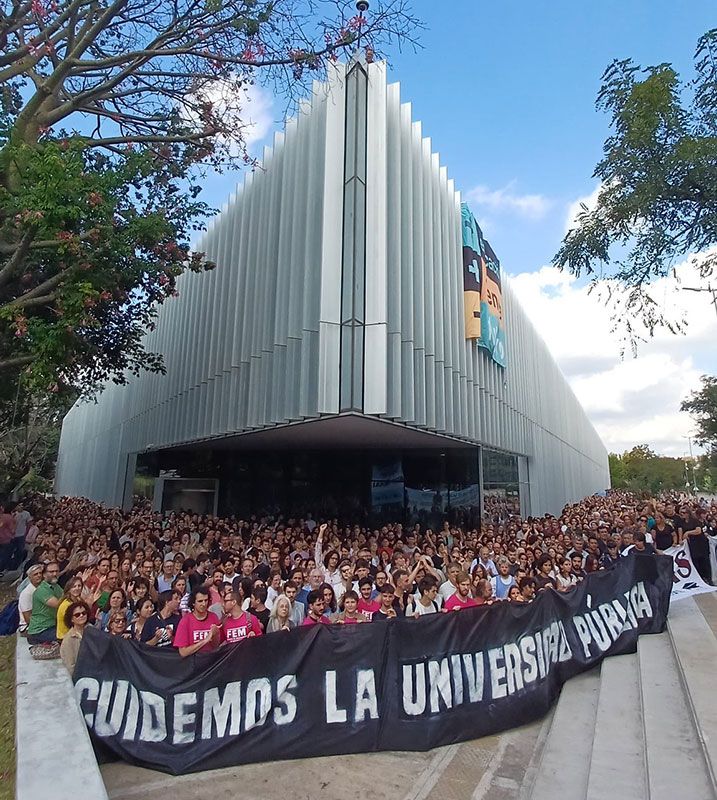
With the sun already extinguishing, teachers are concerned to point out that it is not about pointing fingers at companies but quite the opposite: pointing out that with the government’s definancing, the virtuous symbiosis between companies and public universities is endangered.
The university financing law was approved by both chambers, then insisted upon with a two-thirds majority over a presidential veto, and finally supported by Congress when an attempt was made to repeal it in the budget law: “Rarely has a law had such a level of consensus.”
And they conclude: «Even so, the government refuses to comply with it, even disobeying judicial rulings that indicate so. Without a public university there is no knowledge economy, no artificial intelligence hub, no software industry.