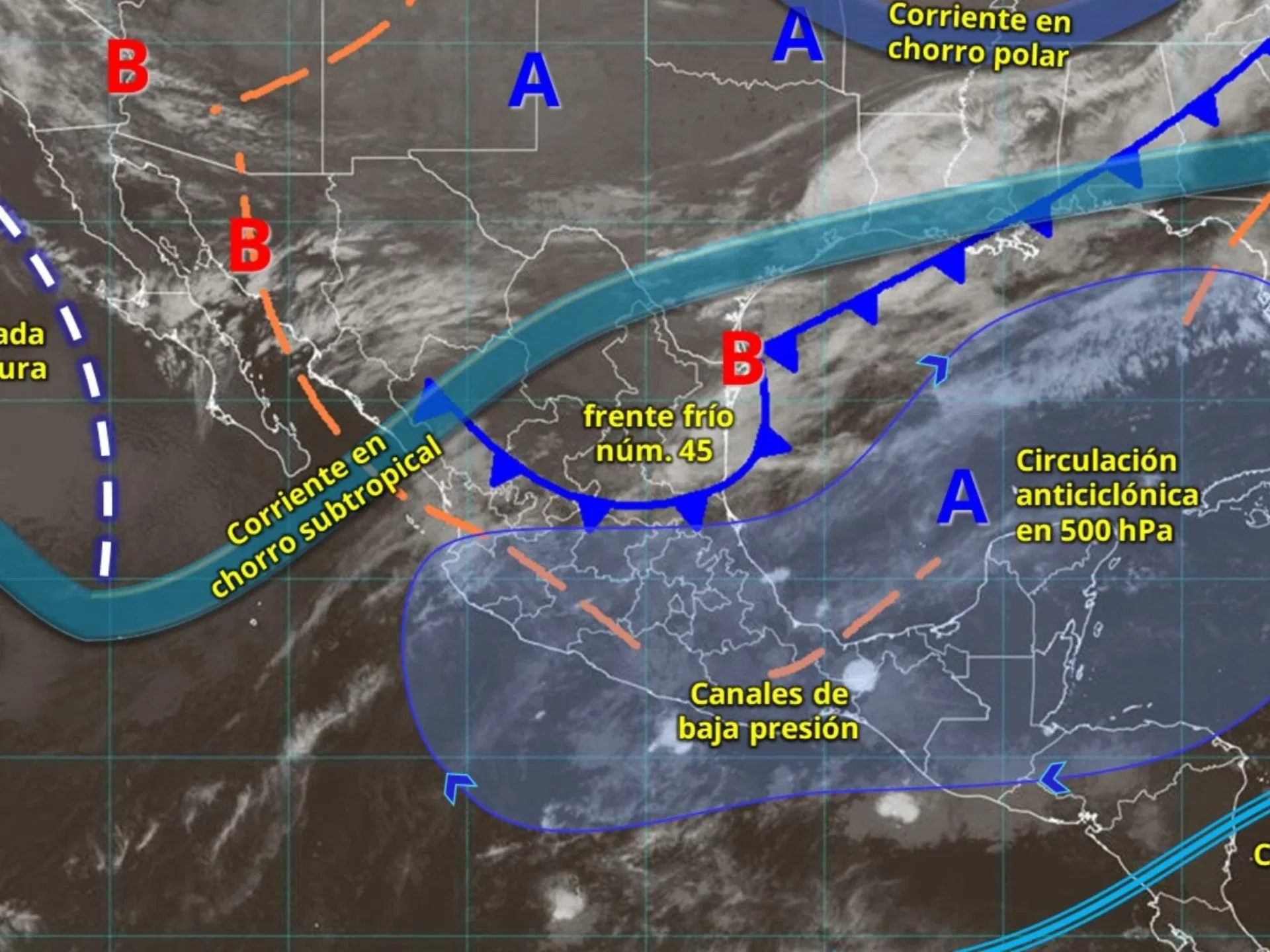
Cold front number 45 moves this Monday, April 20, 2026 towards the Gulf of Mexico, causing torrential rains in the southeast, winds of up to 80 km/h in the Isthmus of Tehuantepec and critical frosts in mountainous areas of the north and center of the country.
You may also be interested in: Are there classes on Monday, April 20? SEP confirms who does not have classes
Meteorological dynamics of cold front 45
The frontal system interacts directly with a low pressure channel and the influx of moisture from the Caribbean Sea. This combination maintains conditions of severe atmospheric instability, manifesting itself through intense precipitation and high-speed wind gusts in multiple regions of the national territory. The mass of cold air that drives the front is responsible for a marked thermal decrease in the high areas, while in the coastal areas a “North” event is established that compromises safety in maritime activities.
States with greater risk from rains and storms
The interaction of the front with the humidity of the Gulf of Mexico and the Caribbean increases the potential for flooding and flooding in specific sectors. The authorities and the population must maintain vigilance regarding the predicted precipitation accumulations:
- Chiapas and Tabasco: The most intense and torrential rains of the day are projected.
- Veracruz and Oaxaca: Forecast of very heavy rains, concentrated mainly in the mountain regions and the southern sector of the Veracruz territory.
- Logwood: Record of heavy showers accompanied by constant electrical activity.
- Yucatan and Quintana Roo: Probability of intervals of showers and isolated rains during the evening period.
SCANNING SOUTHEAST MX
Accumulated > 150mm
Chiapas / Tabascotorrential
Risk of flash flooding and overflows.
Veracruz / OaxacaVery Strong
Focus on mountain areas. Persistent rains.
Yucatan PeninsulaShowers
Evening electrical activity. North winds.
`; } } if (!customElements.get(‘weather-alert-viz’)) { customElements.define(‘weather-alert-viz’, WeatherAlertMonitor); } const init = () => { const target = document.getElementById(VIZ_ID); if (target && !target.innerHTML) { target.innerHTML = ‘
Intensity of the “North” event and strong winds
The force of the polar air mass pushes dangerous gusts of wind, especially on coastlines and transition zones. In the Isthmus and Gulf of Tehuantepec (Oaxaca and Chiapas), the gusts will reach speeds of between 60 and 80 km/h. On the coasts of Tabasco, Campeche and Yucatán, the wind will range between 40 and 60 km/h, causing a significant increase in the height of the waves. Towards the coast of Tamaulipas and Veracruz, winds from the north could register intensities of 50 to 70 km/h with waves up to 3 meters high.
Record of minimum temperatures and frosts
Although the air mass will begin to modify its thermal properties, early Monday morning presents risks due to extreme cold in the mountain areas:
- Range -5 to 0°C: Mountainous areas of Baja California, Chihuahua and Durango, with confirmed presence of frost.
- Range 0 to 5°C: High altitude areas in the State of Mexico, Puebla, Tlaxcala and Zacatecas.
The thermal contrast is severe: while the north faces frost, some areas of the Pacific and the southeast will maintain maximum temperatures of between 40 and 45 °C before the direct impact of the rains.
Detailed forecast for major cities
Monterrey, Nuevo Leon
The capital of Nuevo León will experience a start to the week with post-frontal characteristics. A minimum temperature of 12 °C is expected and a maximum temperature limited to 18 °C. The sky will remain mostly cloudy, with intermittent drizzle and dense fog banks during the first hours of the day. North winds will maintain light gusts of 15 km/h.
Mexico City (CDMX)
A day of high instability is anticipated in the metropolitan area. The thermometers will show a minimum of 11 °C and a maximum that will range between 22 and 24 °C. Cloud cover will increase, with a high probability of isolated showers and thunderstorms during the afternoon and evening. Caution is recommended due to wind gusts of up to 50 km/h in open areas and valleys.
Guadalajara, Jalisco
The west of the country is less affected by the polar mass. The capital of Jalisco will have a cool morning of 14 to 18 °C, rising to 33 °C in the afternoon. Although cloudy and clear skies will predominate, light rains or isolated showers in the urban periphery are not ruled out. The winds will remain moderate, between 10 and 15 km/h.
Impact on the Gulf of Mexico and Yucatan Peninsula
Front number 45 will extend as stationary over the southwest of the Gulf of Mexico, generating critical conditions for navigation. In Campeche Sound and the Tabasco coast, visibility will be reduced by dense fog banks.
In the Yucatán Peninsula, climate change will be gradual:
- Yucatan: Maximum temperatures of 36 °C with a “North” event on the coast and waves of up to 2 meters.
- Quintana Roo: Muggy atmosphere with highs of 32 °C and quick showers in Cancún and Playa del Carmen. Wind gusts of 50 km/h could restrict ferry crossings to Cozumel.
- Logwood: It is positioned as the most affected state in the peninsular region, with heavy rains of up to 50 mm and gusts of 60 km/h due to its proximity to the core of the frontal system.