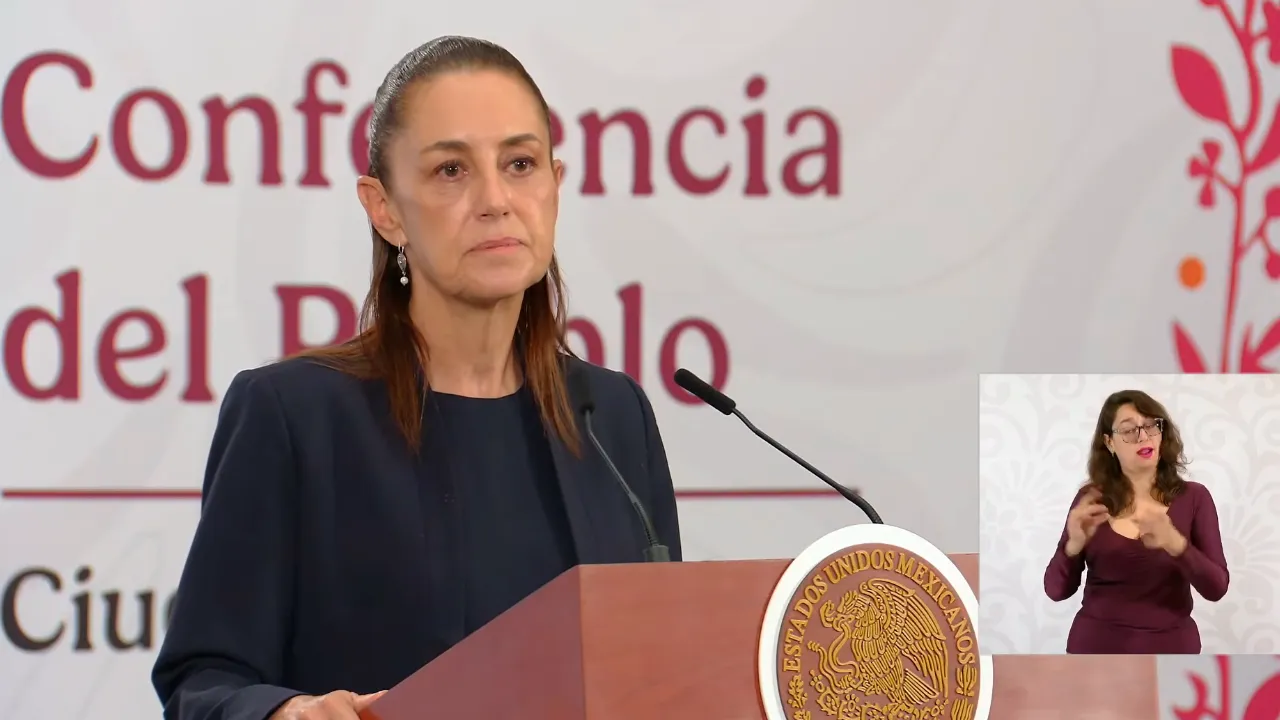
The Government of Mexico is investigating a possible violation of the National Security Law after the death of US and state officials in Chihuahua. The federal administration confirmed that there was no authorization for joint operations or coordinated presence of foreign agents with local authorities in the entity.
You may also be interested in: Sheinbaum externally supports Japan after magnitude 7.5 earthquake in the Pacific
Sovereignty crisis due to unauthorized bilateral operations
The federal administration detected a critical irregularity in the security management of the state of Chihuahua. During a transfer in Mexican territory, a vehicle carrying agents from the local prosecutor’s office and personnel from the United States Embassy suffered a fatal accident. This event revealed a direct working structure between the state government and foreign agencies that operated outside the radar of the National Security Cabinet.
The official position is decisive: the relationship with international organizations and their agents is strictly federal. No federative entity has constitutional powers to establish operational mobilization agreements with diplomatic or security personnel from other countries without prior validation from the Federation.
Axes of government research
- Protocol verification: Analysis of the framework of action of US agencies under current Mexican laws.
- Constitutional review: Evaluation of state autonomy compared to the exclusive powers of the Union in matters of foreign relations.
- Transparency request: Formal request for information from both the government of Chihuahua and the United States Embassy to clarify the reasons for the joint mobilization.
- Determination of sanctions: Legal study on possible legal consequences for the state administration for omitting notification to federal authorities.
Limits of international collaboration and territorial sovereignty
Cooperation with the United States is maintained under principles of intelligence exchange, but strictly excludes joint operations on Mexican soil or airspace. The Government of Mexico emphasized that territorial integrity and national sovereignty are the pillars that govern any interaction with foreign governments, particularly on sensitive security issues.
Although there is a relationship of courtesy and mutual support, this must be channeled through established mechanisms. The National Security Cabinet maintains direct communication with Ambassador Ronald Johnson to delve into the causes of this deployment. The immediate priority, beyond political analysis, is to guarantee that each international agency acts under the rigorous protocol that prohibits autonomous field actions or actions agreed upon with local governments.
Contrasts in the official narrative
The Chihuahua Prosecutor’s Office initially stated that there was prior knowledge about these activities; However, the federal administration categorically denied this version. There was no registration, planning or authorization for embassy personnel to participate in mobilization tasks with the state police. We will seek to determine if this event constitutes an isolated case or if it reflects a systematic practice of parallel collaboration.
Commitment to the legal framework and institutional support
Despite the administrative and legal conflict that this discovery entails, the Government of Mexico expressed its solidarity with the loss of human life in the accident. Attention to the human factor is the immediate response, while the institutional response will focus on shielding the National Security Law to prevent repeated mobilizations of foreign agents without centralized control.
The Secretary of Foreign Affairs and the Security Cabinet will present a detailed report once the data provided by the embassy and the government of Chihuahua are processed. The resolution of this case will set a precedent for how federal entities should manage their interactions with external organizations without violating the constitutional hierarchy.