There are many phrases from prominent personalities that circulate in relation to the potential of AI. One of the most resonant comes from Elon Musk, the CEO of Tesla and SpaceX, who has come to ensure that “Artificial intelligence is potentially more dangerous than nuclear weapons.” But how are organizations using it today and what real results is it generating?
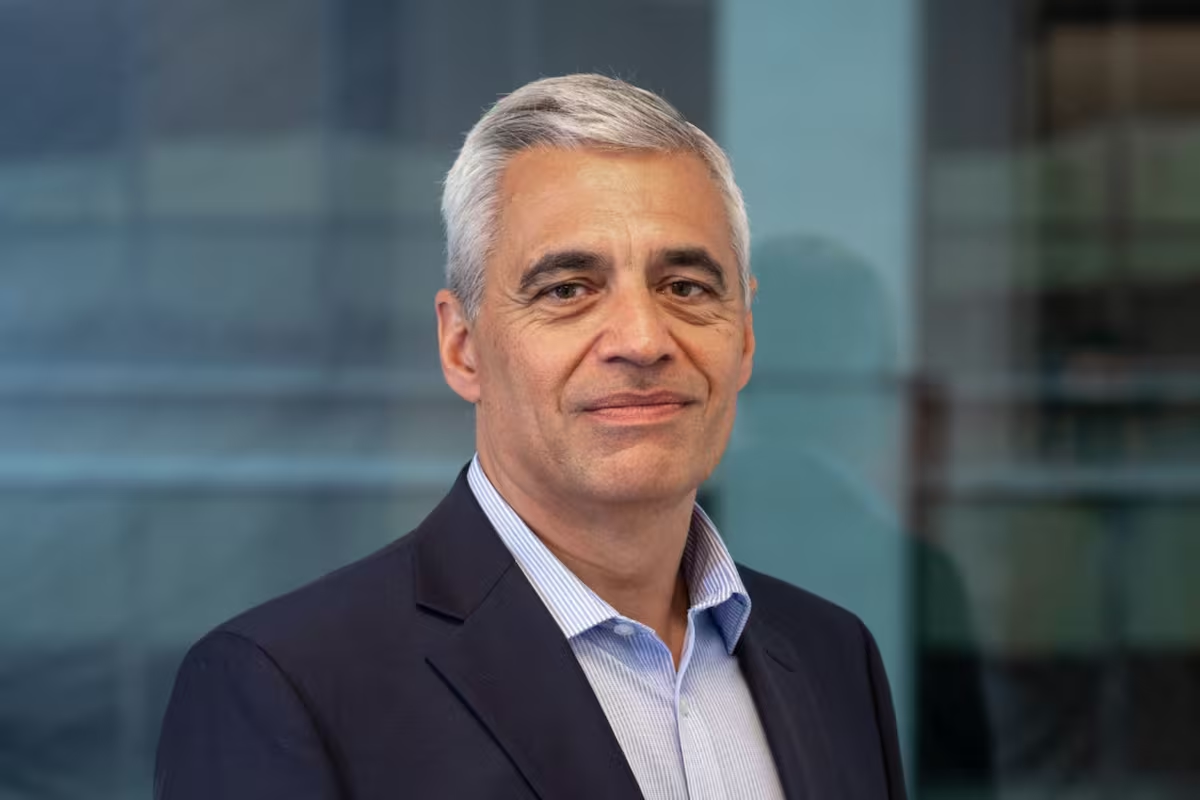
In an event that brought together more than 300 professionals, clients, partners and technology leaders from the region to exchange experiences on artificial intelligence, virtualization and environments cloud-nativeLA NACION spoke with Jorge Payró, head of Argentina for Red Hat and executive director for the Southern Cone region. The specialist, who heads a leading company in open hybrid cloud technology, which, among other things, provides artificial intelligence applications to organizations, shared his diagnosis of the state of AI: from levels of adoption to barriers that prevent it from being installed. For its part, Red Hat provides technology worldwide and in very diverse industries, covering the financial market, energy, the world of health, the public sector, telecommunications, among others.
– How do you see the adoption of AI in Latin America?
– We take hard data from MIT, which agrees with what we see in practice, when interacting with our clients. Of the total number of cases that are beginning to be explored and that some proof of concept is done, 5% is what is actually being adopted and moved to production; Only that percentage sees a tangible impact on some variable, whether it is improving the experience of the customer, the user themselves, the company, the supplier networks, lowering operating costs, increasing billing or accelerating a delivery process. On the other hand, 95% of the projects remain in the exploration phase and are not carried forward.
I believe that the demand and customer interest in this technology is great, both from what we see and from what I talk to different colleagues. But there is still a lot of exploration and few cases that really have a successful deliverable that drastically changes the business.
– What are the advantages of using a platform like OpenShift, which provides software to organizations to run applications and automate tasks?
– Developing models by your own organization is extremely expensive and can take a long time, but integrating an existing model, training it with your data and putting it into production on a platform can be a matter of hours or days. Furthermore, having it integrated into a single space makes it easier to adopt AI in organizations and achieve real results.
But above all, the advantage is in the security of the answers. There will always be hallucinations in these models, but ultimately, if you can train a model with your data, you ensure an issue of sovereignty and information protection. On the other hand, you guarantee that the answers you are going to really have are closer to the reality of your organization.
– Many specialists point to AI agents as the next leap in this technology. How do you see the adoption of these instruments?
– I think it is evolving. This is a boom which in the last two years has escalated a lot: artificial intelligence, agentic and generative artificial intelligence. And in this transition, an unplanned situation has arisen in organizations, perhaps a bit anarchic, where different areas of different industries – from a bank to a mining company – have the need to experiment and be able to deliver some level of automation, of improvement in processes with the adoption of AI. This has led to the different company units taking on agents and training them, but without a planned strategy, without standardization, without controlling the security, stability or robustness of the platform.
The reason behind this frenzy is the fear of falling behind its competition, which is also advancing automation. So, they start incorporating, experimenting, and at some point, some chaos ensues. I have to think about where I want to go, what would be the purpose of integrating artificial intelligence in my processes, in my organization, what result I am looking for and establish a platform that constitutes a good foundation to integrate all that.
This avoids having silos or watertight compartments in an organization. Nor is it incorporating technology because it is coolbecause it is fashionable, but because there is a purpose and a positive impact that must be measured and make the business evolve.
– Are there any advances that you consider will lead the development this year, particularly in the field of artificial intelligence?
– This year that transformation begins more cross in the search for automation and, in particular, infrastructure and platform. Many things that were previously done manually, that are recurring, that take time, and that also have a high error rate if resolved manually, are beginning to be automated. Therefore, if AI was previously applied in specific areas, it is now beginning to spread to multiple areas at the same time.
And then robotics, without a doubt, is having a very high evolution. If you analyze what movements and actions a humanoid robot did a year ago and what it can do today, you realize that the evolution is exponential. Some talk about it having improved on the order of thousands of times.
This advance is not limited to humanoid robots, but also extends to all robotics that are applied in the industrial field, such as automotive plants or the energy industry, geological exploration associated with oil extraction and the construction sector. oil and gasare all areas where there have been many advances, combined with artificial intelligence.
– You work with multiple industries throughout the world, what are the needs of each one in relation to AI?
– It must be understood sector by sector, because the business model is very different from industry to industry. Health has certain problems, oil and gas It has others, mining and financial services as well.
In the world of insurance, for example, they have automated processes to facilitate the customer experience. Specifically, they adopted AI so that, in cases of accidents, a form with very little information is simply completed, online and from the cell phone (such as a photo and location coordinate). This makes it easier for the insurance inspector to do a pre-analysis to determine if the person involved is guilty, neutral or innocent, something that greatly speeds up the process.
In Uruguay, the Agency for Electronic Government and Information and Knowledge Society (AGESIC) also incorporated Red Hat technology to expand, scale and standardize the use of AI in all Uruguayan government agencies. Thanks to technology, AGESIC users were able to accelerate from emails that took a long time to be responded to or that were not responded to, to shortening the manual support ticket process, with the creation of a new automated platform capable of resolving these tickets in less than one percent of the time taken by the manual process.
– When analyzing the level of AI adoption in organizations, what do you consider to be the main obstacles to its incorporation?
– In general, there are two important components, which have to do with the processes within the organization and with talents. The first is linked to the existence of watertight compartments within institutions (each area works on its own), where it becomes very difficult to standardize a form of access to artificial intelligence or a form of application. Furthermore, if the board level in the organization does not insist on the importance of applying certain tools – such as artificial intelligence – or automating areas of the company, barriers are generated.
The second element has to do with the training of people; Lack of knowledge can lead to not making the best decisions or delaying resolutions thinking that the architecture of your business model is fine; However, your competition may be doing something different and, in this way, taking advantage of you. Of course, the economic issue can be a barrier, but I insist on the importance of clearly defining the foundations of that platform.
– Do you think we are living an AI bubble?
– No, I don’t think we are in a bubble and there are examples that prove it. If we look at the Southern Cone, Chile, for example, today has about 30 data centers settling in, for which they consider that their main demand will be linked to AI.
On the other hand, you find that hardware suppliers or sellers have had an increase in demand, most of it destined for large data centers, which are thinking about consumption, what artificial intelligence produces and will produce, which is very resource-consuming.
I think that the important thing that does need to be organized is what I mentioned before: standardize methodologies, have an aligned platform, have a strategy and not adopt in an anarchic way. Otherwise, what I mentioned happens: companies invest a lot, but find that they have to reinvest, because they did not solve the root problem. Many times, because they start the other way around, they start with the decoration of the rooms, without thinking that the first thing is to lay the foundations of the house.