In the world of strategy, when an actor cannot confront a stronger actor, he sometimes ends up choosing to align himself with him or negotiate, instead of confronting him. In better known words: “If you can’t beat them, join them.” A similar strategy emerged in medicine, finding a solution to a condition that claims 10 million lives each year. And that outing, in which an Argentinian was involved, has just received a push that will allow the therapy to be brought a little closer to the patient: a company listed on the Nasdaq in the United States -the main market for technology, biotech and high-growth companies- has just licensed this solution for US$12.5 million.
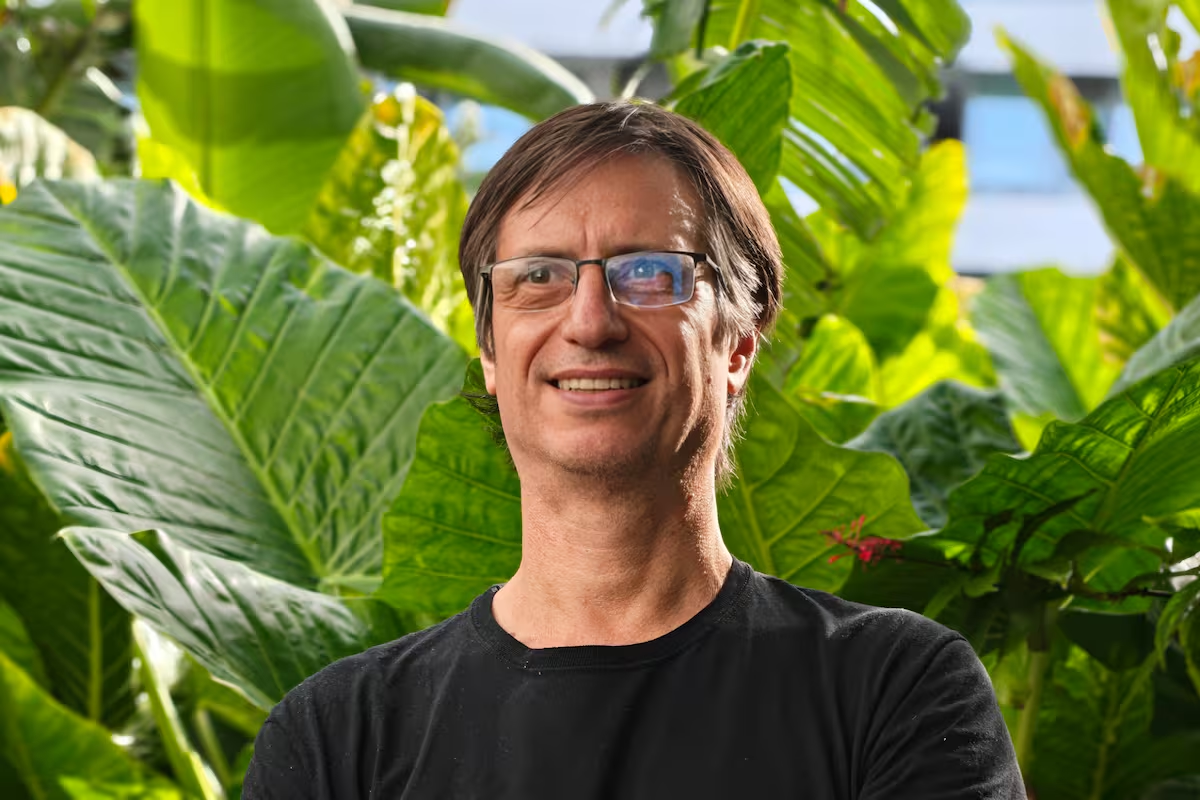
According to data from the American Cancer Society, worldwide, there are 19 million people with diseases of this type. It is a condition that affects many people closely, including Daniel Katzman, a man from La Plata who studied biochemistrywhose parents, in-laws and other relatives died from this condition. This personal experience encouraged him to combine his studies in biochemistry with this problem, to create a tool that changes the prognosis of these diseases.
The solution, which has just been exported outside, uses oncolytic virus therapy. What does it consist of? are selected viruses that are modified or designed in laboratories, with the aim of reprogramming them to destroy tumor cells. Additionally, they have the potential to help the immune system better recognize tumors.
This therapy has already been developed in other places in the world, with the aim of creating treatments that attack solid tumors such as melanoma, pancreatic, gastrointestinal, ovarian, lung cancer, among others.
The most visible case today is “cretostimogene grenadenorepvec”, from CG Oncology, a therapy for non-muscle invasive bladder cancer. “It is one of the most advanced candidates in the field, which could reach the market in 2027 -if it obtains regulatory approval-, since it showed something very valuable: in a context in which, under current standards, many patients end up with an indication for radical cystectomy (removal of the bladder), treatment with this oncolytic virus allowed in many cases to avoid or delay this surgery and preserve the organ. The company itself presents this as an important clinical objective and in phase 3 results reported that the majority of patients avoided cystectomy,” explains Katzman.
Katzman knows first-hand the impact of this disease and more than 20 years ago decided to dedicate his professional career to the design of these therapies. He trained at the National University of La Plata and, after spending time in several companies in the sector, decided to explore the oncolytic viruses, to be able to design a technology that brings a solution for cancer closer to the patient’s bedside. This is how Unleash Immuno Oncolytics was born in 2015, an Argentine biotechnology company that bears that name because it talks about “awakening” the immune system, to counterattack the disease.
Relying on the basic scientific work that other institutions had already done, they paved the way towards the development of a real medicine. One year after the birth of the company, licensed patents from the Leloir Institute Foundation (FIL), from CONICET and the University of Washington, linked to this therapy.
Over time, Unleash advanced in the production of programmed viruses that infect tumor cells. The company settled in Saint Louis, Missouri, United States, supported by an incubator linked to the University of Washington and, in 2016, closed the first round of investment, which was supported by BioGenerator, Draper Cygnus, Dragones VC and other private investors. Later he added the support of a strong strategic partner in the field, a Japanese company listed on the Tokyo Stock Exchange, which invested US$3.5 million.
Katzman explains that there are different viruses that can be used as a starting point for this therapy: in his case, They chose the adenoviurs and reprogrammed them to attack tumors. In this way, they have three different virus variables: one for bladder tumors, another for tumors linked to liver metastasis; and a last one that attacks angiogenesis (a process by which the body forms new blood vessels from existing ones).
How does it act? Through several mechanisms: on one level they kill tumor cells; in another, they awaken the immune system; Finally, they act by carrying encoded proteins, which cause tumor cells to secrete proteins, which can function as drugs. In Creole, they destroy these tumor cells, generate an infection to the cancer and awaken the immune system so that it responds to the tumor.
Their research is in the preclinical phase and has encouraging results, which will allow it to move on to clinical trials in humans.. The new stage will be in the hands of the American TransCode Therapeutics, a company that has just licensed all its products for approximately US$12.5 million. “At a business level, we believe that this is a success story, which validates that an Argentine basic science model can be licensed and generate value,” shares Katzman.
The Argentine describes the results of the development as “very promising” and provides details: “We administered the medication to the animal’s left limb and observed effects in other areas, which indicates that it not only acts locally, but also at a systemic level.”
With the license of this product, a scientific platform originating in Argentina will reach another structure, with greater possibilities of scaling. Katzman explains that, although technically it is a license, in practice the operation is equivalent to a sale, since his company licenses all its viruses in exchange for a single payment: “It is a way to give these assets the possibility of development and reaching the clinic and patients.”