There are projects that are born marked by a paradox: the larger the object, the more insufficient any attempt to capture it seems. Xulthe documentary dedicated to the artist Your director, Cristian Costantini – aware of this excess – chooses not to reduce, not to domesticate, but to open. Instead of a portrait, he proposes a constellation. And in that decision, both aesthetic and ethical, lies the singular power of the documentary.
The voice of Jorge Luis Borges resonates like a secret axis of the film: “I have to talk about that great continent…,” said the writer in a tribute dedicated to the artist. The quote does not function here as authority but as a warning. Xul is not an artist: he is a system. A territory with its own botany, zoology, mythologies and languages. The documentary assumes that infinity and, far from exhausting it, borders it. As in the best essayistic tradition, the work does not intend to close the meaning but to intensify the enigma: it does not decipher it, it surrounds it with patience, it interrogates it without subduing it, and in that gesture it finds its most rigorous form of knowledge.
The choral structure is decisive. Critics, artists and researchers – among them Patricia Artundo, Luis Felipe “Yuyo” Noé, Daniel Nelson, Cintia Cristiá, Rafael Cippolini and Jorge Schwartz– They are not arranged hierarchically but rather orbit. Each voice is a fragment of intelligibility, a partial attempt to name the ungraspable. The result is not cumulative but polyphonic: a choral biography where The tensions – between the painter and the mystic, between the system and the drift – are not resolved, but rather exposed.
The film also advances with notable archival work. Photographs, manuscripts, hand-drawn letters, domestic scenes: all of this is arranged with a poetic flight that avoids mere illustration. The image, the sound, the editing have meticulous care, sustaining their own breath where each element finds its place in a sensitive and rigorous harmony.
The house on Laprida Street, the library admired by Borges, the objects, the instruments: each element is read as a sign. The camera does not record; interpret. And in that gesture, it converts space into text.
 “Xul”, the documentary by Cristián Costantini is a portrait of an immeasurable artist like Xul Solar.
 A piano to play the universe
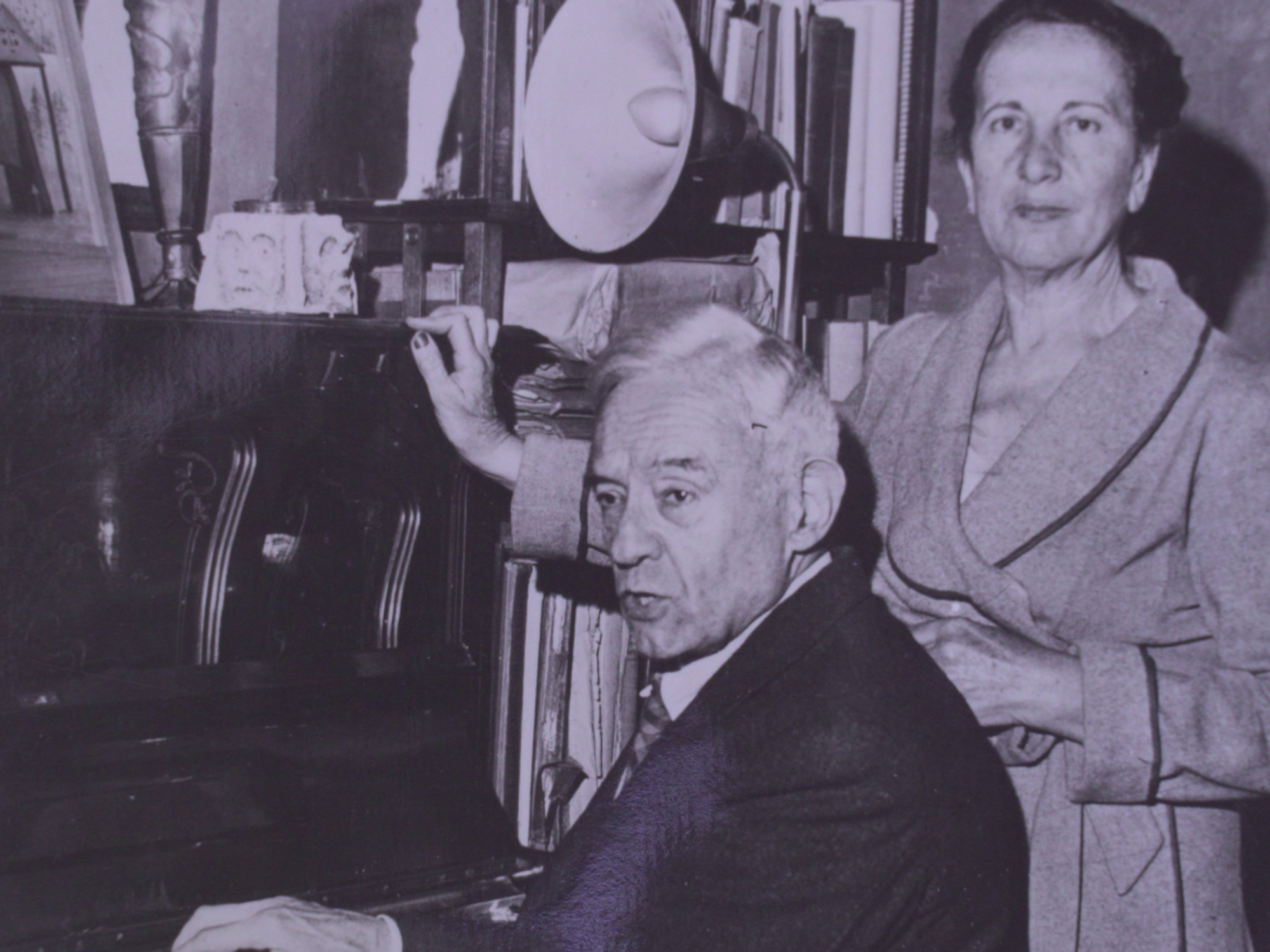
The piano sequence played by Xul is fascinating. Restored and tuned by Marco Nayathat instrument – with three keyboards of colors and textures – appears as an emblem of a greater aspiration: that of translating the universe into a system of correspondences. Music, here, is not ornament but an organizing principle. The original score by the talented Argentine pianist Leo Genovese accompanies and structures the narrative, giving it a unique rhythm, both meditative and dynamic. As if the film itself aspired to be, in Xulian terms, a musical spelling.
Genovese also makes Xul’s piano play: an extraordinary show of magic. A way to evoke the artist through his own instrument, which had remained silent since his death.
At this point, the documentary reaches one of its greatest achievements: understanding that in Xul there are no separate disciplines. Painting, language, music, astrology: everything participates in the same totalizing impulse. The “panlangua”, the “neocriollo”, the panchess – that game “more complicated than chess but also more spiritual” – are not eccentricities, but fragments of a cognitive utopia. Xul does not seek the common truth, as Horacio Quiroga already warned, but his own. And that truth is necessarily non-transferable.
The documentary does not avoid, however, the historical dimension of this rarity. The figure of Xul appears stressed by his reception: marginal in his time, overshadowed even by the centrality of Emilio Pettorutioften converted into an appendix to the Borgesian myth. Here the film introduces a critical counterpoint: the hypothesis that Xul was, in some way, a victim of his own character. “An astrologer who paints,” it was said. And yet, as Rafael Cippolini emphasizes, this construction was also a strategy: the invention of a figure to make a work possible.
 Xul Solar and panchess, that game “more complicated than chess but also more spiritual.”
 There is a particularly dense moment in the documentary: the reconstruction of the library lost after the 1964 fire to which it refers. Patricia Artundo. That missing file could function as a metaphor for the entire film. Because what we see is not Xul, but his remains, his traces, his translations. And yet, in that mediation a form of presence is at play.
The affective dimension is not ignored either. The figure of Lita, his wife, appears as guardian of a legacy and as an active agent in its subsequent recognition. From the retrospectives promoted by Lita to the market valuation – with names like Natalio Jorge Povarché, the film traces the slow passage from marginality to the canon.
But it would be a mistake to read this documentary as a simple vindication. His gesture is more complex: he does not seek to repair an injustice, but rather to restore a complexity. In that sense, the inclusion of voices such as Jorge López Anaya or Mario Gradowczyk is key to thinking about Xul as a figure of spiritualism, as someone for whom art was “a metaphor for spiritual freedom.”
Towards the end, the film returns to Borges. Not as closure, but as echo. Xul’s death, evoked in dialogue with Lita, does not close anything. On the contrary: it intensifies the feeling of having been faced with something irreducible. As George Steiner writes about certain geniuses, there is an excess in them that no exegesis can contain.
 The poster for “Xul”, the documentary about Xul Solar, directed by Cristián Costantini.
The director has ultimately accepted that limit. He has entered an unfathomable continent and, instead of mapping it, he has drawn its constellations. What emerges is not a synthesis, but an experience: that of having glimpsed -barely- the vertigo of a universe, as Borges mentions. And where knowledge is recognized as incomplete, the film finds its truth: not in the capture, but in the intensity of the approach.
File
Argentina/2026/103 minutes Script: Cristián Costantini Photography direction and editing: Miguel de Zuviría Sound: Gabriel Real Music: Leo Genovese Production: Candelaria Artundo, Cristián Costantini Features: Friday, April 17 at 9:25 p.m. Cacodelphia Art Cinema Headquarters Room 1; repeats Monday the 20th, at 11:30, Cinépolis Recoleta Headquarters Room 2