The Central Bank’s dollar purchasing streak seems unstoppable and everything indicates that it will last for several months: The liquidation season for the large agricultural harvest, which is only in its initial phase and promises to be large, will provide a large supply of foreign currency so that the entity continues adding large amounts, at least until the middle of the year. The income of dollars via finance will reinforce the supply in the exchange market, so the net reserves, which would already be close to zero, would soon move into positive territory.
The purchase of US$75 million that recorded yesterday was well below the last six days, all above US$100 million and with a daily maximum of up to US$457 millionbut so far in April it accumulates US$1,539 million. Thus, the accumulated purchases since the year began amounts to US$5,921 millionso probably this Friday or, at the latest, next Monday, the account will exceed US$6,000 million.
The Central has already reached almost the 60% of its annual purchase goal of US$10,000 million. This is a performance much higher than that initially expected by the market and by the Government itself when it implemented the monetary and exchange program. In fact, except for the first business day of the year, the monetary authority has registered dollar purchases every day and the amounts far exceed 5% of the traded volume that was established as a target.
The BCRA and Treasury appear increasingly strengthened in their holdings of foreign currency: to the almost US$6 billion accumulated in purchases of reserves in the exchange market, are added the dollars that Minister Luis Caputo has so far raised in the tenders for new debt securities in dollars in the local market. Through the AO27 and AO28 bonds, it has acquired US$1,431 million. Therefore, the Government’s economic team has captured US$7,352 million through both sources.
Net reserves come out of the red and head into positive territory
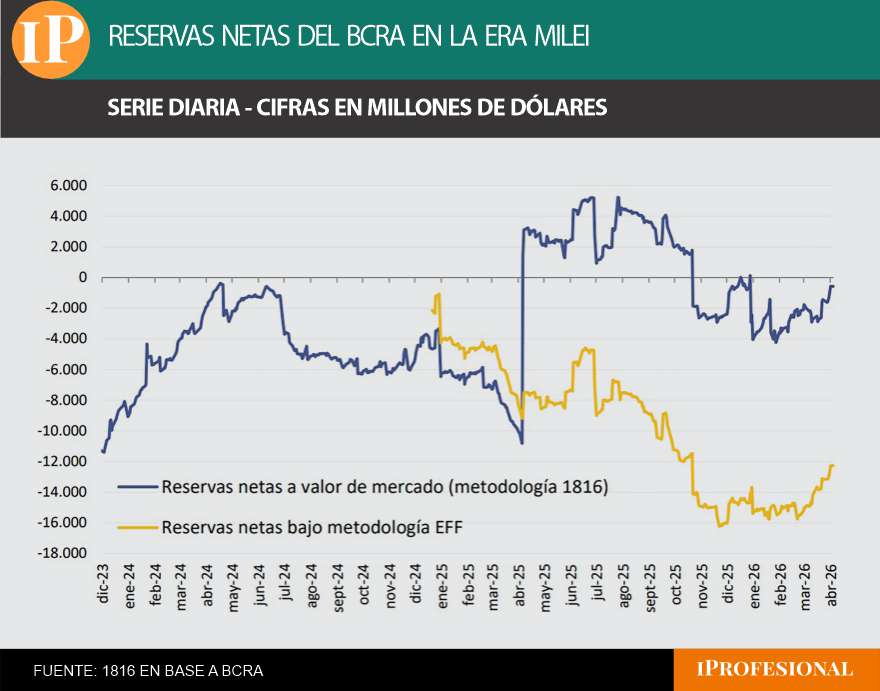
The consulting firm 1816 highlights that the acceleration in dollar purchases by the Central Bank is so strong that, according to its calculations, Net reserves at market value (subtract all BCRA liabilities with less than one year of remaining term, including Bopreal), rose rapidly from the negative zone in which they have remained since January and are practically at zero. Until the middle of this week, they would have been located around negative US$300 million.
In this way, they would have returned to a practically neutral zone for the first time after debt payments in dollars in January. But, according to the calculation, with the methodology used by the International Monetary Fund (IMF) in the financial assistance program, the net holdings would be around US$11.7 billion negative. However, under the agency’s methodology, the estimate contemplates a recovery of US$2.5 billion so far this year.
The gap between the collection of dollars from the Government (BCRA and Treasury) and the growth of net reserves is fundamentally explained by debt payments in foreign currency to both private individuals and international organizations, which makes the net accumulation of foreign currency more demanding and forces the economic team to look for alternatives for the next maturities.
Furthermore, beyond the difficulty that net reserves show to grow, it is worth highlighting the strong recovery during the administration of President Javier Milei and Minister Luis Caputo compared to what was inherited from the administration of former President Alberto Fernández and former Minister Sergio Massa: today they are almost zero, but in December 2023, prior to the change of government, they were in negative territory for approximately US$12,000 millionaccording to market calculations.
Source: 1816 based on BCRA
Is the goal of $8 billion set by the IMF realistic?
The market believes that the dollar purchase objective set by the IMF in this week’s review, above US$10 billion by 2026is perfectly achievable. In fact, as mentioned above, it has already achieved almost 60% of the goal. However, the goal of US$8 billion in growth in net reservesAlthough it implies a relief with respect to the US$11 billion objective set in the previous review, it looks challenging and it is still not entirely clear that it will be achieved.
1816 analysts highlight that, according to their calculations, the improvement in net reserves so far this year, according to the Fund’s methodology, is US$2.5 billion, just over 30% of the objective established by the organization. However, in the market they highlight that it is still not clear what the starting point will be (accumulated from the year or from the previous review) nor the criteria that will be established for accounting, so they are waiting for more details in this regard.
“The objective of dollar purchases in the market will be comfortably exceeded. The objective of accumulation of net reserves seems more difficult. Last week, Morgan Stanley estimated a growth of US$6 billioncontemplating an increase in international commodity prices of 10% on the annual average. But, apparently, they did not take into account the credit guaranteed by the World Bank. The latter could help reach the US$8 billion requested by the Fund. I don’t see it as impossible,” estimates Martín Genero, from Clave Bursátil.
The consulting firm Outlier considers that the goals set by the credit organization are “demanding” but “very achievable”, and contrast with the previous ones, which were “unattainable.” However, he highlights that we will have to wait to know the “fine print” of the definitions and know if there will be changes with respect to the guidelines of previous reviews. But, a priori, its fulfillment seems feasible, although it will fundamentally depend on the BCRA maintaining good performance in terms of currency purchases.
“In principle, The Central Bank will have to continue buying reserves in the exchange market at a good pace, especially because debt payments are coming in dollars. The Government is trying to close the guaranteed credit that was discussed these days, but has not yet closed it. There could be a drop in net reserves, in case the Treasury has to buy dollars from the Central Bank. Before this guaranteed credit, you had to buy more than US$100 million per day to get there and this Thursday it bought a little less than that level,” says Outlier.