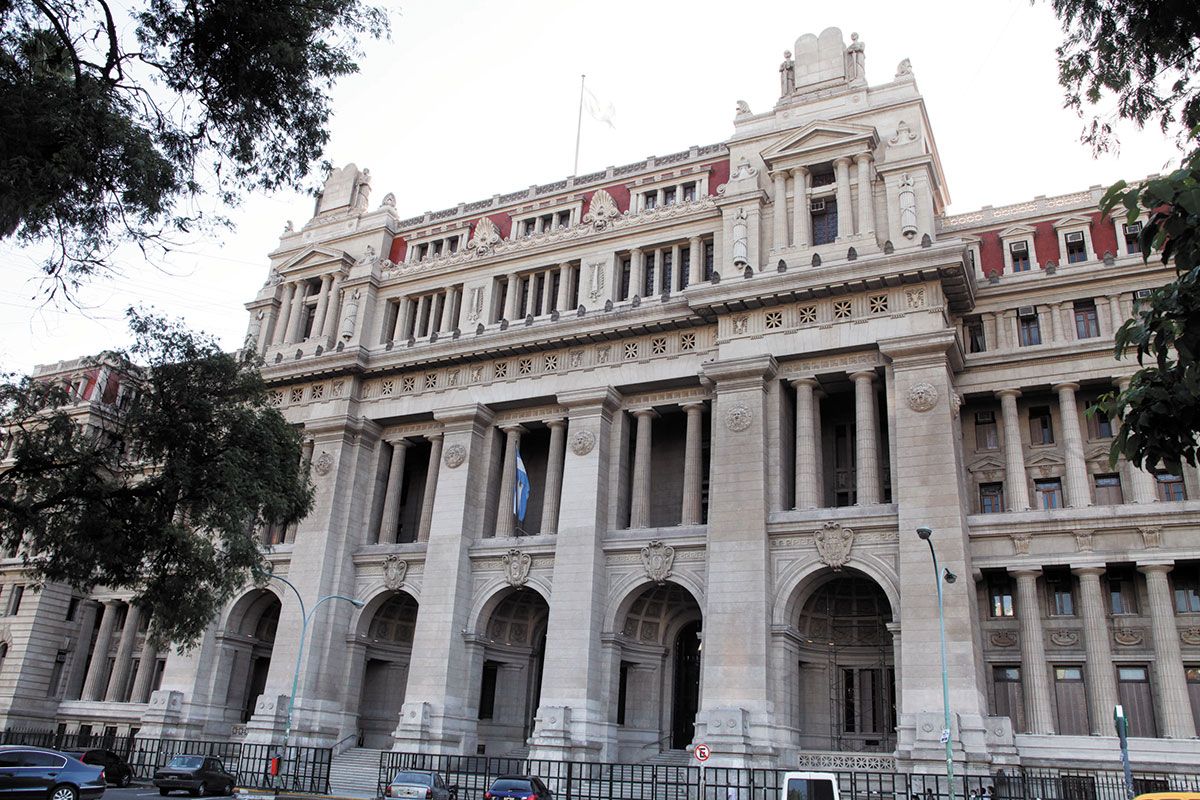
The Ministry of Justice postponed for the third time, now until February 2027, the implementation of the adversarial system in Comodoro Py, tobequeathing an alleged lack of resources that the Ministry itself denied until a few days ago. Beyond the already mentioned political reasons for these suspensions, The decision leaves the Federal Justice in a situation of regulatory chaos: For at least one more year, the same system will coexist with two completely different procedural regimes. If this new 10-month period is not used to put an end to this permanent transition, There is a real risk of moving towards a disintegration of the Federal Justice system.
The reasons that deny any excuse to continue postponing the reform of the Federal Justice and, in particular, of Comodoro Py, are already known. We have already said that the argument of lack of resources does not correspond to reality data. We also point out the suspicions aroused by the fact that the Government, cornered by cases of corruption, grants to the prosecutors who investigate it the persistence of a system that facilitates the political manipulation of these types of cases and their extension over time, up to decades.
But beyond these discussions, the new postponement now introduces an additional problem: the prolongation of a legal and organizational anomaly that affects the very functioning of the federal justice system.
Currently, two procedural systems with opposite characteristics coexist in the country:
- In seven federal districts, the National Criminal Procedure Code (1991), of the inquisitorial or “mixed” type, is still in force.
- In another nine, the Federal Criminal Procedure Code (2014), of an accusatory nature, already governs.
A Justice that operates with a scheme split in half
Since 2024, this situation has deepened, generating a scheme in which practically half of the country operates under one model and the other half under another. Added to this is the partial and fragmentary application of some provisions of the new Code in districts that continue to be governed by the previous system.
The result is a federal system that, despite being unique, operates under different rules and organizational models depending on the jurisdiction.
The consequences of this situation are not merely formal. While in some jurisdictions operators must investigate and litigate under strict deadlines, with evidentiary requirements typical of orality, in others they continue to work under a model that allows processes to be extended for years and where less than 2% of cases obtain a relevant response.
This difference directly impacts the quality of the justice service, hinders the essential interjurisdictional work and affects the allocation of institutional resources, which will naturally be concentrated in the districts where deadlines are mandatory. This generates, in fact, different levels of judicial quality depending on where in the country a case is processed. Thus, defenders of different jurisdictions of the neglected districts could begin to allege, with increasing support, the application of certain better regulated guarantees in the CPPF, causing true regulatory chaos.
Extending this scheme beyond the new deadline scheduled for February 2027 implies deepening this fragmentation and moving towards a scenario of disintegration of the federal judicial system. Therefore, it is essential that, unlike previous extensions, this new deadline is used to effectively resolve the problems that have been invoked.
This requires that the Government, the Supreme Court, the Judicial Council and the Public Ministries assume, in a coordinated manner, a specific work plan. Among the measures that should be adopted, the following stand out:
In the Attorney General’s Office:
- Reorganize the prosecutor’s offices into District Prosecutor’s Offices that allow a more efficient use of resources, without waiting for the system to come into effect.
- Appoint district coordinating prosecutors throughout the country through a competition.
- Retrain officials into tax assistants to expand litigation capacity.
- Advance in the dozens of inexplicably pending contests.
In the Judiciary:
- Establish single colleges of judges, based on data from the districts where the CPPF governs, which shows that the number of hours of guarantee hearings is up to 10 times higher than the number of trial hours.
- Create, strengthen and professionalize judicial offices
At the inter-institutional level:
- Transfer personnel from the courts towards prosecutors and defense offices.
- Advance in filling vacant positions, particularly that of Attorney General of the Nationestablishing by law a temporary period of duration, as was done in all Latin American countries that moved to an adversarial system (with the exception of Argentina and Cuba).
- Finalize the transfer of powers of the National Justice, to prevent taxpayers from across the country from having to continue financing the trial of ordinary CABA cases.
Federal Justice is very close to naturalizing a regulatory chaos that divides the country between first-class jurisdictions and second-class jurisdictions. These 10 months may be the last opportunity to prevent this fragmentation from becoming permanent. It is necessary to take advantage of them to, once and for all, put an end to this anomaly.