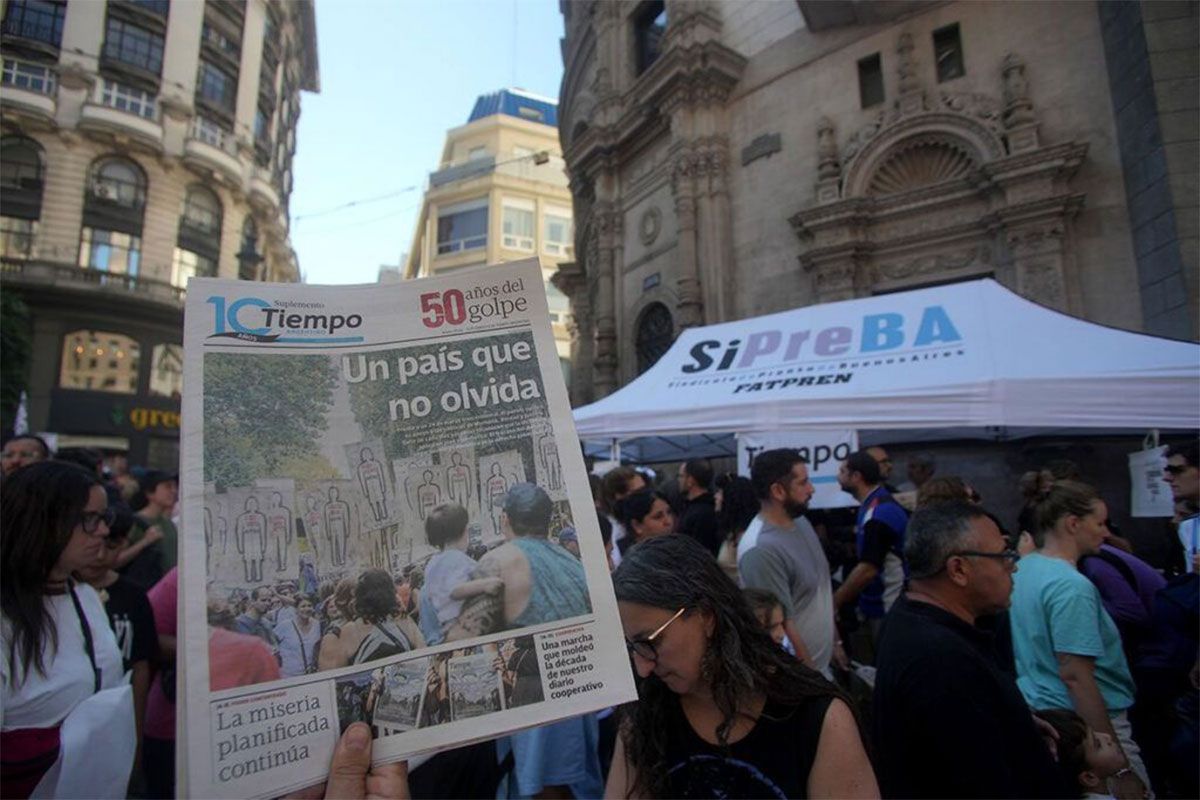
Ten years ago, the streets, the squares and even the train cars did not show that diligent swarming of cyclists and motorcyclists with thermal backpacks on their backs, with the orange or red of Rappi and PedidosYa. Ten years ago, the population of monotributistas began to grow although it had not yet exploded exponentially as would happen in 2018 but especially in 2020, as a result of the pandemic, according to statistics from the Argentine Integrated Pension System (SIPA). Ten years ago Mauricio Macri governed and a group of journalists formed a cooperative to continue the story of Argentine Weather.
Things happened. An everyday expression summarizes the mutation that the country experienced in the last decade: from the first year of Macri’s administration to the third of the ultra-liberal Javier Milei, whose government heads the boat to the middle of the river to face “the curse of the third year”, as the combo of economic difficulties and social unrest that puts an expiration date on Argentine governments is known in the political environment.

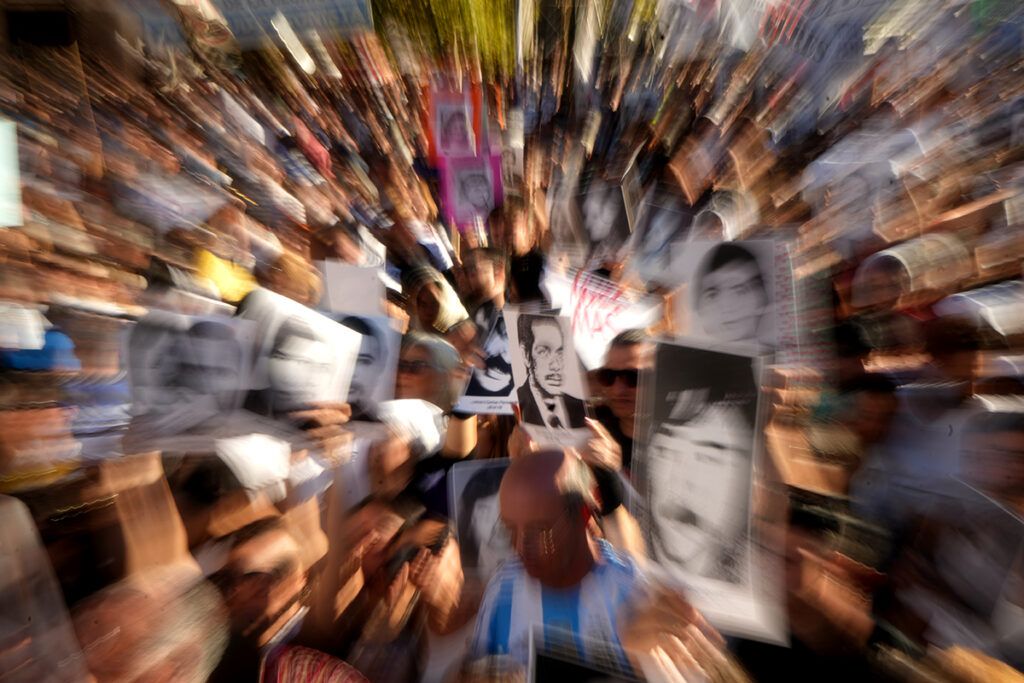
In these ten years there was a new record debt with the IMF in Macri’s time when the country ran out of financing; monetary turbulence; successive devaluations of the peso; and a growing impact of inflation on everyday lives and relationships. The decade was also crossed by collective phenomena that shook foundations, traditions, prejudices, by dint of mobilization, creativity and rebellion: the emergence and centrality of the women’s movement, the decriminalization of abortion and the questioning of machismo left marks on the public conversation. Relativism about the atrocities of the dictatorship also debuted discursively. With Macri, the figure of 30,000 missing people was questioned and with Milei, the concept of “complete memory” almost represents a vindication of state terrorism.
Since 2016, with a Macri who had narrowly won the ballot, until the present – which has Milei rehearsing an absolute reconversion of the economic structure – the country became a laboratory of accelerated transformations. The Argentina in which the collective of journalists from Time It aims to be reorganized from above under the logic of Darwinism: that of the survival of the fittest, the “adapt or die” directed at the different economic actors. The “maximalism” attributed to Federico Sturzenegger.
And what happened, meanwhile, to the famous “egalitarian impulse” that many intellectuals, including the sociologist Juan Carlos Torre, author of Diary of a season on the fifth floorDo they continue to define Argentina as the differential feature compared to other Latin American nations? Milei’s arrival at the Casa Rosada, what does it say about the beliefs, values and desires of the Argentine population today? Is there a weakening of the sense of community, a valorization of private interest and a slow transition, promoted by local and global elites, towards “extreme social selfishness”? The singer Liliana Herrero – also a teacher and graduate in Philosophy -, the political analyst Gustavo Córdoba (director of the consulting firm Zuban Córdoba), the essayist and researcher Alejandro Kaufman and the political scientist Eduardo Rinesi spoke about all this.
Gathered in these pages following ten years of Time In their cooperative stage, the four contributed reflections and also, if you will, provocations. Author of very beautiful interpretations, Herrero warned about the social effects that have lasted since the times of health isolation to prevent Covid. He mentioned, in particular, a continuous process of withdrawal or “individual withdrawal.”
“In the pandemic there was a ‘double capture’: in our homes and in technology. Even though we could communicate multiple times a day through the computer, we were alone. In addition to the economic hardship in which millions of Argentine families were left,” he stated. From that premise, he warned that the withdrawal of millions of individuals towards their personal problems and issues can lead to “a very dangerous devaluation of the historical power of the community.”
Herrero left a recommendation for those who actively participate in politics: the message sounded directed at the progressive and national-popular opposition group. “Militancy continues without understanding that a legacy must be thought critically,” he noted. By delving into party issues, pollster Córdoba made a rather crude analysis of Milei’s current affairs. “Somehow it seems not to be able to sustain itself over time, as no other project similar to this one has ever been able to sustain itself,” he described: he did it with the ease of someone who is used to dealing with polls (public and confidential).
Córdoba maintained that the La Libertad Avanza government is going through “a complex and dangerous moment” due to “the moral contradiction” of having popularized the slogan “there is no money” and at the same time showing society facts of alleged corruption or nepotism like televised skits: he listed “the (Manuel) Adorni crisis, the $Libra issue and mortgage loans for front-line officials.” And to that saga, he added, we must add a “geopolitical problem.” “A possible defeat of Trump in the midterm legislative elections in November could bring real and concrete governance problems to Milei,” he stressed.
From these premises, the analyst warned in any case that “Argentine society is angry with Milei but at the same time remains angry with Peronism.” And he added: “I could say, with great calm, that Milei today is no longer the problem but the society that voted for him.” For Córdoba, the different figures of mileism are the emergence of a new climate of the times, silently incubated by the “very high levels of frustration” that the Argentine population carries. “We have gone from questioning private interests to considering them superior to the public interest, and we have normalized that. We also have a cult of economic efficiency,” he diagnosed.
Regarding the chances of an opposition electoral articulation, Córdoba mentioned two obstacles. In political matters, he said that there remains an “important tension” between “the slightly more conservative identities of the different Peronisms in the interior of Argentina” with the “national Peronism identifiable with that of Buenos Aires.” He referred to the difficulty of bringing together the Kirchnerist electorate with the Cordoba voters who are distancing themselves from Milei.
“There is a kind of nostalgia for other times in which work was from 9 to 5, formal, and constituted the backbone of the life of society. Today work is something else. It is mutating at a speed that political parties, nor emerging forces, fully understand,” he warned, and then insisted on the scope and speed of the applications of Artificial Intelligence.
Infamous decade?
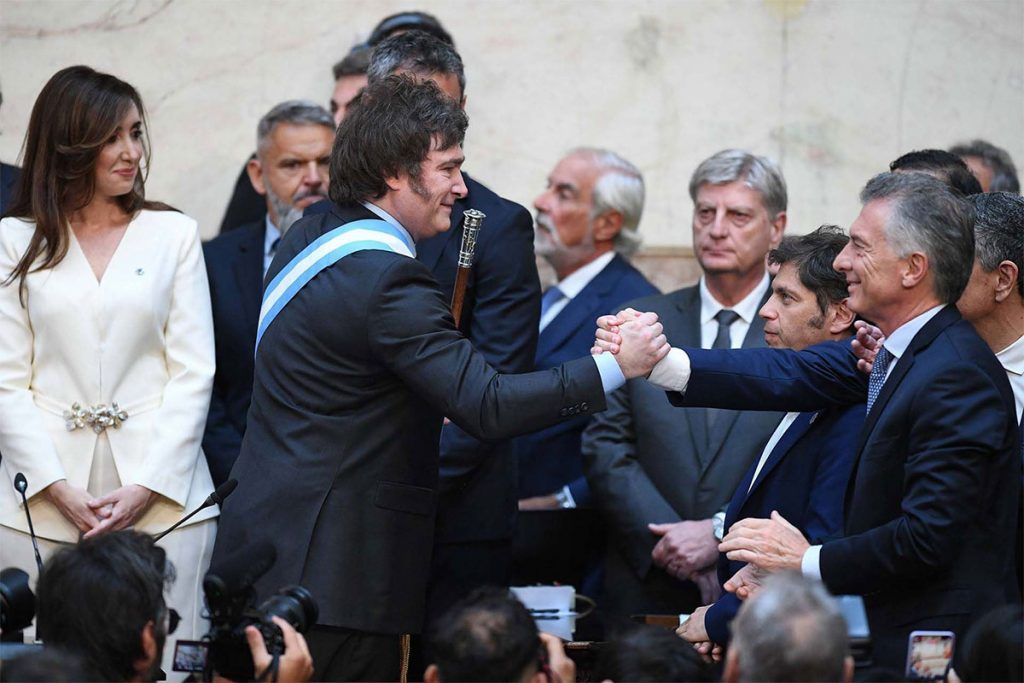
When it came to imagining futures and making forecasts, Kaufman and Rinesi – both representatives of the university community – agreed on the very serious risks of a continuation of mileism. Cultural critic and professor at several universities, Kaufman defined the period 2016-2026 as another “infamous decade.” And he characterized it as “a novelty,” which he identified in the fact that “the ‘non-politician’ (by Macri) was now winning elections.” “Macri was not a politician but a businessman who was not going to steal because he already had money and since he was a businessman he knew how to manage: how and what was best. Furthermore, he was not corrupt and did not know how to speak, but that did not matter because politicians talk too much,” he ironized in his analysis.
“With Macri, an electoral victory was generated from a notion that is incompatible with life in common. Because the speech of a businessman is structured so as not to be responsible. That is why he cannot govern,” he risked. And he expanded: “Now, with Milei, we fell directly into hell, because we no longer have a businessman in the Casa Rosada but rather an ideologue of global monopolies, who in reality are ten or 20 ultra-millionaires.”
Rinesi, in contrast to other visions, denied that in the last ten years Argentine society has become a “selfish, individualistic, possessive, unhappy and unsupportive” population in order to account – as an intuitive hypothesis – for Milei’s progress. “Our subjectivity is a motley and complex knot. I don’t share the idea that, because society overwhelmingly voted for Milei, now Argentines, or the vast majority of them, are crap,” he replied. And he stressed: “Argentines, like all human beings, are unfortunate and stupid guys. We are selfish and supportive, we are individualistic and communal. We think about ourselves and others, all of this at the same time and in a complex way.”
Also philosopher and author of the book “Politics and tragedy. Hamlet, between Hobbes and Machiavelli”, Rinesi recalled that inflation is “a disciplining phenomenon” (“it is, along with terror, as so many times emphasized by León Rozichtner”) and cited a phrase by Margaret Thatcher (“there is no such thing as society, there are individual men and women”) to warn about the final objectives of the mileist project. “Society exists, because rules, laws, traditions, culture and institutions exist: there is society because we care about our parents and our children. This guy (Milei) says ‘our parents are already gone and our children, what do they matter’. He proposes: ‘let’s live in the present’. And then there are no intergenerational ties. Milei wants to destroy the State because the State is one of the plastics (sic) that make society exist.”
Regarding Argentina’s egalitarian impulse, Rinesi stated that “it is still very present” in society. And he highlighted: “This can be verified in the university issue, in the social expectation that children may want to study. The same in the women’s movement and feminism: it is a field of dispute with a furiously anti-feminist government but since the roads are not traveled for free, sediments, traces and vestiges remain.”