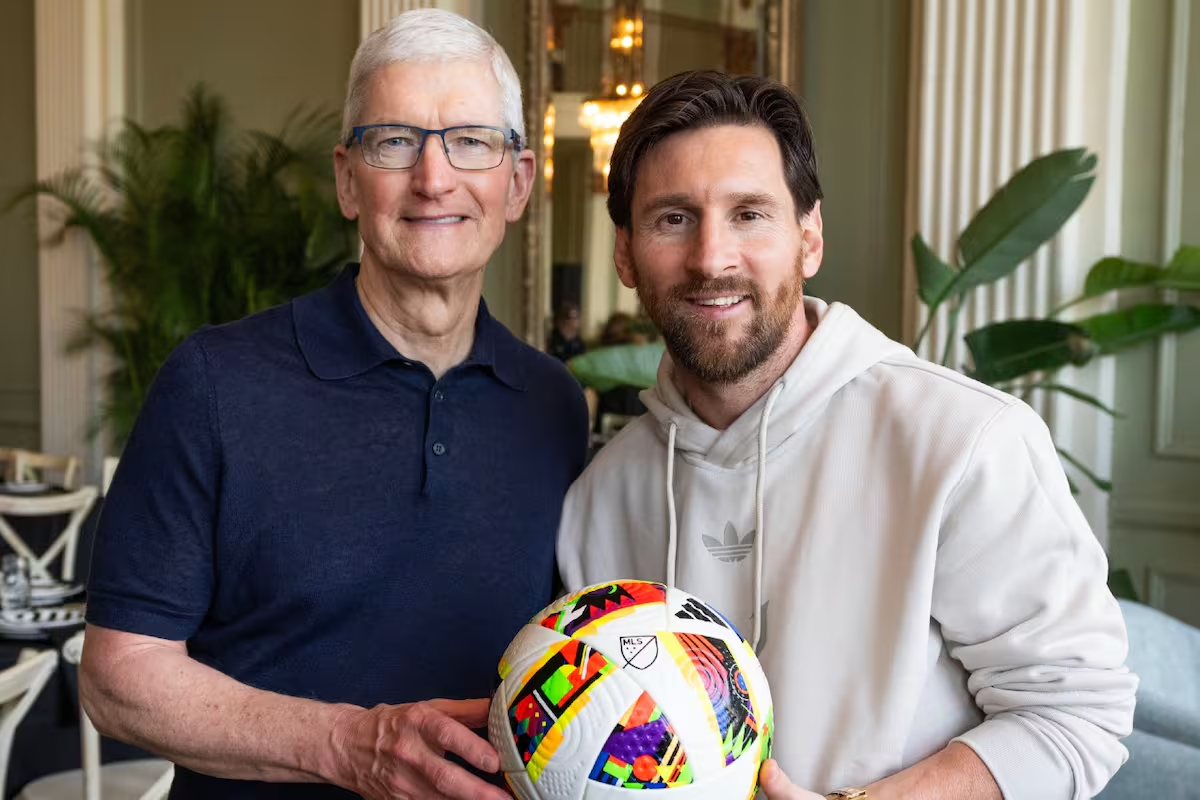
Tim Cook will step down as CEO of Apple to make way for John Ternus as successor, starting a new stage with those from Cupertino as executive president, after 15 years of innovation in iPhone and consolidating the company as one of the most valuable and influential today.
In the midst of celebrating Apple’s 50th anniversary, the technology company has decided to give a script twist to its executive structure. The current head of the hardware unit, John Ternus, will become the new CEO (CEO) of the apple company replacing Tim Cook, who will become CEOstarting September 1.
Timothy Donald Cook (1960, Alabama, United States) is currently recognized for his extensive and consolidated technological career that, although it reached its peak with Apple, began much earlier.
Your first work foray It began with the giant International Business Machines Corporation (IBM), where he spent 12 years holding management positions in the manufacturing and distribution division for North America and Latin America. He then moved to high-performance electronic equipment company Intelligent Electronics and, after that, jumped to computer company Compaq.
Cook did not set foot in the Cupertino facilities until the year 1998, when he was hired by then-Silicon Valley icon and Apple CEO Steve Jobs.
His first steps at Apple were like responsible for global supply chainalthough he also held positions responsible for the company’s global sales and operations, as well as Apple’s service and technical support in all markets and countries.
Likewise, his achievements in technology include the management of Apple’s Macintosh divisionas well as provide a key boost in the continuous development of strategic relationships with distributors and suppliers.
During this period, he faced the company’s management on some occasions, due to the Steve Jobs’ medical absences caused by his long-term pancreatic illness. Finally, Tim Cook was named CEO in August 2011, at which time he took the reins of the technology company months before the disease claimed Jobs, who died on October 5, at the age of 56.
Since then, the manager has dealt with the expectations of matching the figure of technological genius that Jobs held and, although perhaps with a different style, he has managed to consolidate Apple as one of the most valuable and influential companies in the world today.
Recognized for a more collaborative and tactful leadership style than his predecessor, Cook has been known during these 15 years of leadership for more work-focused behavior, as an executive who lets himself be guided by data and knows how to listen to those around him.
With this perspective, Cook has led the launch and consolidation of key products, with evident changes in its product offering, although always remaining faithful to the company’s philosophy: thinking about design as a user service.
For example, during his years as CEO, he left behind one of what was considered a key device for the company. It is none other than the iPod, which lost presence in the company’s strategy due to market developments. Specifically, they were discontinued in 2022 in favor of music streaming services for mobile devices, with Apple Music.
Regarding the iPhone, its flagship device, the Cook-led strategy shift toward larger screensin contrast to the vision that Jobs had. Above all, since the iPhone 6 series, when they became 4.5 and 5.5-inch smartphones, compared to the reduced sizes of previous models such as the iPhone 4. Following this evolution, the latest iPhone models have screens of up to 6.9 inches, as is the case with the iPhone 17 Pro Max.
The iPad, for its part, have expanded its options with products such as the iPad Mini (2012), the Air version (2013) or the iPad Pro (2015), with the intention of adapting to the needs of each user and making them more powerful and thinner, all focused on productivity and entertainment.
For both iPhone and iPad, different designs with straight and rounded edges have been chosen, an all-screen format eliminating the well-known bottom center button, increasingly visual panels such as Liquid Retina XDR screens, as well as an increasingly relevant approach to the camera and photographic capabilities.
Under his leadership, Apple also made the strategic leap into own chips with Apple Silicon, which were initially released with the M1 version on the 13-inch MacBook Pro and Air computers and the Mac Mini desktop computer.
The power of these chips was introduced in the iPad range, and has continued to evolve until October last year, when the M5 was introduced, moving towards the era of artificial intelligence (AI).
Likewise, Cook oversaw the launch of new product categories like the Apple Watchthe first smart watch that arrived in 2014 to later establish itself as one of the most requested wearables, with specific functions focused on sports and health care.
The same thing happened with the AirPods, which arrived in 2016 as a new device that reinvented headphones as a way to listen to audio without cables, with high quality sound.
Furthermore, beyond its devices, Cook’s leadership has also led a expansion of services business, including Apple Music, Apple TV+ and Apple Payamong various changes for the apple company.
In addition to all this, Cook has placed topics such as User privacy, diversity and carbon neutrality at the center of corporate discoursecommitting the company to ambitious environmental objectives.
Among the newest devices that Apple has recently incorporated, in the last stage of Tim Cook’s leadership, we cannot stop talking about its mixed reality (MR) viewer. Apple Vision Pro, which was launched in June 2023, priced at $3,499 and access to more than a million applications from iOS and iPadOS.
This viewer presents an interface that takes up the design language of iOS and Mac, it can be controlled with your eyes, hands and voice; and integrates a screen with an EyeSight system, which projects the image of the user’s eyes.
Regarding the artificial intelligence (AI) is one of the fields in which Apple has fallen behind under the direction of Cook and in the face of the rise of other technologies, such as OpenAI, Meta or Google.
However, it has marked a revolution in its iOS, iPadOS, macOS and watchOS operating systems, mainly thanks to Apple Intelligence, its suite of AI-powered tools with writing options, message summary or photo editing ways, which arrived with iOS 18.1.
It also aims to mark a new experience from your renewed assistant Siriwhich is expected to arrive this year 2026 to offer a vision of integrated AI, hand in hand with the Google Gemini models.
Yet, Tim Cook will continue as CEO of Apple during the coming months in a transition periodwhich will host its annual WWDC developer conference on June 8 and unveil its revamped Siri assistant, until finally John Ternus takes over as CEO and Cook steps aside to become executive chairman, where he will continue to lead the company.