In a market that once again focuses on the Meval after several weeks marked by external noise, IEB defined a portfolio of Argentine stocks with a lower bet on oil, more weight in banks and an important defensive base in regulated. The build does not include CEDEARs or bonds, it is a portfolio 100% composed of Argentine stocks and, in a version taken to $1 million, it is distributed among 11 papers on the local Stock Exchange.
The strategy arises from the firm’s latest weekly report, where it maintains that Argentine stocks still show upside potential due to its valuation levels and the improvement that is beginning to appear in some sectors of the economy.
The starting point of the report is that, even with a week full of international and local news, the country risk showed a marked compression. IEB emphasizes that it descended towards the zone of 525 basis points, after having touched levels close to 640 points in the midst of the international conflict. To this he added two elements that helped improve the financial climate: progress in the second review of the agreement with the IMF and the confirmation that the World Bank is working to help refinance Argentine debt for up to US$2,000 million.
Additionally, the report mentions statements of Luis Caputo about a package US$10 billion to refinance maturities between World Bank mechanismsother organizations, biweekly Bonares issues and privatizations.
This framework did not prevent the S&P Merval from having a mixed week since, according to IEB, the index fell 1% in dollars during that period, in line with the behavior of country risk. But the broker’s reading was not negative and, on the contrary, it suggests that, if the historical relationship between country risk and stock market valuation is observed, there is still room for local stocks to recover ground.
The central argument is that Argentine stocks continue to operate at undervaluation levels, even more so if the recovery shown by some sectors of the real economy is taken into account.
How $1 million is distributed
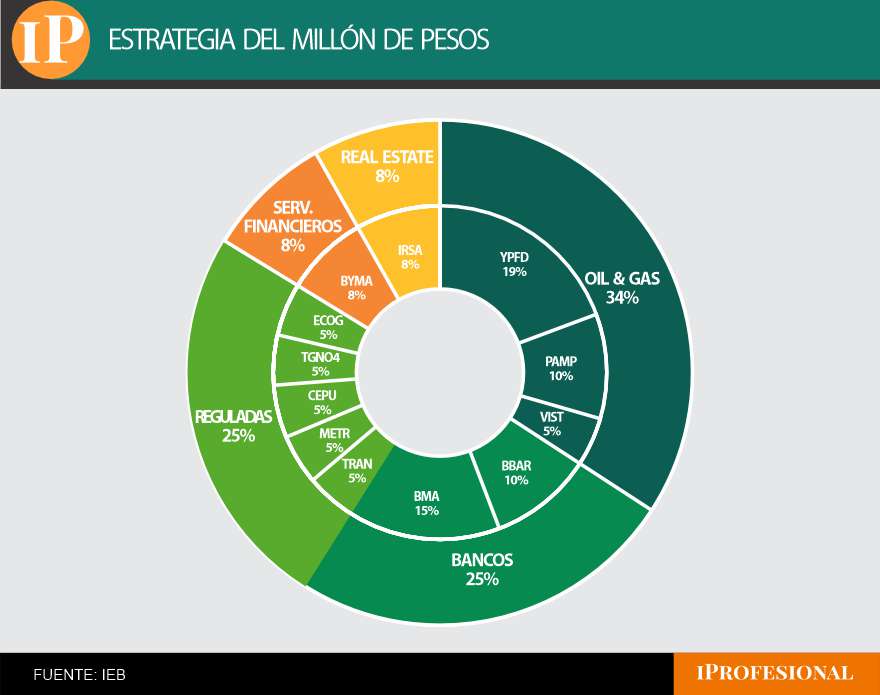
The distribution of the portfolio allows you to quickly see where the strongest convictions of the brokerage company are. The largest individual position is YPF, with almost a fifth of the portfolio, followed by Banco Macro and BBVA, which together explain a quarter of the portfolio. Then a diversified block of regulated companies appears, all with the same weight, and two complementary bets, BYMA and IRSA, linked to an eventual improvement in activity and business volume.
- Oil & Gas 34%
- YPF (YPFD) 19% = $190,000
- Pampa Energy (PAMP) 10% = $100,000
- Vista Energy (VIST) 5% = $50,000
- Banks 25%
- Macro Bank (BMA) 15% = $150,000
- BBVA (BBAR) 10% = $100,000
- Regulated 25%
- Transener (TRAN) 5% = $50,000
- Metrogas (METR) 5% = $50,000
- Central Port (CEPU) 5% = $50,000
- Northern Gas Carrier (TGNO4) 5% = $50,000
- Ecogas (ECOG) 5% = $50,000
- Financial services 8%
- Real Estate 8%
The million dollar strategy
Less oil than before, but still heavy
The most visible change in the strategy is not an exit from the energy sector, but an adjustment to star assets to capitalize on Vaca Muerta. IEB says it decided to partially take profits on Oil & Gas in the face of a possible drop in the price of crude oil.
That implies a less aggressive approach than the market took during the peak of tension in the Middle East, when rising oil prices boosted stocks in the sector.
Even so, Oil & Gas continues to be the most important block of the entire portfolio, with 34% of the total. This permanence shows that the cut was partial and not a fundamental change. IEB continues to leave YPF as the main bet, with 19%, accompanied by Pampa with 10% and Vista with 5%.
The report indicates that during the conflict in the Middle East, the sector’s actions were decoupled from the rest of the local market due to the oil rally and the lower global supply of the commodity. What has changed now is that, with lower geopolitical tensions, the sector began to retreat and stopped having the same defensive character as weeks ago.
The IEB reading, then, is not bearish on energy, but rather more selective since maintains relevant exposure because it continues to be one of the sectors with the greatest specific weight in the Argentine Stock Market, but it takes advantage of the journey already made to move part of the portfolio to other areas.
Banks gain prominence
Where a more marked bet does appear is in the banking sector. IEB maintains that strengthened its position in banks for two reasons: its sensitivity to changes in the level of risk and the expectation of a ROE recovery in 2026. The portfolio reflects this decision with a total weight of 25%, distributed between BMA with 15% and BBAR with 10%.
The hypothesis behind this move is macro and micro at the same time since, on the macro side, the report highlights that the Rates remain at low levels in real terms and that the current financial scheme is supported by a highly offered exchange market, both in the official and financial segments. In the week surveyed, the official dollar fell 2.2% and the financial dollars fell nearly 1.4%.
In the year, the dollar A3500 accumulated a down 7.3% and the MEP of 5.5%.
On the micro side, IEB considers that a scenario of lower rates can improve default levels and facilitate a recovery in private credit. This reasoning is what explains why the banking sector appears among the few that, according to the report, began to show positive performance in April, along with materials.
The broker sees them as better off than in previous months to capture eventual financial normalization and a gradual improvement in activity.
Regulated, the defensive block
The other 25% of the portfolio is concentrated in regulated ones. There IEB distributes the capital evenly between Transener, Metrogas, Central Puerto, Transportadora de Gas del Norte and Ecogasall with 5%. It is not looking for a specific winner within the segment, but rather a block that provides relative stability in the face of a still unstable context.
The report states it bluntly: it maintains a strong positioning in the regulated sector to maintain the level of defensiveness of the portfolio against the volatility of the external front. It is a logical decision within a portfolio that, by design, is totally exposed to Argentine risk.
If there is no international coverage or dollarized assets within the portfolio, that regulated block It works as an internal shock absorber.
IEB acknowledges that these companies began to lose some traction as geopolitical tensions deflated and the price of crude oil fell. But even so it keeps them at a high weight. The reason is that, in a market that can still have jumps in volatility, they remain a useful tool for balancing exposure to more cyclical sectors.
BYMA and IRSA
The remaining two positions are BYMA and IRSA, with 8% each which, in money, is equivalent to $80,000 per paper. IEB leaves that portion outside the three large sectoral blocks and justifies it with an expectation of recovery in the level of activity.
In the case of BYMA, the thesis is quite direct: if the mood of the local market improves, if interest in Argentine assets increases and if the financial system gains depth, a company tied to the functioning of the capital market can benefit. At IRSA, the bet is more linked to the economic cycle and the recomposition of activity.
Neither of them leads the portfolio, but together they account for 16%, a figure that stop being marginal.
The monetary and financial context
IEB insists that the currency flow It is today the variable that allows simultaneously sustaining a negative real rate, a stable exchange rate with a tendency to appreciate and uninterrupted purchases of dollars by the BCRA. He also states that, as long as this flow continues, he does not see a change in the real interest rate, which would remain negative.
In parallel, the report details that the Treasury placed $9.9 billion against maturities $8.3 billion, with a 127% rollover. 44.4% of what was awarded was to a LECAP that cut to 1.99% TEM, while 28.1% went to TAMAR bonds and 22% to CER bonds.
More than half of what was placed was concentrated in maturities 2027 and 2028, which shows that the Treasury He took advantage of the calm in pesos to extend deadlines.
Added to this is that the CER curve continues to show negative returns throughout the 2026 section and that the fixed rate curve yields only 1.65% for April, against an expected inflation of 2.6% for that month according to the REM. Furthermore, the REM top 10 projects inflation of 31.8% year-on-year by 2026, above a fixed rate curve around 24% TEA.
That cocktail explains why the broker’s gaze is inclined towards stocks and, within actions, by sectors that can capture an improvement in credit, a reduction in risk and a recovery of activity.
For all this, IEB’s million-dollar portfolio does not rely on a single narrative. Keep a large portion in energy because remains a central sector of the Merval, the weight of banks increases because he sees there one of the best expressions of the new section of the market and keeps regulated to lower the volatility of the portfolio to external shocks.