For decades, hoarding dollars was synonymous with protection in Argentina. Each time the peso collapsed – 1989, 2001, 2018, 2023 – those who had their savings in foreign currency came out better off. That collective memory built an almost automatic reflex: When there are pesos left over, dollars are bought.
However, the macroeconomic scenario for 2026 presents a novelty: the dollar is still, or almost. The official exchange rate advances at a controlled pace – in what is known as a crawling peg – and market forecasts suggest that this stability will continue, at least in the short term.
This raises a question: If the dollar performs less than inflation, does it make sense to continue saving in green?
What the market says: future dollar and REM
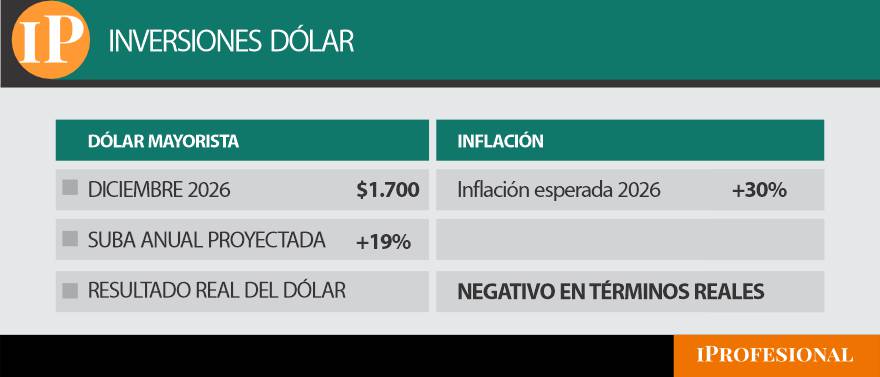
The Central Bank of the Argentine Republic, through the Market Expectations Survey (REM), concentrates the projections of the main consulting firms, banks and analysts in the country. By December 2026, The consensus points to a wholesale dollar around $1,700, which implies a annual increase of approximately 19%.
The problem is that this figure is well below the expected inflation for the same periodwhich the same analysts place around 30%. In real terms, the dollar loses purchasing power against the local price basket.
Keeping dollars is no business: you will lose against inflation in 2026
The market of dollar futures on the ROFEX confirms this trend: December contracts are trading in line with REM projections, without anticipating sudden jumps. This does not mean that the exchange risk has disappeared – it never does completely in Argentina – but that today the market is not paying for it.
In the short term, keeping idle dollars means giving up real profitability. Instruments in pesos—both at a fixed rate and at a variable indexed rate—can outperform the dollar in scenarios of exchange stability. Those who only hoard banknotes not only do not win: they lose against inflation.
Why do Argentines continue saving in dollars?
“The Argentine does not save in dollars for what happens today, but for what he believes can happen tomorrow.”
The answer is not economic in the strict sense: It is psychological and historical. Argentina has the world record for largest amount of physical dollars in the hands of individuals outside the banking system, estimated at more than US$200,000 million. That figure says a lot about the structural distrust in the peso.
Each generation of Argentines has at least one traumatic memory associated with the local financial system: the Rodrigazo, the hyperinflation of ’89, the corralito of 2001, the bullfight of 2018 or the exchange gap of recent years. That story outweighs any REM projection.
Added to this is a coverage logic: The dollar does not need to be the most profitable asset of the year to justify itself. Its value lies in what it represents as insurance against extreme scenarios. If the peso devalues abruptly—something that is always on the Argentine horizon of possibilities—whoever had dollars protected themselves. Who bet everything on returns in pesos, no.
In that sense, the dollar functions less as an investment and more as an insurance policy. And like any policy, it pays even if it is not used.
The most chosen options and their returns in dollars
Not all dollars are equal. Within the universe of dollarized instrumentsthere are options with very different risk and return profiles. Below are the alternatives most chosen by Argentine savers and investors in the current context:
Dollar bill (traditional savings) 0% annual
The refuge par excellence. It does not require a bank account or financial knowledge. Its great advantage is immediate liquidity and direct custody. Its great disadvantage is that it does not generate any return: the bills kept in a safe or under the mattress are worth the same tomorrow as today, but inflation in dollars is eroding them slowly. Ideal as an emergency reserve, not as an investment vehicle.
Accounts in dollars / MEP Dollar 0 – 1% annually
The most accessible alternative for those who want to get out of the physical ticket. The Accounts paid in dollars offer marginal rates, but at least somewhat generate. The MEP dollar -obtained through the purchase and sale of bonds in the stock market- allows access to the financial exchange rate without formal restrictions. Today the gap between the MEP and the official one is limited, which reduces the incentive, but the instrument continues to be widely used due to its transparency and accessibility.
Common investment funds in dollars 2 – 4% annually
The Dollarized FCIs allow access to a diversified portfolio of assets in hard currency with subscription from very low amounts. They invest mainly in Negotiable Obligations (ON) of leading Argentine companies and in capital market instruments. They offer liquidity in 24 or 48 hours and returns higher than the banknote, with professional management that simplifies decision-making for the retail investor.
Bonds in sovereign dollars (hard dollar) 6 – 10% annually
Argentine Treasury bonds denominated in dollars – such as AL30, GD30 or GD35– offer significantly higher interest ratesbut with an also greater risk: the Argentine sovereign risk. Whoever buys a sovereign bond is betting that the Argentine State will honor its commitments in a timely manner. In contexts of financial normalization, these rates are very attractive in global terms. They require greater tolerance to volatility and a medium-term investment horizon.
CEDEARs and corporate Negotiable Obligations Variable: 4-7%
CEDEARs are certificates that replicate the behavior of international stocks —Apple, Amazon, Google, Nvidia— quoting in pesos but adjusted to the financial exchange rate. The corporate ONs, for their part, are debt of private Argentine companies in dollars, with lower risk than sovereign bonds and moderate returns. Both instruments allow exposure to global assets from the local market, with different levels of required sophistication.
Fixed terms and other instruments in pesos
In scenarios of exchange stability, instruments in pesos can greatly outperform the dollar in terms of nominal and even real performance. UVA fixed terms -adjusted for inflation- and short-term Treasury Bills have outperformed the exchange rate in several recent periods. Its Achilles heel is always the same: if the exchange rate takes an unexpected jump, all the gain in pesos is liquefied in a few hours.
Conclusion: green is still the color of Argentine money
He dollar is not the most profitable asset of 2026 in Argentina. The REM and futures market numbers clearly confirm this. However, it would be a mistake to conclude from this that it no longer makes sense to save in dollars.
The rationality of the Argentine saver is not the same as that of the investor from a country with a stable currency. Here, the dollar fulfills a function that no peso instrument can completely replace: that of insurance in the face of uncertainty. And in a country where recent economic history includes confiscations, defaults, stocks and abrupt devaluations, that function is valid.
The key is not to be left alone with the bill in the drawer. Exploring the different dollarized vehicles – from corporate ONs to FCIs – allows you to capture some performance without giving up coverage. And for those with a greater risk appetite, combining dollars with instruments in pesos may be the formula that best captures the best of both worlds.
In the end, the Argentine “Green Lantern” does not go out. It just evolves.