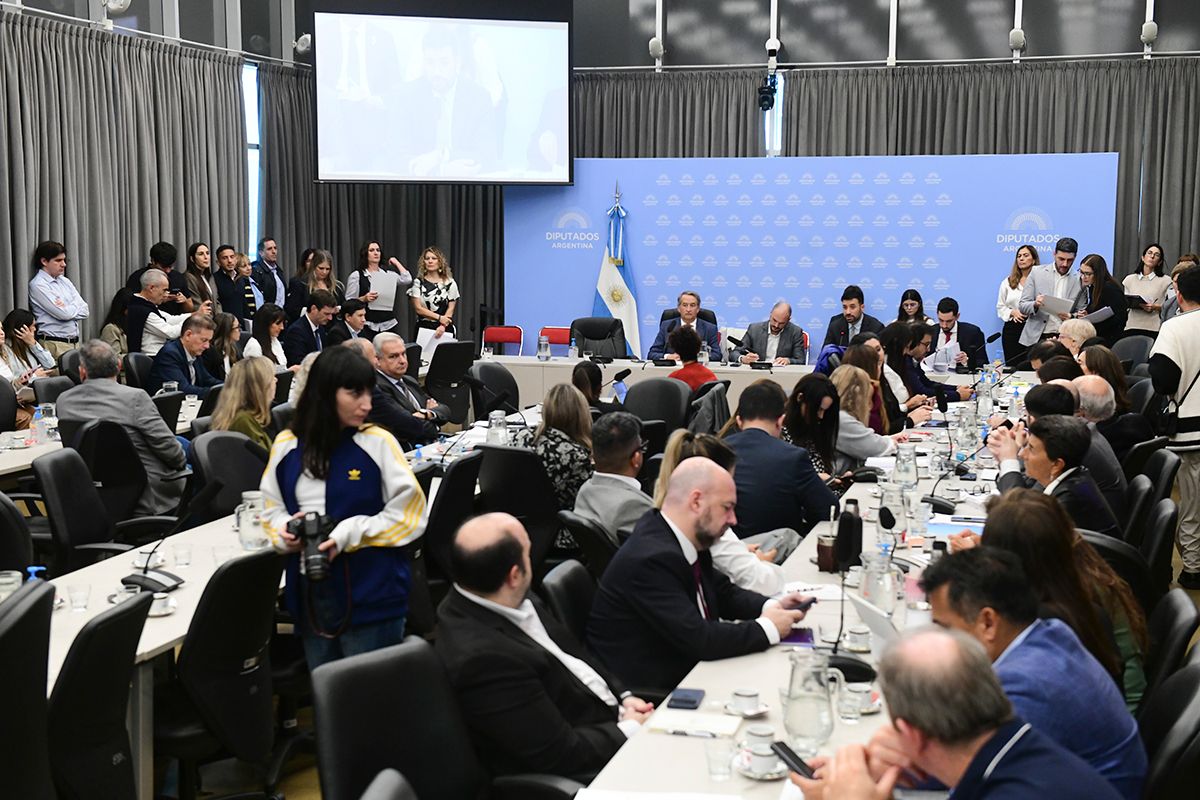
While the Congress ruling party wants to advance in both chambers with the bills promoted by the Minister of Deregulation, Federico Sturzeneggerthe opposition continues to set its own agenda focused on the economic crisis that different sectors of the country are going through. It will be a week without sessions in the venues, but full of committee meetings.
In the Lower House, officials from Sturzenegger’s portfolio defended the bill on Tuesday. Leaf Litter Lawthat repeals more than 70 laws that are out of use or, according to the libertarian government, hinder the economy. For Union for the Homelandit is “a Trojan Horse law where in a single article they try to repeal several laws with names and surnames,” he said. German Martinez.
In fact, representatives of cooperatives pointed out, in the Cooperative Affairs Commission, against the bill and asked that an article of Law 11,380 not be repealed.
In this context, Bruno Rodríguez, secretary of the Argentine Interfederation Confederation of Electric Cooperatives and other Public Services (Conaice)requested that “the exemption proposed by Law 11,380 on the solidarity contribution for cooperative formation be taken into consideration and that it be removed from the current project, due to the damage it would generate in the cooperatives because the contribution amounts of the non-taxable minimums are going to multiply and put the cooperatives in a situation of bankruptcy.”
As spokesperson for the Deregulation Secretariat, Alejandro Cacace He said: “It is necessary to make a regulatory order for the certainty of Argentines, for the administrative bodies and for the freedom of Argentines who do not believe that they have to violate a conduct that should no longer exist because it has become obsolete.” “Our expectation is to begin to organize our legal system,” he added.
For her part, the UP representative, Vanesa Silleytreated the minister of deregulation as “obsolete” and “old” in the government: “Everything deregulated by Sturzenegger is going up in smoke. Sectors of the same government blame Mr. Leaf for the rise in prices in Argentina.”
Silley anticipated that his space presents its own opinion and expressed: “Get to work to lower inflation, to generate employment, so that there is industry in Argentina and to get the country out of debt. What you are doing is bringing chaos and pain while your president goes to another country to celebrate the war.”
From the Left Front, Romina del Pla He stated: “This is not an innocent law to see how a lot of regulations that are out of use are removed. There is a package of laws that has issues in the middle that leave businessmen free hands to avoid regulations.”
The laws that the government wants to repeal
Among the laws that the ruling party proposes to repeal is the one that regulated the right of assembly, sanctioned in 1973 during the defacto government of Agustín Lanusse. In addition to a law referring to the punishment of whipping, abolished by the Constitution; the authorization of color television broadcasts; the creation of the “backpacker card” and the creation of the National Cuniculture Commission (rabbit breeding).
“These are laws that are not applied today, but are still in force. They became obsolete due to technological advances, economic development or the passage of time, or even laws that affect individual freedoms,” he noted. Maximiliano FariñaSecretary of State Transformation.
The libertarian bloc signed the majority opinion and is preparing the venue to discuss the initiative after the visit of the Chief of Staff Manuel Adorni, who will present his first management report on April 29.
SMEs warn about the crisis due to the fall in consumption
Meanwhile, with large federal attendance, the Small and Medium Enterprises Commission of Deputies met, chaired by the socialist Pablo Farias. The businessmen gathered in the Argentine Confederation of Medium Enterprises (CAME) They warned about an urgent scenario in which they asked for a regulatory framework for the entire provincial tax and municipal rates. Loss of income, drop in consumption and informal marketing (smuggling) were some of the topics presented by the guests.
In this context, the CAME spokesperson, Vicente Lourenzo He pointed out: “Faced with a situation of falling income, loss of working capital and profitability, it greatly affects us that the working capital remains in the hands of the provinces and municipalities. The tax that we are suffering today is that of gross income and also the municipal rates that are becoming more and more.”
“We propose a new fiscal consensus, so that this system of perverse payments that some provinces are generating, such as the case of Misiones, is proposed. Internal customs are generated, where the taxpayer has to pay in advance the gross income tax for that merchandise to enter the province. This can end in a problem where marginality ends up being the only alternative to avoid all these situations,” he warned.
From Union for the Homelanddemanded the need to resume the treatment of an SME emergency law. “The ruling was signed in October 2025, we are in April 2026 and the context has not improved. As of today 24,180 companies closed“It is the fastest process of destruction of productive units in history, even surpassing the 2001 crisis and the pandemic,” he indicated. Sabrina Selva.