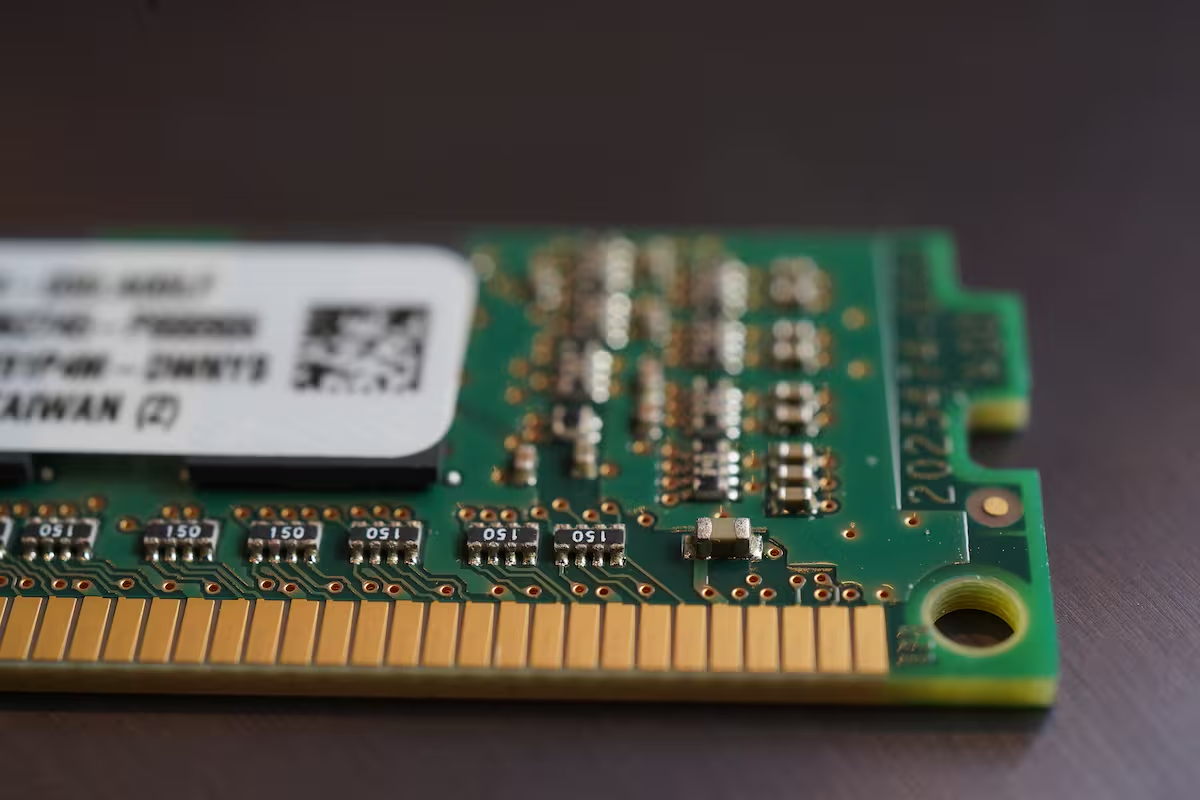
The main global memory manufacturers are working on increase DRAM memory productionHowever, it is expected that they will only be able to cover 60 percent of the demand by the end of next year 2027according to Nikkei Asia, which will lengthen the memory shortage crisis for years to come.
The technology sector is experiencing a shortage of RAM that mainly affects consumption, and will force raise product pricesas some manufacturers have already anticipated.
This is due, in part, to the high demand for artificial intelligence (AI), which is causing technology companies prioritize the manufacturing and supply of high-performance memory for data centersinstead of RAM for consumption.
In this framework, although the main manufacturers in the sector such as Samsung, SK Hynix and Micronwhich account for nearly 90 percent of the global market’s production, are working to increase memory production with new manufacturing plantsthe process will take time and it is expected that they will only be able to cover 60 percent of the demand by the end of next year, as Nikkei Asia has learned.
In the case of Samsung Electronics plans to launch its fourth plant Memory manufacturing in South Korea this year, however, will not reach large-scale mass production until at least 2027.
In addition, the aforementioned media has indicated that this new plant will also manufacture computing chips, along with memory chips, which translates into a decrease in its capacity to increase production exclusively of RAM.
Following this line, Samsung is also building a fifth memory manufacturing plantbut this will be dedicated to the manufacturing of advanced high-bandwidth memory (HBM), which is based on a type of DRAM memory used for semiconductors for AI. In this case, operations will begin in 2028.
The manufacturer SK Hynix, for its part, has also opted for the production of HBM memory and already has a factory production in South Korea that began operating in February, thus the only company that will increase production in 2026 among the three manufacturers mentioned. However, from the aforementioned media they point out that it is also working on the construction of a new plant that will be completed in February 2027, three months ahead of schedule.
To all this we must add that Micron intends to begin production of HBM memories at its plants in the United States and Singapore during the next year 2027. It will also begin building a factory in Japan in May of this year, although it will begin mass production in 2028.
It is worth remembering that in January Micron announced its intentions to prioritize AI demand before consumer demand, after abandon the Crucial brandfocused on DRAM memories for computers, with the aim of dedicating its resources to manufacturing memories for data centers and AI.
Therefore, although the main manufacturers are already working on increasing memory production, Most of its efforts will not be operational until next year at the earliest, and will focus mainly on HBM memories. This means that the momentum is not enough and, therefore, the RAM shortage crisis will continue for the next few years.
Even memory for AI will also be affected, according to the president of SK Group, Chey Tae-won, who has pointed out that AI memory supply limitations may continue until 2030.
To put it in perspective, according to data collected by Counterpoint Research and also collected by Nikkei Asia, for To solve the memory shortage, industrial production growth of 12 percent annually should be achieved in 2026 and 2027. However, taking into account the current plans mentioned, production is estimated to only grow by 7.5 percent.
Other companies, such as Dell, have also warned about the RAM shortage crisis that the technology sector is going through. Specifically, its CEO Michael Dell has already predicted that it will not have an end in the short term and that “we are still in the early stages.”
Meanwhile, relevant manufacturers in the consumer market, such as Microsoft or Sony, have already announced a increase in the price of your devices Surface and PlayStation 5 consoles, respectively.
Valve also recently warned that the memory shortage will affect the availability of its Steam Deck portable game console, indicating that it may be out of stock in some regions.