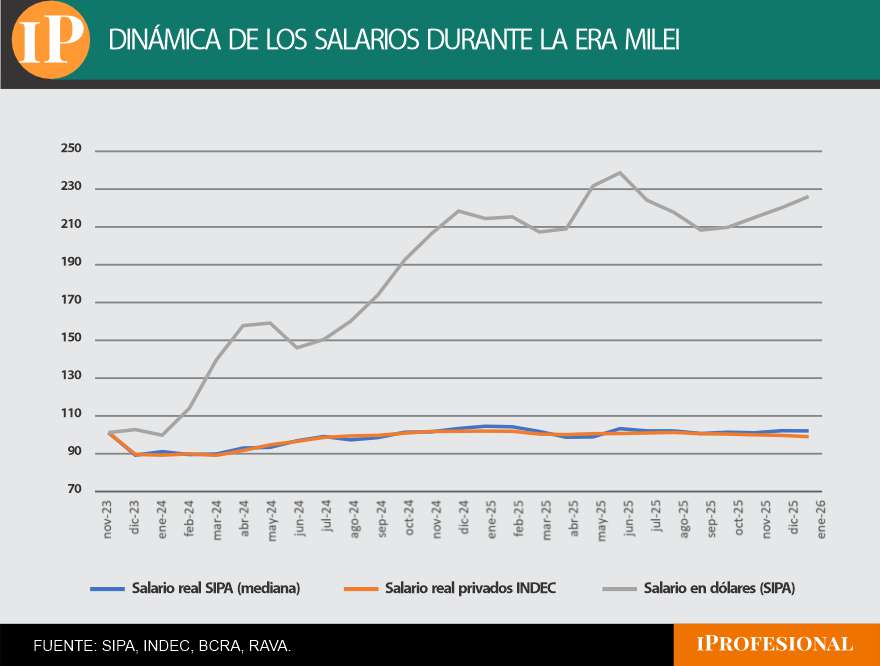
Since Javier Milei has been president, real wages of formal workers show a negative trendmainly between state employees and those in the private sector who only receive equal increases. On the contrary, Measured in dollars, salaries made a notable jump During this period and since the last legislative elections they resumed the upward path. What is the indicator that best reflects reality?
The dynamics of salaries, deflated by inflation, vary depending on the series of official data taken. For example, The INDEC Salary Index for registered workers sank a real 7.8% between November 2023 and the last available data, from January 2026; This basically responded to a collapse of 17.9% in the public sectoralthough in the private sector purchasing power also contracted, by 2.2%.
The statistics of the Argentine Integrated Pension System (SIPA) are somewhat more ambiguous. The average remuneration of private employees reached its peak in the Milei era in January and it was even 3.7% above the last value of Alberto Fernández’s management. However, if the median is used instead of the average (which implies taking the salary located in the center within the 6.16 million workers in a dependency relationship), the number is just 0.8% above that of November 2023 and 2.5% below the Milei maximum, reached in January 2025.
Regarding these differences, the economist of the consulting firm CP, Federico Pastrana, marked the root in salary heterogeneity: “The highest salaries had increases greater than those of the vast majority of workers. “If the highest wages had a higher nominal improvement than the low ones, that drives the average up, despite the fact that more than half of the workers suffer real declines.” This inequality occurs since, according to SIPA itself, lower-income workers “present increases in line with what is determined in parity”, something that is not corroborated for the highest-income segment.
Even taking the most benevolent indicator (the SIPA average), the dynamics of the last 12 months show a virtual stagnation in purchasing power of the workforce with greater rights.
The paradox that divides economists about true purchasing power
The paradox is that, valued in dollars (CCL until April 2025 and official wholesale since the relaxation of the stocks), salaries improved between 5.5% and 8.4% in the last yeardepending on the source of information. In addition, With the current Government, income in hard currency skyrocketed between 105.9% and 131.8%.
Salary dynamics
This behavior essentially responds to the tendency towards appreciation that the exchange rate has had during the last two years, more than anything after the first post-devaluation months of December 2023. A calm “greenback” can mean that salaries can lose against inflation, but at the same time gain purchasing power for dollars or goods tied to the evolution of the US currency.
According to the Central Bank (BCRA), The official wholesale dollar registered its greatest delay in January 2025although salaries in hard currency reached their peak a few months later, between May and June, before nominal income entered a phase of stagnation and the overheating of the exchange market after the disarmament of the Lefis and in the run-up to the national elections.
Experts question whether salary in dollars reflects real wealth or just an illusion
“We have tripled the salary in dollars,” Milei stated in his last opening speech of the legislative sessions in Congress. On the one hand, previously reported data shows that this statement overestimates growth. But, in addition, many economists clarify that this way of measuring salary does not make much sense, since does not adequately reflect how many goods and services those wages can buy.
In response to the query of iProfessionalthe economist Federico Glustein elaborated a look at these “two different photos” that exist between the real salary in pesos and the salary measured in dollars. On the one hand, he pointed out that the increase in income in dollars implies that “you can access better foreign services,” but it does not have an impact on the real micro economy since inflation continues and internal costs become more expensive. “In dollars locally I continue to consume less,” he said.
For the expert, “A higher salary in dollars is good when it arises from greater productivity, but when it arises especially from exchange rate appreciation, it is more of an illusion of wealth than a solid improvement.“.
Along the same lines, Melisa Sala, from the consulting firm LCG, expressed to this medium that the high salary in dollars “is more a reflection of the delay in the exchange rate than of a distributive bid encouraged by a more dynamic activity.”
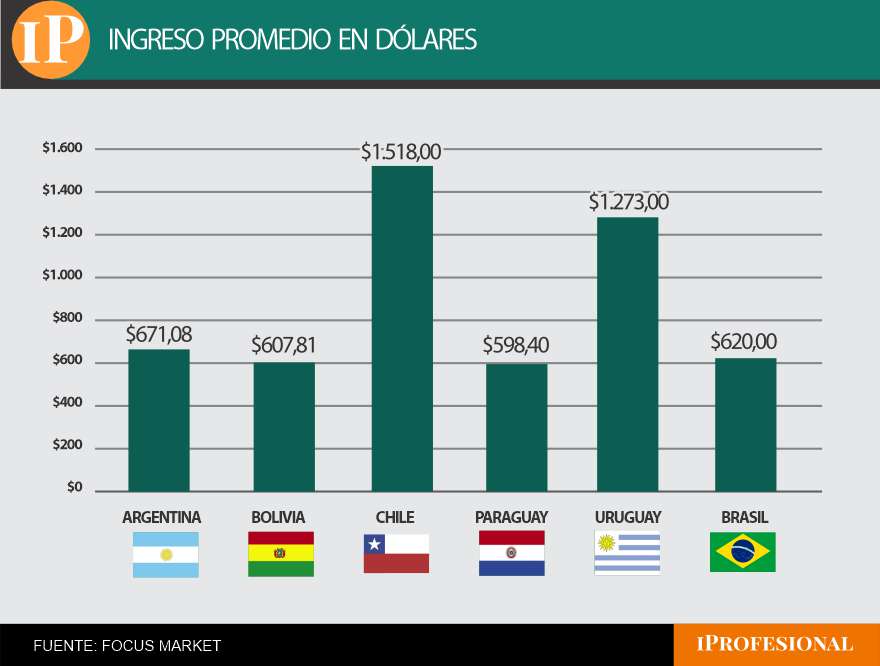
There aren’t too many jobs that have an up-to-date comparison between countries’ dollar salaries. A Focus Market report published this Thursday showed that Argentina has an average income in dollars higher than that of Bolivia, Paraguay and Brazilalthough still well below that of the other two neighboring nations, Uruguay and Chile.
Average income in dollars
How experts measure true purchasing power between countries
However, what is usually done to compare salaries between countries is to use the Purchasing Power Parity (PPP) measurement, which allows us to compare how many dollars each of them needs to acquire an equivalent basket of goods and services, taking one from the United States as a reference. This basket can include, for example, one kg of meat. If that kg of meat increases at the domestic level by 20%, and all the rest of the variables remain stable (price of meat in the rest of the world, value of the nominal exchange rate and nominal income), Argentina’s salary in PPP dollars would be shrinking.
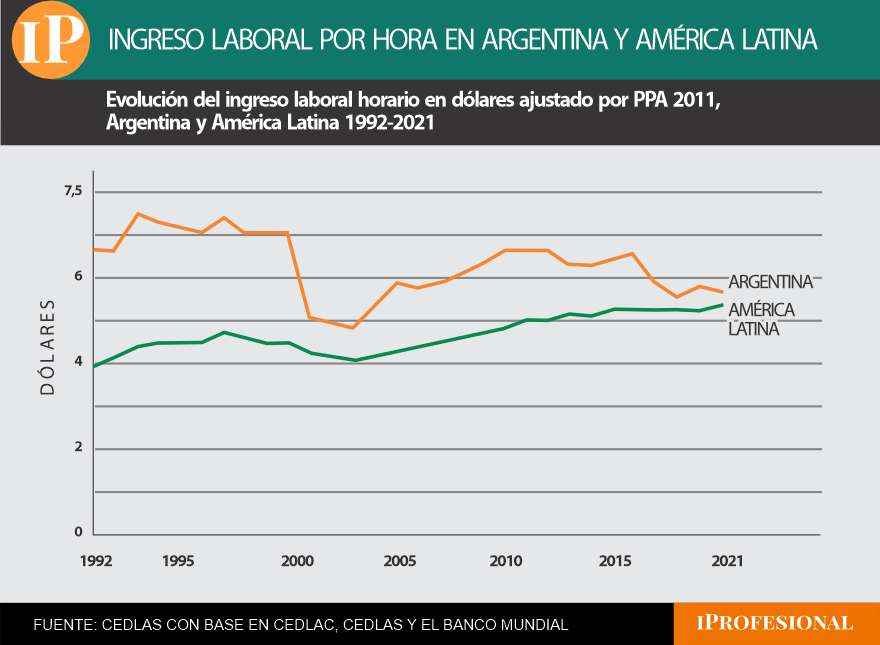
Hourly labor income
Recent research by Leopoldo Tornarolli, Leonardo Gasparini and Daniel Schteingart, carried out for Fundar, showed that Argentina has a higher level of labor income in PPP dollars than the Latin American average, but that gap has narrowed recentlywith a first strong approach after the 2001 crisis, and a new, and sustained, cut since 2018. The series runs until 2021, but it is estimated that in recent years the trend has continued.