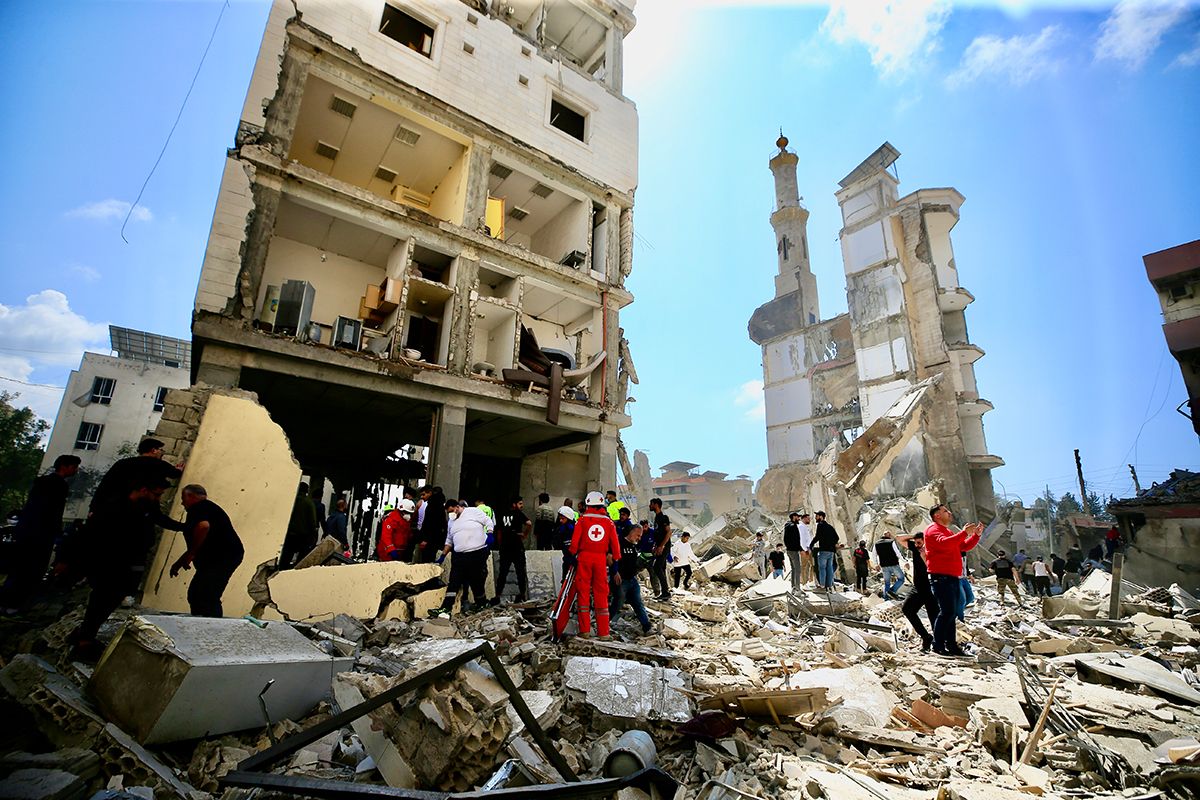
Contemporary war is no longer fought only on the visible terrain of missiles, bases and seas. It is also played in the most unstable space of perception: there where images of the enemy are formed, affects are distributed, facts are prioritized and the legitimacy of actions is defined. Since the start of the war on February 28, 2026, Iran appears to have acted under that premise. Its communication strategy was not an appendix to the confrontation, but one of its operational dimensions. A way to intervene in how the conflict should be read and felt.
The question is not only what Iran did militarily, but how it sought to organize the meaning of what was happening. In its official communications, in the interventions of its spokespersons, in its diplomatic appearances and in the digital ecosystem that surrounds it, Tehran built the scene – supported by reality – of an attacked State that responds. The objective was twofold. Inwards, produce cohesion and resistance. Outwardly, dispute legitimacy.
But the effectiveness of that narrative depended not only on the content, but also on the architecture of voices that embodies it. Iran does not speak a single language. Distributed functions. The chancellery stabilized the legal and political level. Foreign Minister Abbas Araghchi translated that line into the international and Western register. Ebrahim Zolfaghari personified the coercive and deterrent dimension. And, around that core, an ecosystem of like-minded accounts, viral channels, and pieces generated with artificial intelligence occupied the most unstable ground of platform culture.

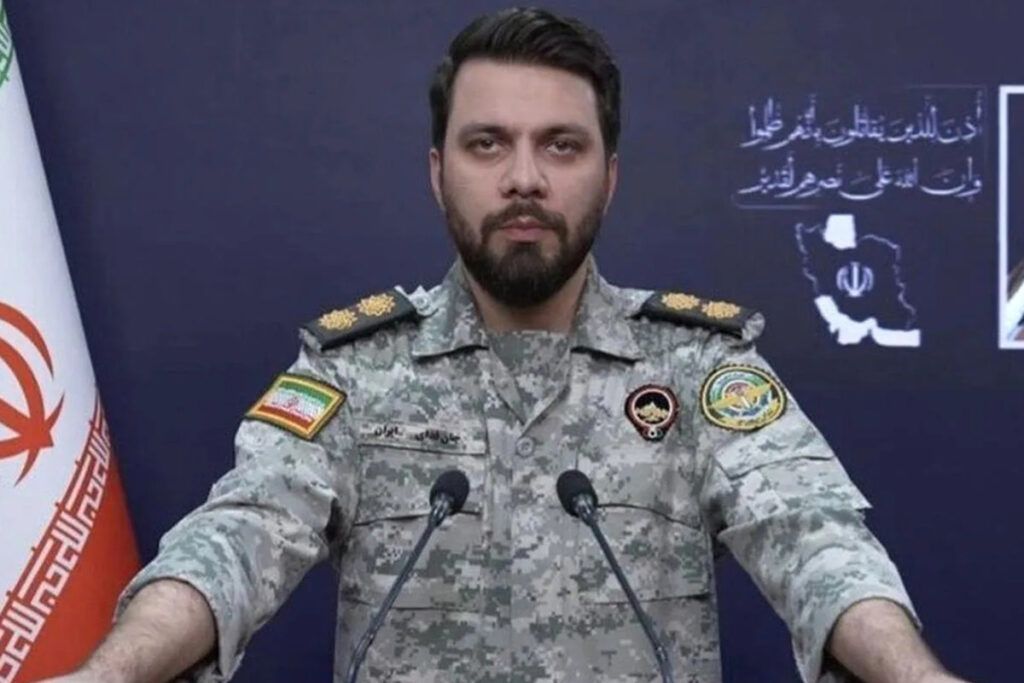
The singular thing is that this threat does not appear wrapped only in solemnity. Zolfaghari introduces a more hybrid register, where intimidation coexists with irony and an aesthetic of calculated relaxation. Therein lies part of its novelty. He does not present himself only as a war official, but as the face of a communication that already understood the logic of the clip and its viralization. The video in which he appears riding a skate while a missile is launched behind him condensed this mutation with an almost cartoonish clarity: the retaliation converted into a performance, the war rewritten as a pop image, the military spokesperson displaced from the State liturgy towards the visual culture of platforms.
Its effectiveness was precisely in mixing codes that previously seemed incompatible: destruction and lightness, threat and self-confidence, military apparatus and memetic language. The apparent trivialization of violence does not neutralize the message; makes it more circulatable. War, in the era of platforms, needs images capable of competing with entertainment.
Added to this dimension is the exploitation of the adversary’s internal fractures. Pro-Iran propaganda worked insistently on the figure of Trump as an erratic, contradictory leader and increasingly less supported by his own society. Different polls show limited support for US attacks and a majority rejection of sending ground troops or a prolonged war. Iran did not need to invent this unrest from scratch, but rather it was enough to intensify it narratively, presenting the war not only as external aggression, but as a product of unstable and rotten American leadership.
At that point, the appeal to the Epstein case functions as a transversal motif of the Iranian communication ecosystem. Epstein appears as a semiotic condenser of the immoral. In memes, posts and viral videos, the war is linked to a corrupt, unpunished and decadent elite. Trump appears reviewing files linked to Epstein before ordering attacks. Thus, the escalation of war would function as a distraction from the ethical crisis of the American elites. The operation is clear: move the center of the problem from Iran to the rot of the aggressor bloc.
If Zolfaghari administers the threat and humiliation of the adversary, Foreign Minister Araghchi plays a very different but equally decisive role. His appearances in Western media, speaking fluent, serene and confident English, seek to break with a sedimented image of Iran as an opaque actor, merely reactive or incapable of inhabiting the global diplomatic record with ease. Araghchi appears as an official who speaks without tension, argues with precision and transmits control. It is not just about saying something reasonable, but about embodying reasonableness.
Araghchi’s strength is that it does not moderate the content to be acceptable. It maintains the firmness of the message, but does so from a scene of composure. There is a counterimage operation there. While Zolfaghari dramatizes the cost of escalation, Araghchi dramatizes Tehran’s ability to speak as equals to the world. One hardens the perception of punishment; the other complicates the perception of legitimacy. Between the two, Iran builds a representation of itself as an actor that did not lose control of the situation or the tone with which it communicates it.
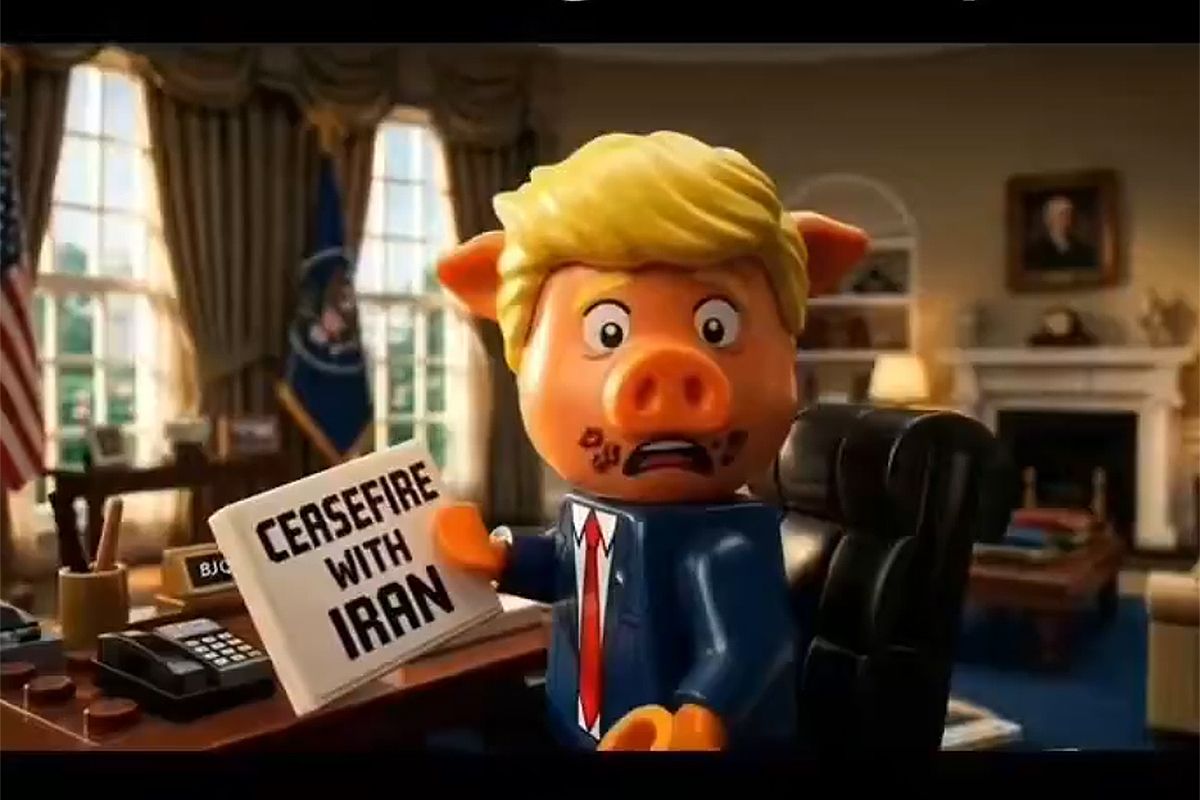
Iranian propaganda releases a video with LEGO figurines telling the American people that they are ruled by pedophiles acting at the behest of Israel. In the video we can see Netanyahu blackmailing Trump with Epstein’s papers. What a time to be alive! pic.twitter.com/cxaF8Uc86P
— Pablo Echenique (@PabloEchenique) April 10, 2026
The area where this rationality becomes more novel is, however, that of videos generated with artificial intelligence. The realistic, anime and Lego versions were not simple propaganda eccentricities. They functioned as instruments of adaptation to the attention economy. The New Yorker documented that the Lego clips racked up millions of views and were redistributed by accounts linked to the Iranian state ecosystem; Forbes also highlighted its wide circulation on platforms and the visual prominence of humiliating caricatures of Trump and Netanyahu. What is decisive here is not only the volume of dissemination, but the type of effectiveness that these formats enable.
🇮🇷🇺🇸🇮🇱 Regime Change. 😂 pic.twitter.com/Vf1t7aJ27k
— Simon Dixon (@SimonDixonTwitt) April 10, 2026
AI allowed this ecosystem to produce low-friction, high-speed propaganda, capable of going from solemnity to absurdity, from war spectacle to black humor, from threat to meme. In Lego format, war is miniaturized and made shareable; in anime, it is aestheticized and serialized; In a realistic key, it seeks an impression of power and proximity to destruction. In all cases, the objective is for the war not only to be seen, but to circulate. Make it commentable, remixable, memorable. Let it penetrate a digital sphere where attention is no longer captured only with arguments, but with images that condense emotion, mockery and fear.
The underlying question is whether this strategy managed to modify Iran’s previous image. The answer cannot be linear, but what can be stated is that Iran managed to prevent a univocal reading of the conflict. It did not completely reverse its global image, but it managed to break the comfort of the dominant Western framing. That is already a partial victory on the cognitive level. It forced us to look at the conflict from more than one angle, forced us to incorporate the question of the legitimacy of the aggressor, and showed an unusual ability to move between diplomacy, propaganda, digital aesthetics, and platform culture.
The lyrics 👏
pic.twitter.com/S8EaJhHwit— Sanam Naraghi Anderlini, MBE now on Blue Sky (@sanambna) April 10, 2026
But it is important not to lose sight of a decisive point: no war is won only on the cognitive level. The dispute over perception matters, a lot, but it is only effective when it is supported by real capabilities: strategy, political leadership, sovereign military production, technological infrastructure, and the effective capacity to sustain a correlation of forces. Because in the contemporary world the missile and the meme circulate through the same current, but neither of the two, by itself, is enough to decide history.